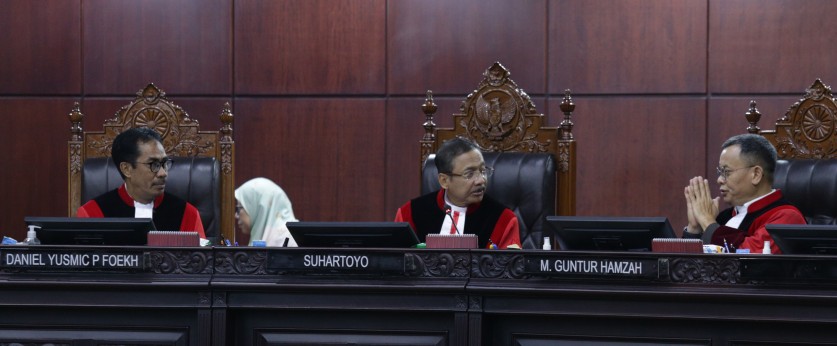
Petition revision hearing for Case No. 244/PUU-XXIII/2025 on the judicial review of Law No. 14 of 2002 on the Tax Court, Thursday (1/8/2026). Photo by MKRI/Bay.
JAKARTA (MKRI) — The Constitutional Court of the Republic of Indonesia (the Court) held a second hearing to examine a petition for the material judicial review of Article 78 of Law No. 14 of 2002 on the Tax Court on Thursday (January 8, 2026). The petition was filed by PT Arion Indonesia, represented by its President Director, Diana Isnaini.
The hearing for Case No. 244/PUU-XXIII/2025, which was scheduled to hear the substance of the revised petition, was presided over by Suhartoyo, along with Constitutional Justices Daniel Yusmic P. Foekh and M. Guntur Hamzah.
The Petitioner’s legal counsel, Kahfi Permana, conveyed the revisions to the petition online. He also submitted documentary evidence in the form of a Tax Court ruling related to the legal dispute faced by the Petitioner.
“The referenced ruling explains the juridical obligation to assess each piece of evidence submitted, as stipulated under the a quo provision. We have also refined the section on the Petitioner’s constitutional losses, particularly the failure to take into account the submitted evidence individually in its case,” Kahfi stated.
Also read: PT Arion Indonesia Challenges “Judicial Conviction” in Tax Court Rulings
At the preliminary hearing held on Tuesday (December 16, 2025), Kahfi Permana explained that, under Article 78 of the Tax Court Law, there is no mandatory mechanism requiring judges to assess all submitted evidence. The provision merely states that rulings must be based on the evaluation of evidence and the judges’ conviction, without stipulating an obligation to explicitly set out all evidence in the decision.
From a doctrinal perspective, the Petitioner argued that judges’ conviction constitutes a final conclusion rather than a substitute for evidence. However, in the Petitioner’s case, such conviction was applied without assessing primary evidence and without providing reasons for rejecting the evidence. None of the Petitioner’s evidence was even mentioned in the ruling, rendering the judges’ conviction subjective and beyond scrutiny. According to the Petitioner, this practice potentially violates Article 28D paragraph (1) and Article 24 paragraph (1) of the 1945 Constitution.
Accordingly, the Petitioner requested the Court to provide a constitutional interpretation of Article 78 of the Tax Court Law, specifically the phrases “the result of the evaluation of evidence” and “judges’ conviction.” These phrases, insofar as they are not interpreted as imposing an “obligation to set out all evidence in the ruling,” an “obligation to assess and provide legal considerations for each piece of evidence individually,” and “limitations on the use of judges’ conviction,” should be deemed conditionally unconstitutional.
The Petitioner further requested the Court to order the lawmaker to enact a new Tax Court Law to replace Law No. 14 of 2002 within a maximum period of three years from the pronouncement of the decision. Should no amendment be made within that timeframe, Law No. 14 of 2002 on the Tax Court would become permanently unconstitutional.
Explore the case: Case No. 244/PUU-XXIII/2025 (in Bahasa Indonesia)
Author: Sri Pujianti
Editor: N. Rosi
Translator: Yuanna Sisilia
Disclaimer: The original version of the news is in Indonesian. In case of any differences between the English and the Indonesian versions, the Indonesian version will prevail.
Thursday, January 08, 2026 | 16:50 WIB 104