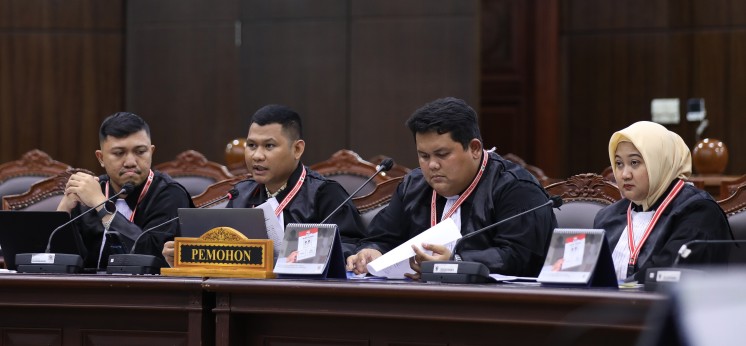
The Petitioner’s legal counsel conveying the main points of the petition at the preliminary hearing of the material judicial review of Law No. 14 of 2002 on the Tax Court, Tuesday (12/16/2025). Photo by MKRI/Ifa.
JAKARTA (MKRI) — PT Arion Indonesia, represented by its President Director Diana Isnaini, filed a petition for the material judicial review of Article 78 of Law No. 14 of 2002 on the Tax Court against the 1945 Constitution before the Constitutional Court of the Republic of Indonesia. The preliminary hearing for Case No. 244/PUU-XXIII/2025 was chaired by Suhartoyo alongside Constitutional Justices Daniel Yusmic P. Foekh and M. Guntur Hamzah, on Tuesday (12/16/2025).
Article 78 of the Tax Court Law stipulates that Tax Court rulings shall be rendered “based on the assessment of evidence, the relevant tax laws and regulations, and the judge’s conviction.”
The Petitioner’s legal counsel, Kahfi Permana, explained that the Petitioner is a private legal entity, as evidenced by its deed of establishment and approval decree issued by the Ministry of Law and Human Rights. According to the Petitioner, Article 78 of Law No. 14 of 2002 does not provide a mandatory mechanism requiring judges to assess all pieces of evidence. The provision merely states that decisions must be grounded in the assessment of evidence and the judge’s conviction, without imposing an obligation to articulate all evidence in the ruling.
Doctrinally, the Petitioner argued that a judge’s conviction constitutes a final inference rather than a substitute for evidence. In the Petitioner’s case, however, judicial conviction was allegedly invoked without evaluating primary evidence, nor were reasons provided for rejecting such evidence. Indeed, none of the Petitioner’s evidence was mentioned in the ruling, rendering the judge’s conviction subjective and beyond meaningful scrutiny. The Petitioner contended that this practice may violate Article 28D, paragraph (1), and Article 24, paragraph (1), of the 1945 Constitution.
“Law No. 14 of 2002 on the Tax Court is a procedural law that must reflect fair, certain, and just due process of law, far removed from arbitrariness. Given that legal remedies pursued by taxpayers before the Tax Court may result in sanctions affecting their rights and obligations, the procedural framework for enforcing substantive tax law must not only be fair but also certain and just. Actions, measures, and decisions of law enforcement authorities must not be driven by personal discretion, but by clear and just legal norms. In a state governed by the rule of law, it is the law that must prevail, not individual law enforcers,” Kahfi asserted.
Accordingly, the Petitioner requested the Court to provide a constitutional interpretation of Article 78 of the Tax Court Law, particularly the phrases “assessment of evidence” and “judge’s conviction.” The Petitioner argued that insofar as these phrases are not interpreted to mean an obligation to set out all evidence in the ruling, a responsibility to assess and provide legal considerations for each piece of evidence individually, and clear limits on the use of judicial conviction, they should be deemed conditionally unconstitutional.
The Petitioner further urged the Court to order the legislature to enact a new Tax Court Law to replace Law No. 14 of 2002 within a maximum period of three years from the issuance of the Court’s decision. Should no legislative amendment be made within that timeframe, the Petitioner argued that the Tax Court Law ought to be declared permanently unconstitutional.
Strengthening the Posita
Responding to the petition, Justice Foekh advised the Petitioner to align its submission with the requirements set out in Constitutional Court Regulation No. 7 of 2025 on Procedures in Judicial Review Cases. He noted that the petitum included a three-year timeframe and emphasized that the reasoning underpinning such a request must be elaborated and strengthened in the posita.
Justice Guntur observed that the Petitioner’s legal standing remained insufficiently substantiated. He underscored the need to reinforce the explanation of standing and to complement normative arguments with concrete factual circumstances. He also pointed out that the petition merely cited constitutional provisions without providing a comprehensive analysis of how the contested norms contravene the Constitution.
Chief Justice Suhartoyo likewise requested the Petitioner to clearly articulate the constitutional harm allegedly suffered as a result of the contested provision. “The legal standing must explain the nature of the conflict, the uncertainty, and the injustice claimed. The issue being challenged must be clearly delineated,” he stressed.
Before adjourning the hearing, Chief Justice Suhartoyo granted the Petitioners 14 days to refine their petition. The revised submission must be filed with the Court’s Registrar’s Office no later than Monday, December 29, 2025, at 12:00 p.m. WIB. The Court will subsequently convene a second hearing to examine the revised petition.
Explore the case: Case No. 244/PUU-XXIII/2025 (in Bahasa Indonesia)
Author: Sri Pujianti
Editor: N. Rosi
Translator: Yuanna Sisilia
Disclaimer: The original version of the news is in Indonesian. In case of any differences between the English and the Indonesian versions, the Indonesian version will prevail.
Tuesday, December 16, 2025 | 16:30 WIB 98