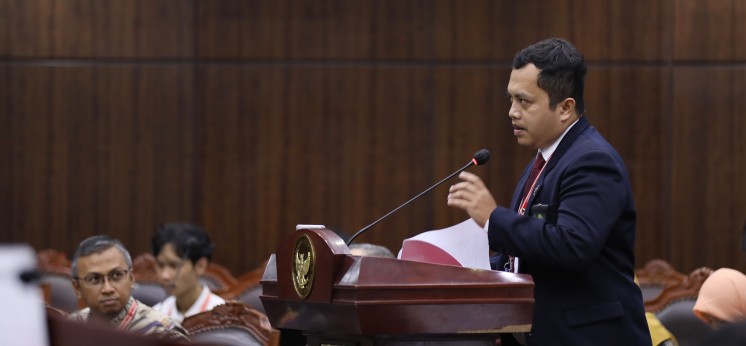
Adji Prakoso, representing the Supreme Court as a relevant party, delivering a statement at hearing of the judicial review of the Law on the budgetary independence of judicial institutions on Tuesday (12/9/2025). Photo by MKRI/Ifa.
JAKARTA (MKRI) – The Constitutional Court (MK) held a hearing to review Article 81A paragraph (1) of Law No. 3 of 2009 on the Supreme Court (UU MA), Article 9 of Law No. 24 of 2003 on the Constitutional Court (MK), and Article 7 paragraph (2) letter b of Law No. 1 of 2004 on State Treasury for Petition No. 189/PUU-XXIII/2025 on Tuesday, December 9, 2025. Today's hearing was scheduled to hear statements from the Relevant Parties consisting of the MA, the Audit Board (BPK), and Legal Examination Researchers.
Supreme Court, represented by the Judicial Judge at the Legal and Public Relations Bureau, Adji Prakoso, said that the budget independence of the judicial institution as part of the independent and autonomous judicial power, has been affirmed through the organizational, administrative and financial management of the Supreme Court and the judicial bodies under it, as stipulated in Article 21 paragraph (1) of Law No. 48 of 2009 on Judicial Power. The affirmation of the budget independence of the judicial institution under the authority of the Supreme Court has been normatively regulated since 2004 after the judicial institution freed itself from the influence and intervention of other powers, especially the executive, which then shifted under the authority of the Supreme Court as described in the provisions of Article 41-Article 46 of Law No. 4 of 2004 on Judicial Power.
"However, to date, the budget independence of the judicial institution has not been realized, which has resulted in obstacles in the implementation of various programs of the Supreme Court and the judicial bodies under it, in order to realize the Supreme Court's vision of realizing a supreme judicial body," said Adji in the Plenary Courtroom of the Constitutional Court, Jakarta.
He continued, without budget independence, an independent and independent judiciary will be limited in providing adequate legal services, difficulties in developing human resources, limited physical facilities of the judicial body, implementation of security guarantees for judges and court officials, to the inadequacy of supporting facilities such as information technology to support the interests of case administration and trials. In fact, Adji quoted the explanation of Indonesian Constitutional Law Professor Prof. Jimly Asshiddiqie that a judicial institution that is not institutionally and financially independent is more easily intervened by other powerful interests, even though the judges are neutral individually.
Adji then explained that through the budgeting mechanism that is required to undergo correction or review by the Ministry of Finance and the National Development Planning Agency (Bappenas), the portion of the budget received by the Supreme Court through the Budget Implementation List (DIPA) is always far from that proposed by the Supreme Court, as occurred from 2023 to 2025. In addition, the lengthy process of allocating and budgeting the Supreme Court's finances and the interference or intervention of executive power that can hinder the programs and work plans of the Supreme Court and the judicial bodies under it, can affect the delay in providing access to justice to the public, especially justice seekers and users of court services. According to him, budget independence is not about being free from the state's fiscal system, but rather guaranteeing the acquisition of financial resources proportionally, adequately, and in accordance with the needs of institutional functions.
"The Supreme Court, as a state institution tasked with exercising independent judicial power to uphold law and justice, should be granted budgetary independence," Adji emphasized. Meanwhile, the Supreme Audit Agency (BPK) was represented by the Head of the State Financial Audit Agency (BPKP), Akhmad Anang Hernady. Akhmad stated that the BPK's budgeting mechanism aligns with the state budget preparation and approval mechanisms for ministries and other institutions, as stipulated in laws and regulations.
"The additional mechanism in BPK's planning and budgeting is not a separate mechanism from the state budget cycle, but should be viewed as a medium to provide BPK with the space to communicate budgetary needs to the House of Representatives (DPR) and the government to ensure the effective implementation of audit duties," Akhmad said.
In addition, the Indonesian Legal Examination Research Institute, represented by Secretary Faisal Santiago, explained that philosophically and legally, it is clear that the budget of the judicial body (judiciary) within the scope of judicial power is independent, so it cannot be limited, cut, or regulated by other powers. The principle of budget independence is a logical consequence of the principle of independence of judicial power as guaranteed by the constitution, which emphasizes that the judiciary must be free from all forms of intervention, whether direct or indirect, from other branches of power.
"Thus, any form of budget regulation, limitation, or control has the potential to diminish judicial independence and contradict the principles of the rule of law. Therefore, the judicial budget must be viewed as an instrument inherent in judicial power, ensuring the upholding of justice, legal certainty, and the protection of citizens' constitutional rights," Faisal said.
He continued, stating that interference in the judicial budget not only undermines the independence of the judiciary but also hinders public access to judicial decisions, which should be transparent and free of charge. Such a situation clearly contradicts the principle of public information transparency and the principle of simple, expeditious, and low-cost justice, as mandated by the procedural law.
He cited the example of Indonesian Legal Examination researchers experiencing difficulties obtaining complete court decisions regarding access to information. One example is an examination conducted in a ruling on an illegal mining case. The Examination Panel attempted to uncover alleged errors in persona and errors in objecto, but the Examination Panel was unable to review and decide on the results because it only received an excerpt of the District Court's cassation ruling No. 2806/Pid.Sus-LH/2024, without the judge's complete legal considerations.
This occurs because the decision is still undergoing the administrative bureaucratic process. This issue clearly deviates from the system's intended function, even though modern judicial developments demand the use of information technology to ensure decisions are reached quickly and transparently.
Based on his team's empirical experience, Faisal concluded that the service system for accessing court decisions remains very limited. This situation is exacerbated by inadequate budgetary support and interference in spending. Therefore, his team is also concerned with ensuring the independence of the judicial budget, in order to achieve accountability and independence in managing judicial costs.
Also Read:
Legal Journalists Join Petitioners in Judicial Institution Budget Independence Review
Judicial Institutions’ Budgetary Independence Called Into Question
President, House Request Delay of Hearing on Laws on Constitutional Court, Supreme Court, Judicial Commission
Government: Executive Involvement in Drafting Judicial Institution Budgets Is Not Intervention
For information, this case was filed by advocate Viktor Santoso Tandiasa, tax specialist advocate Nurhidayat, and journalist and General Chair of the Legal Journalists Association Irfan Kamil. They believe that the articles being challenged reflect the lack of budget independence of the judiciary, so that the principle of an independent judicial power as mandated by Article 24 paragraph (1) of the 1945 Constitution has not been realized.
The impacts referred to include reduced independence due to budgetary dependence on the executive, which allows for intervention and pressure on the independence of judges; non-independent budget management because the judiciary is limited in preparing and managing the budget according to its actual needs; budget limitations can reduce the welfare of judges, which impacts motivation and work quality; budget limitations hinder the development of facilities, technology, training, and other important resources; and the impact of reduced independence and welfare influences the decline in the quality of judicial decisions. These impacts are considered to affect the service and handling of cases in the judicial institution, which is within the scope of the Applicant in carrying out its duties and responsibilities.
Article 81A paragraph (1) of the Supreme Court Law states that “The Supreme Court budget is charged to a separate budget line in the state revenue and expenditure budget.” Article 9 of the KY Law states that “The Judicial Commission budget is charged to the State Revenue and Expenditure Budget.” Article 9 of the MK Law states that “The Constitutional Court budget is charged to a separate budget line in the State Revenue and Expenditure Budget.” Article 7 paragraph (2) letter b of the State Treasury Law states that “The Minister of Finance as the State Treasurer General has the authority to: b. ratify budget implementation document.
According to the Petitioner, the provisions of the articles being challenged regulate the submission of budget proposals for the judiciary to be included in the State Budget (APBN) without any affirmation of autonomy and independence, which allows the proposal to be substantially reduced or changed by the executive branch (before being approved by the DPR). If the judiciary is substantially dependent on executive approval for its core budget, then the checks and balances relationship becomes unbalanced, which ultimately reduces the degree of independence of the institution in upholding law and justice.
Petitioner wants the Minister of Finance to only act as an administrative facilitator and cannot change the substance of the proposal without the joint approval of the relevant judicial institution and the DPR as the people's representative in the discussion of the APBN. Therefore, in his petition, the Petitioner asks the Court to declare Article 81A paragraph (1) of the MA Law, Article 9 of the KY Law, and Article 9 of the MK Law conditionally contradictory to the 1945 Constitution of the Republic of Indonesia and not having binding legal force as long as it is not interpreted as the Petitioner's petition. The Petitioner wants these articles to be interpreted so that the budget is submitted by each institution, whether the MA, KY, or MK to the DPR to be discussed in the preliminary discussion of the draft APBN and the results of the discussion are submitted to the Minister of Finance as material for preparing the draft Law on the APBN.
The Petitioner also requested the Court to declare Article 7 paragraph (2) letter b of the State Treasury Law to be conditionally contradictory to the 1945 Constitution of the Republic of Indonesia insofar as it is not interpreted as "The ratification of the budget implementation documents for the Supreme Court and the Constitutional Court is only limited to verifying administrative compliance and formal accountability, and is not used to change, reduce, delay or cancel the substance of the budget allocation resulting from the Preliminary Discussion of the Draft State Budget of the Supreme Court/Constitutional Court with the DPR."
Track case No. 189/PUU-XXIII/2025
Author : Mimi Kartika
Editor : N. Rosi
Translator : Donny Yuniarto
Disclaimer: The original version of the news is in Indonesian. In case of any differences between the English and the Indonesian versions, the Indonesian version will prevail.
Tuesday, December 09, 2025 | 17:12 WIB 453