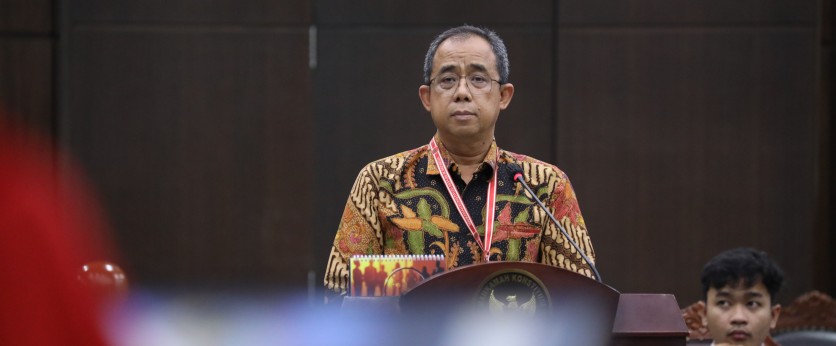
Secretary General of the Ministry of Finance (Kemenkeu), Heru Pambudi, delivering a government statement in the plenary courtroom on Tuesday (11/25/2025). Photo by MKRI/Panji.
JAKARTA (MKRI) – The Constitutional Court (MK) again held a hearing to review Article 81 paragraph (1) of Law No. 3 of 2009 on the Supreme Court (UU MA), Article 9 of Law No. 22 of 2004 on the Judicial Commission (KY), Article 9 of Law No. 24 of 2003 on the Constitutional Court (MK), and Article 7 paragraph (2) letter b of Law No. 1 of 2004 on State Treasury, on Tuesday, November 25, 2025 in the Plenary Courtroom, Jakarta. The fourth hearing for Petition No. 189/PUU-XXIII/2025 today was on the agenda of hearing statements from the DPR and the President.
The President/Government's statement was delivered by the Secretary General of the Ministry of Finance (Kemenkeu), Heru Pambudi. He stated that the Minister of Finance's approval of the budget implementation documents embodies a system of checks and balances to maintain good governance within the judiciary as a state institution.
"This demonstrates that the executive branch/president has a constitutional role in drafting the State Budget (APBN), including the budget for the judiciary. Therefore, executive involvement is not a form of intervention, but rather a manifestation of the system of checks and balances between branches of government," said Heru, who was present in person in the courtroom.
He stated that the regulation regarding the Minister of Finance's approval of budget implementation documents does not directly impact the Petitioners' rights as advocates or journalists. The Petitioners' constitutional rights as advocates and journalists are not necessarily related to the Minister's approval of budget implementation documents.
The constitutional rights of the Petitioners are actually more related to the independence of the judicial institutions, both the Supreme Court and the Constitutional Court in carrying out their judicial functions, as well as the right to public information for the Petitioners who work as journalists. However, said Heru, these interests are indirect and do not cause specific or actual constitutional losses as referred to in Article 51 paragraph (1) of the Constitutional Court Law.
He continued, the Petitioners' concerns regarding the independence of the Supreme Court and the Constitutional Court in carrying out their judicial functions are guaranteed by Article 24 paragraph (1) of the 1945 Constitution of the Republic of Indonesia (UUD NRI). However, this independence is functional, not administrative and budgetary.
"In other words, executive involvement in the budget-making process does not negate judicial independence, because the budget aspect is part of overall state governance that must comply with the principle of fiscal accountability," Heru said.
Also Read:
Judicial Institutions’ Budgetary Independence Called Into Question
Legal Journalists Join Petitioners in Judicial Institution Budget Independence Review
President, House Request Delay of Hearing on Laws on Constitutional Court, Supreme Court, Judicial Commission
For information, this case was filed by advocate Viktor Santoso Tandiasa, tax specialist advocate Nurhidayat, and journalist and General Chair of the Legal Journalists Association Irfan Kamil. They believe that the articles being challenged reflect the lack of budget independence of the judiciary, so that the principle of an independent judicial power as mandated by Article 24 paragraph (1) of the 1945 Constitution has not been realized.
The impacts referred to include reduced independence due to budgetary dependence on the executive, which allows for intervention and pressure on the independence of judges; non-independent budget management because the judiciary is limited in preparing and managing the budget according to its actual needs; budget limitations can reduce the welfare of judges, which impacts motivation and work quality; budget limitations hinder the development of facilities, technology, training, and other important resources; and the impact of reduced independence and welfare influences the decline in the quality of judicial decisions. These impacts are considered to affect the service and handling of cases in the judicial institution, which is within the scope of the Petitioners in carrying out their duties and responsibilities.
Article 81A paragraph (1) of the Supreme Court Law states that “The Supreme Court budget is charged to a separate budget line in the state revenue and expenditure budget.” Article 9 of the KY Law states that “The Judicial Commission budget is charged to the State Revenue and Expenditure Budget.” Article 9 of the MK Law states that “The Constitutional Court budget is charged to a separate budget line in the State Revenue and Expenditure Budget.” Article 7 paragraph (2) letter b of the State Treasury Law states that “The Minister of Finance as the State Treasurer General has the authority to: b. ratify budget implementation documents.”
According to the Petitioner, the provisions of the articles being challenged regulate the submission of budget proposals for the judiciary to be included in the State Budget (APBN) without any affirmation of autonomy and independence, which allows the proposal to be substantially reduced or changed by the executive branch (before being approved by the DPR). If the judiciary is substantially dependent on executive approval for its core budget, then the checks and balances relationship becomes unbalanced, which ultimately reduces the degree of independence of the institution in upholding law and justice.
The Petitioners want the Minister of Finance to only act as an administrative facilitator and cannot change the substance of the proposal without the joint approval of the relevant judicial institution and the DPR as the people's representative in the discussion of the APBN. Therefore, in their petition, the Petitioners ask the Court to declare Article 81A paragraph (1) of the MA Law, Article 9 of the KY Law, and Article 9 of the MK Law conditionally contradictory to the 1945 Constitution of the Republic of Indonesia and not having binding legal force as long as it is not interpreted as the applicant's petition. The Petitioners want these articles to be interpreted so that the budget is submitted by each institution, whether the MA, KY, or MK to the DPR to be discussed in the preliminary discussion of the draft APBN and the results of the discussion are submitted to the Minister of Finance as material for preparing the draft Law on the APBN.
The Petitioners also requested the Court to declare Article 7 paragraph (2) letter b of the State Treasury Law to be conditionally contradictory to the 1945 Constitution of the Republic of Indonesia insofar as it is not interpreted as "The ratification of the budget implementation documents for the Supreme Court and the Constitutional Court is only limited to verification of administrative compliance and formal accountability, and is not used to change, reduce, delay or cancel the substance of the budget allocation resulting from the Preliminary Discussion of the Draft State Budget of the Supreme Court/Constitutional Court with the DPR."
Track case No. 189/PUU-XXIII/2025
Author : Mimi Kartika
Editor : N. Rosi
Translator : Donny Yuniarto
Disclaimer: The original version of the news is in Indonesian. In case of any differences between the English and the Indonesian versions, the Indonesian version will prevail.
Tuesday, November 25, 2025 | 19:28 WIB 256