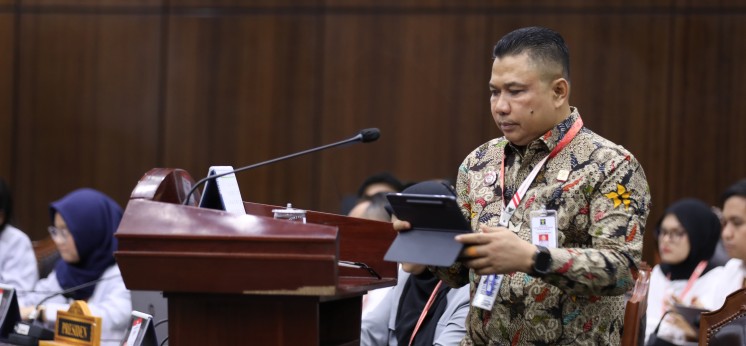
Sucipto, representing the Government, stated that the provision of pensions to Members of the House of Representatives (DPR) constitutes a form of recognition of public office and an acknowledgment of service in carrying out constitutional functions. Photo by MKRI/IlhamWM.
JAKARTA, (MKRI) — The Constitutional Court (the Court) again held a hearing on the judicial review of Law Number 12 of 1980 on the Financial and Administrative Rights of the Leaders and Members of the Supreme/High State Institutions and Former Leaders and Members of High State Institutions against the 1945 Constitution of the Republic of Indonesia (UUD 1945), on Monday (12/08/2025) at the Plenary Courtroom of the Constitutional Court. The hearing, which was held to hear the Government’s statement, was filed by Lita Linggayani Gading and Syamsul Jahidin as Petitioners in Case Number 176/PUU-XXIII/2025.
The hearing was presided over by Chief Justice Suhartoyo, accompanied by the other Constitutional Justices. The Petitioners—Lita, a psychologist, and Syamsul, a student and advocate—challenged Article 1 letter a, Article 1 letter f, and Article 12 paragraph (1) of Law 12/1980, arguing that these provisions violate the principles of justice and equality before the law as guaranteed by the 1945 Constitution.
Representing the Government, Sucipto, Expert Staff for Inter-Institutional Relations and Strengthening Bureaucratic Reform at the Ministry of Law, stated that the provision of lifetime pensions for DPR leaders and members constitutes a form of recognition of public office based on the principle of amtswürde (the dignity of office) in the public law system (publieke recht). According to the Government, this policy has constitutional rationality as an acknowledgment of service in carrying out state constitutional functions.
The Government further emphasized that the pension system for DPR members does not constitute a privilege, but rather an integral part of the National Social Security System (SJSN), which serves as the basis for old-age protection for all state officials, including the President, the Supreme Court (MA), the Constitutional Court (the Court), the Judicial Commission (KY), and the Audit Board of Indonesia (BPK). In terms of funding, the DPR pension scheme is not wasteful, as it employs a combination of a defined benefit (DB) scheme through mandatory member contributions and a pay-as-you-go (PAYG) mechanism within a fiscal framework that takes budget sustainability into account.
“The pension funding mechanism for DPR members is not wasteful because it uses a combination of a defined benefit (DB) scheme—under which pension benefits are determined based on a formula related to length of service—that is supported by mandatory contributions from DPR members, and operates within a fiscal framework that considers sustainability, as well as the PAYG (pay-as-you-go) principle—namely, financing pension benefits through current budget allocations—as applied in many modern national pension systems,” he said.
Sucipto added that the proportion of the DPR pension budget amounts to only around 0.001%–0.002% of the total budget for the education, health, and social protection sectors. This demonstrates that lifetime pension benefits do not disrupt national spending priorities; therefore, allegations of budget misallocation are not supported by empirical data or legal grounds.
The Government also asserted that the policy of lifetime pensions falls within the realm of the legislature’s open legal policy. Accordingly, the Court cannot substitute the legislature’s policy considerations unless there is a clear contradiction with the 1945 Constitution, which, according to the Government, has not been demonstrated in this case. The ratio legis of granting lifetime pensions has also been affirmed by the Court in Decision Number 41/PUU-IX/2013 as a form of recognition of the services of state officials. Thus, the repetition of similar arguments is considered unfounded, as the matter has already attained final and binding legal force (res judicata).
In response to the Petitioners’ claim regarding disharmony between Article 13 paragraph (1) and Article 16 paragraph (1) of Law 12/1980, the Government stated that the two provisions regulate different aspects—namely, the amount of pension benefits and the duration of their payment. Therefore, there is no normative contradiction as alleged.
The Government further maintained that lifetime pension provisions serve as a guarantee of continuity of old-age income for state officials who must relinquish their previous employment, comply with conflict-of-interest rules, and perform legislative functions involving high political risk. Consequently, lifetime pension benefits are viewed as reasonable and proportional compensation.
Moreover, the Government warned that if the petition were to be granted, the impact would extend beyond DPR members to all state officials covered under Article 1 of Law 12/1980. The annulment of the provisions would create a vacuum in old-age income protection for other state officials and could potentially violate the principle of constitutional welfare protection.
Regarding the Petitioners’ allegations concerning development budget priorities, the Government emphasized that such claims cannot be linked to the existence of DPR pensions, as the structure of the State Budget (APBN) is formulated based on the principles of efficiency, economic sustainability, and fiscal balance in accordance with Article 33 of the 1945 Constitution.
Overall, the Government argued that the Petitioners’ application is speculative, vague (obscuur libel), irrelevant to any personal constitutional harm, and fails to demonstrate a violation of constitutional rights arising from the enactment of the challenged provisions.
Read also:
Claimed to Have Created Inequality, Pension Benefits for House Members Challenged
Petitioners Challenge Pension Benefits for House Members
House: Pension Scheme for House Members Is Already Proportional and Measurable
Previously, at the preliminary examination hearing held on Friday (10/10/2025), the Petitioners argued that the phrase “Members of the House of Representatives” in Article 1 letter a of Law 12/1980 creates inequality and legal injustice. According to the Petitioners, this provision allows DPR members who serve only one term (five years) to receive lifetime pensions that may even be inherited. This, they argued, contradicts the principles of justice and the rule of law oriented toward public welfare,” Syamsul stated without being accompanied by legal counsel.
The Petitioners further contended that granting lifetime pensions to DPR members imposes a disproportionate financial burden on the state. Based on the data they presented, the total pension benefits for DPR members amount to IDR 226.015 billion, fully sourced from the State Budget (APBN). They also compared the system with pension schemes for other state institutions. For Supreme Court Justices, BPK members, civil servants, the Indonesian National Armed Forces (TNI), and the National Police (Polri), the qualifying period for pensions generally ranges from 10 to 35 years. In contrast, DPR members serve for only one to five years, yet still receive lifetime pension benefits.
The Petitioners also referred to practices in several other countries. In the United States and the United Kingdom, parliamentary pension entitlements are based on length of service, age, and contributions. In Australia, a contribution-based pension system has been applied since 2004. Meanwhile, in India, a lifetime pension system for members of parliament remains in place but is frequently criticized by the public for burdening state finances—a situation that, according to the Petitioners, is similar to that in Indonesia.
Beyond legal and financial issues, the Petitioners also raised concerns about morality and the performance of the DPR, which they argued has not been commensurate with the facilities and allowances received. They cited public perceptions regarding low attendance at plenary sessions and conduct by DPR members that is viewed as failing to reflect the responsibilities of representatives of the people.
Under the current regulations, DPR members receive pensions ranging from IDR 401,894 to IDR 3,639,540, depending on their length of service, as stipulated in Government Regulation Number 75 of 2000. However, the Petitioners maintained that these provisions remain unfair because they grant lifetime pensions for a political office that is inherently temporary.
Through this petition, the Petitioners requested that the Constitutional Court declare the provisions of Law 12/1980 that grant lifetime pension rights to DPR members to be contrary to the 1945 Constitution and to have no binding legal force.(*)
Explore the Case: Permohonan Nomor 176/PUU-XXIII/2025
Author : Utami Argawati
Editor : Lulu Anjarsari P.
PR : Andhini S.F.
Translator : Agusweka Poltak Siregar
Disclaimer: The original version of the news is in Indonesian. In case of any differences between the English and the Indonesian versions, the Indonesian version prevails.
Monday, December 08, 2025 | 15:31 WIB 196