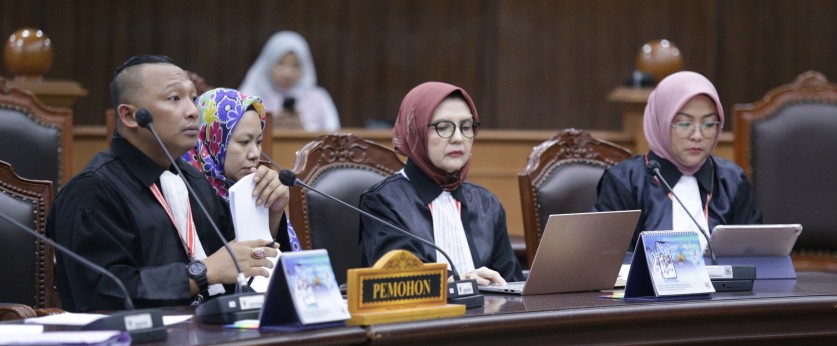
The Petitioners and their legal counsel during the Revision Hearing for Case Number 176/PUU-XXIII/2025 concerning the Judicial Review of Law Number 12 of 1980 on the Financial/Administrative Rights of the Leaders and Members of the Highest/High State Institutions as well as Former Leaders and Members of such institutions, Thursday (10/23/2025). Photo by MKRI/Bay
JAKARTA, (MKRI) – The Constitutional Court (MK) once again held a judicial review hearing for Law Number 12 of 1980 concerning Financial/Administrative Rights of the Leaders and Members of the Highest/High State Institutions as well as Former Leaders and Members of such institutions (Law 12/1980) against the 1945 Constitution of the Republic of Indonesia (UUD 1945). The hearing, scheduled for the revision of the petition, was filed by Lita Linggayani Gading and Syamsul Jahidin as Petitioners in Case Number 176/PUU-XXIII/2025.
The session, held at the Plenary Courtroom on Thursday (10/23/2025), was chaired by Chief Justice Suhartoyo, accompanied by Constitutional Justices Daniel Yusmic P. Foekh and M. Guntur Hamzah. In this case, the Petitioners-Lita, a psychologist, and Syamsul, a student and advocate—filed a judicial review of Article 1 (a), Article 1 (f), and Article 12 (1) of Law 12/1980. They argued that these provisions contradict the principles of justice and equality before the law as guaranteed by the 1945 Constitution.
In presenting the revised petition, Syamsul Jahidin stated that the number of Petitioners had increased from two to nine. “On page six, point four, we emphasize that this case is not nebis in idem, since a similar judicial review was previously registered as Case Number 41/PUU-XI/2013,” Syamsul explained before the Panel of Justices.
Furthermore, Syamsul clarified that the Petitioners have legal standing as Indonesian citizens whose constitutional rights are potentially harmed by the enforcement of the challenged provisions. “Our rights are potentially violated by the continued enforcement of these norms,” he asserted.
The Petitioners also presented comparisons with similar policies in other countries and attached a petition with 88,834 public signatures supporting the abolition of pension benefits for members of the House of Representatives (DPR RI).
Read also: Claimed to Have Created Inequality, Pension Benefits for House Members Challenged
Legal Arguments
During the preliminary hearing on Friday (10/10/2025), the Petitioners argued that the phrase “Members of the House of Representatives” in Article 1 (a) of Law 12/1980 creates inequality and legal injustice. According to the Petitioners, the provision allows DPR members who serve only one five-year term to receive lifetime pensions that can even be inherited.
“This contradicts the principles of justice and the rule of law oriented toward the people’s welfare,” Syamsul said, appearing without legal counsel.
The Petitioners contended that granting lifetime pensions to DPR members imposes a disproportionate financial burden on the state. Based on their data, total pension benefits for DPR members amount to Rp226.015 billion, all funded by the State Budget (APBN).
“The harm we experience is both real and potential. As taxpayers, we believe the use of public funds for pensions for DPR members serving only five years constitutes fiscal injustice,” Syamsul added.
Comparative Perspective and Considerations
In their petition, the Petitioners also compared the pension system of other state institutions. For Supreme Court Justices, Audit Board Members (BPK), civil servants, and members of the military and police, the minimum service period for pension eligibility ranges from 10 to 35 years. Meanwhile, DPR members, with terms of one to five years, still receive lifetime pensions.
They also referred to practices in several countries. In the United States and the United Kingdom, parliamentary pensions depend on tenure, age, and contribution. Australia has adopted a contribution-based pension system since 2004, while India continues to grant lifetime pensions to its parliament members, though the system is often criticized by the public as a fiscal burden—similar, the Petitioners argued, to the situation in Indonesia.
Beyond legal and financial concerns, the Petitioners also highlighted moral and performance aspects, noting that DPR members’ attendance and conduct do not correspond with the extensive privileges they receive. The Petitioners cited public opinion on the low attendance rates in plenary sessions and behavior seen as inconsistent with the responsibilities of public representatives.
Currently, DPR members receive pensions ranging from Rp401,894 to Rp3,639,540, depending on tenure, as stipulated in Government Regulation Number 75 of 2000. Nevertheless, the Petitioners argued that the rule remains unjust, as it grants lifetime pensions for political positions that are inherently temporary.
Through this petition, the Petitioners requested that the Constitutional Court declare the provisions of Law 12/1980 granting lifetime pensions to DPR members unconstitutional and without binding legal force. (*)
Author : Utami Argawati.
Editor : Lulu Anjarsari P.
PR : Andhini S.F.
Translator : Agusweka Poltak Siregar.
Disclaimer: The original version of the news is in Indonesian. In case of any differences between the English and the Indonesian versions, the Indonesian version prevails.
Thursday, October 23, 2025 | 15:13 WIB 611