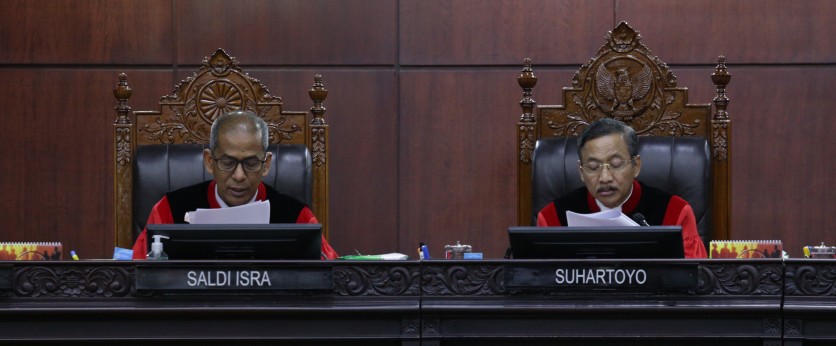
Deputy Chief Justice Saldi Isra pronouncing Decision No. 195/PUU-XXIII/2025 on the material judicial review of Law No. 2 of 2002 on the Indonesian National Police, Thursday (27/11). Photo by MKRI/Bay.
Jakarta (MKRI) – The Constitutional Court (MK) declared the Petition No. 195/PUU-XXIII/2025 on the material judicial review of Law No. 2 of 2002 on the Indonesian National Police (Police Law) unacceptable. The Decision Pronouncement Hearing of the case was held on Thursday, November 27, 2025. According to the Court, there was both consistency and error in the mention of the norm requested to be reviewed, neither of which was intended by the Petitioner.
“The Petitioner did not carefully draft the petition a quo because it included the norm of Article 28 paragraph (3) and the Elucidation of Article 28 paragraph (3) of Law No. 2 of 2002, which differs from the norm requested in the petition, namely requesting to declare the Elucidation of Article 3 paragraph (1) letter of Law No. 2 of 2002,” Deputy Chief Justice Saldi pread out the legal consideration of Decision No. 195/PUU-XXIII/2025.
The Court found that in the section describing the Court's authority, the Petitioner stated that it was challenging the norm of Article 28 paragraph (3) and the Elucidation of Article 28 paragraph (3) of Law No. 2 of 2002. Meanwhile, in the section on legal standing, the Petitioner mentioned Article 3 paragraph (1) letter c and the Elucidation of Article 3 paragraph (1) letter c of Law No. 2 of 2002. Furthermore, in the Petition, the Petitioner requested that the Court declare the Elucidation of Article 3 paragraph (1) letter c of Law No. 2/2002 to be conditionally unconstitutional with the 1945 Constitution of the Republic of Indonesia and to have no binding legal force.
In addition, in the section describing the reasons for the petition (posita), the Petitioner stated that the Elucidation of Article 3 paragraph (1) letter c of Law No. 2 of 2002 contradicts Article 1 paragraph (3), Article 27 paragraph (2), Article 28D paragraph (1), and Article 28D paragraph (2) of the 1945 Constitution of the Republic of Indonesia. However, after examining all the arguments explaining the conflict between the Elucidation of Article 3 paragraph (1) letter c of Law No. 2 of 2002, there is no adequate description of the conflict in question.
For example, of all the bases for testing in the 1945 Constitution that are argued in the petition, the Petitioner does attempt to explain the reasons for the conflict between the Elucidation of Article 3 paragraph (1) letter c of Law 2/2002 and Article 1 paragraph (3) of the 1945 Constitution, namely by quoting a number of expert opinions regarding the elements of a constitutional state. However, these expert opinions are not correlated with the Elucidation of Article 3 paragraph (1) letter c of Law No. 2 of 2002, so that they can form the basis of a strong argument showing a conflict with the principle of the rule of law as stipulated in Article 1 paragraph (3) of the 1945 Constitution.
In this case, for example, the Petitioner attempted to explain the function of “assistant” in the Elucidation of Article 3 paragraph (1) letter c of Law No. 2 of 2002. However, after the Court read it carefully, it turned out that the word “assistant” did not appear in the Elucidation of Article 3 paragraph (1) letter c of Law No. 2 of 2002 a quo. Moreover, the Petitioner elaborates that the function of assistants who perform police duties must be free of conflicts of interest. The problem is how to explain and accept this argument when it is placed as the basis for testing Article 1 paragraph (3) of the 1945 Constitution.
Based on the above legal considerations, in the absence of a clear and adequate description in the grounds for the petition that could indicate a conflict between the Elucidation of Article 3 paragraph (1) letter c of Law No. 2 of 2002 and the articles in the 1945 Constitution which are used as the basis for the review as stipulated in Article 30 letter a and Article 31 paragraph (1) of Law No. 3 of 2003 on the Constitutional Court, as well as Article 10 paragraph (3) and Article 36 paragraph (1) of Constitutional Court Regulation No. 7 of 2025, there is no doubt for the Court to declare that the Petitioner's petition is unclear or vague.
Also read:
Security Guard Challenges Police Law, Alleges Commercialization of Security Services
Security Guard Revises Petition on Police Law over Security Service Commercialization
The petition was filed by Syamsul Jahidin who is a security guard. He argued that the regulation had triggered a conflation of executive and legislative functions because members of the Police are allowed to engage in private-sector activities relating to the procurement of security personnel.
He further asserted that the Police’s role in regulating and commercializing private security services generates social inequality and undermines the principle of equality before the law as guaranteed by Article 28D paragraph (1) of the 1945 Constitution, which affirms that every person is entitled to recognition, guarantees, protection, and fair legal certainty as well as equal treatment before the law.
As reference, Article 3 paragraph (1) letter c of the Police Law stipulates: “(1) The implementers of police functions are the Indonesian National Police, assisted by: a. special police; b. civil servant investigators; and/or c. forms of community-based security. The elucidation of Article 3 paragraph (1) letter c further clarifies that “Forms of community-based security refer to security initiatives created out of community volition, awareness, and interest that subsequently obtain affirmation from the Indonesian National Police, such as neighborhood security units and security service businesses.”
In his petitum, the Petitioner requested the Court to declare the phrase “security service businesses” and the clause “Regulation on community-based security is within the authority of the Chief of the Indonesian National Police” in the elucidation of Article 3 paragraph (1) letter c of the Police Law unconstitutional and not legally binding, or to declare them conditionally unconstitutional insofar as they are not interpreted as follows:
“Forms of community-based security refer to security initiatives established on the volition, awareness, and interests of the community itself, subsequently affirmed by the Indonesian National Police, such as neighborhood security units. These forms of community-based security shall possess limited police authority within the territorial jurisdiction (lingkungan kuasa tempat), including residential areas, workplaces, and educational settings. Examples include neighborhood security units in residential areas, security units in office complexes, or those operating in commercial areas.”
Explore the Case: Case No. 195/PUU-XXIII/2025 (in Bahasa Indonesia)
Author: Mimi Kartika
Editor: N. Rosi
PR: Andhini SF
Translator: Rizky Kurnia Chaesario/Yuanna Sisilia
Disclaimer: The original version of the news is in Indonesian. In case of any differences between the English and the Indonesian versions, the Indonesian version will prevail.
Thursday, November 27, 2025 | 14:59 WIB 387