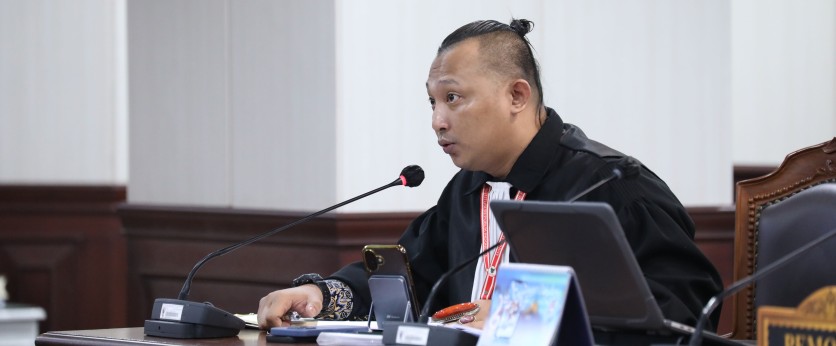
Syamsul Jahidin presenting the main arguments of his judicial review petition of Law No. 2 of 2002 on the Indonesian National Police, Wednesday (10/29/2025). Photo by MKRI/Panji.
JAKARTA (MKRI) — Syamsul Jahidin, a security guard by profession, filed a judicial review petition of Article 3 paragraph (1) letter c and its Elucidation of Law No. 2 of 2002 on the Indonesian National Police (Police Law) against Article 1 paragraph (3), Article 27 paragraph (2), Article 28D paragraph (1), and Article 28D paragraph (2) of the 1945 Constitution to the Constitutional Court (MK). He argued that the phrase “and business entities in the field of security services” in the elucidation has led to commercialization in the management of community-based (swakarsa) security services, which lack clear limits and oversight.
“The provision in the a quo article has been used to justify organized entrepreneurial activities by police officials,” Syamsul asserted during the preliminary hearing of Case No. 195/PUU-XXIII/2025 in the Constitutional Court, Jakarta, on Wednesday (10/29/2025).
As context, Article 3 paragraph (1) letter c of the Police Law stipulates that “The holders of police functions are the Indonesian National Police, which shall be assisted by: a. special police; b. civil servant investigators; and/or c. community-based security forms.”
Meanwhile, the Elucidation of this provision defines “community-based security forms” as “security forms established on the initiative, awareness, and interest of the community itself, which then receive endorsement from the Indonesian National Police, such as neighborhood security units and business entities in the field of security services.”
Syamsul argued that he has the right to legal certainty and protection from the commercialization of his profession, which undermines his ability to earn a decent living. As both a security guard and an advocate, he stated that he bears a moral responsibility to ensure the principles of law are upheld.
He also testified that before working as a security guard, one must undergo Gada Pratama training, a paid course costing around IDR 4 million. Furthermore, to advance to supervisory positions such as chief, team leader, or manager, a guard must complete the Gada Utama qualification, which costs about IDR 13.5 million. He considered these costs disproportionate to the authority and income of a security guard, creating a legal imbalance.
Syamsul further explained that he had registered with a Private Security Service Company (Badan Usaha Jasa Pengamanan/BUJP) for training, while the Police act as facilitators and issue the security guard certificates and identification cards (KTA). In his view, these training activities remain under the control of the Police, as stipulated in Article 3 paragraph (1) letter c of the Police Law, creating a potential for abuse of authority.
In his petitum, the Petitioner requested the Court to declare the phrases “and business entities in the field of security services” and “the regulation of community-based security services is under the authority of the National Police Chief” in the elucidation of Article 3 paragraph (1) letter c contrary to the 1945 Constitution and not legally binding. He urged the Court to reinterpret the article as follows:
“Community-based security forms are established on the initiative, awareness, and interests of the community itself, subsequently endorsed by the Indonesian National Police, such as neighborhood security units. These forms shall have limited police authority within their territorial jurisdiction, including residential, workplace, and educational environments, such as neighborhood security units in housing areas, offices, or shopping centers.”
The hearing was presided over by Deputy Chief Justice Saldi Isra as panel chair, accompanied by Constitutional Justices Ridwan Mansyur and Arsul Sani. During the session, Justice Arsul Sani highlighted that Syamsul’s security guard identification card had expired in 2021, even though he continued working as one. Arsul emphasized that this issue is crucial to the Petitioner’s legal standing.
“This aspect will partly determine whether Mr. Jahidin, in his capacity as a security guard rather than as an advocate, has the legal standing to file the petition.” Therefore, supporting documents proving his profession as a security guard should be attached,” Arsul advised.
Before adjourning, Deputy Chief Justice Saldi Isra informed the Petitioner that he could revise his petition within 14 days. The revised petition must be received by the Court no later than Tuesday, November 11, 2025, at 12:00 PM Western Indonesia Time.
Explore The Case: Case No. 195/PUU-XXIII/2025 (In Bahasa Indonesia)
Author: Mimi Kartika
Editor: N. Rosi
PR: Andhini SF
Translator: Yuanna Sisilia
Disclaimer: The original version of the news is in Indonesian. In case of any differences between the English and the Indonesian versions, the Indonesian version will prevail.
Wednesday, October 29, 2025 | 17:19 WIB 411