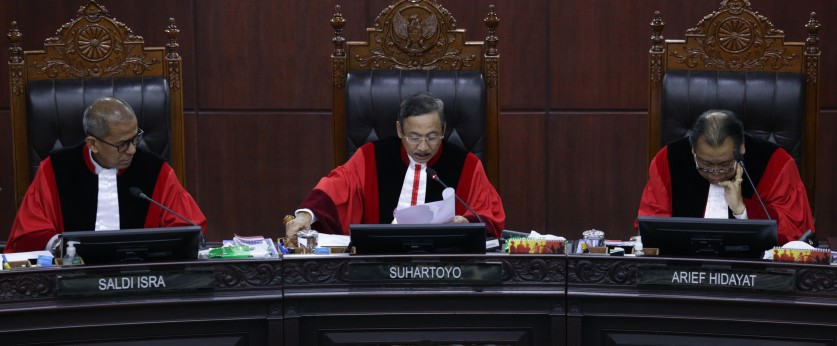
Ruling hearing of Case No. 200/PUU-XXIII/2025 on the material judicial review of Law No. 13 of 2022 on the Second Amendment to Law No. 12 of 2011 on Statutory Lawmaking, Thursday (11/27/2025). Photo by MKRI/Bay.
JAKARTA (MKRI) — The establishment of a law governing lawmaking rests on the need for a legal framework that ensures the protection of the rights and obligations of all Indonesians and responds to the public’s demand for well-crafted statutory laws and regulations. The core protected interest concerns the rights and obligations of the Indonesian people, who constitute the “community” referred to in Article 96 paragraph (3) of Law No. 13 of 2022 on the Second Amendment to Law No. 12 of 2011 on Statutory Lawmaking (the Law on Lawmaking).
The Constitutional Court’s legal considerations in Decision No. 200/PUU-XXIII/2025 were delivered by Constitutional Justice Arsul Sani. The petition challenged the constitutionality of Article 96 paragraphs (1) and (3) of the Law on Lawmaking. The ruling hearing for the petition filed by Alif Rahman took place on Thursday, November 27, 2025, in the plenary courtroom.
In his petitum, the Petitioner requested the addition of the phrase “who are Indonesian citizens and not foreign nationals” so that the wording would read “The community as referred to in paragraph (1) means individuals or groups of individuals who are Indonesian citizens and not foreign nationals who are directly affected by and/or have an interest in the substance of a draft statutory regulation.” The Court found that this request was not systematically nor substantively appropriate.
According to the Court, even without the additional phrase “who are Indonesian citizens and not foreign nationals,” the provision already clearly applies to Indonesian citizens. In practice, foreign nationals may also give input during the stages of lawmaking, as addressed earlier in the Court’s legal considerations, even though such participation is not formally incorporated into Article 96 paragraph (3) of Law No. 13 of 2022.
“Thus, in the Court’s view, the Petitioner’s concern that foreign nationals could take part in the lawmaking stages is unfounded within reasonable limits. Foreign nationals may participate when their experience or expertise is relevant to the draft law being formulated. Therefore, accommodating the Petitioner’s proposed interpretation into the substance of Article 96 paragraph (3) of Law No. 13 of 2022 would instead create legal uncertainty, as it would affect other provisions in the law that also employ the term ‘community’,” Justice Arsul explained.
Based on these considerations, the Petitioner’s argument that Article 96 paragraph (3) of Law No. 13 of 2022 is conditionally unconstitutional unless interpreted to mean “individuals or groups of individuals who are Indonesian citizens and not foreign nationals who are directly affected by and/or have an interest in the substance of a draft statutory regulation” is legally groundless and must be declared unsubstantiated.
Consequently, Article 96 paragraph (3) of Law No. 13 of 2022 does not contradict the right to protection by the state, the right to participate in national defense, nor the right to recognition, guarantees, protection, and legal certainty, as provided under Article 1 paragraph (3), Article 27 paragraph (3), and Article 28D paragraph (1) of the 1945 Constitution. The Petitioner’s arguments are therefore unfounded in their entirety.
“Rejecting the Petitioner’s petition in its entirety,” Chief Justice Suhartoyo stated, delivering the verdict for the a quo petition.
Also read:
Petitioner Questions Ambiguity of “Community” in Legislative Process
Petitioner Revises Petition on Meaning of “Community” in Law on Lawmaking
Earlier, the Petitioner questioned the ambiguity surrounding the term “community” in the challenged provision. He argued that the term created uncertainty over who may participate in the lawmaking process—whether only Indonesian citizens, all residents, or the broader population as referred to in Article 26 paragraph (2) of the 1945 Constitution.
He asserted that clarifying the term is crucial to ensuring the fulfillment of human rights in political participation, particularly citizens’ rights to engage from the planning to the decision-making stages of the legislative process. He also referred to international distinctions between “citizen” and “society,” arguing that meaningful public participation should involve citizens, not all persons regardless of nationality.
As a comparison, the Petitioner pointed to European Union practice, which explicitly regulates citizen participation in legislative initiatives. Article 11(4) of the Treaty on European Union states that only citizens of member states may submit initiatives to the European Commission. Therefore, he argued that specifying that the term “community” refers exclusively to Indonesian citizens is necessary to preserve national legal sovereignty and prevent foreign interference in the country’s lawmaking process.
Author: Sri Pujianti
Editor: Lulu Anjarsari P.
Public Relations: Raisa Ayuditha M.
Translator: Yuanna Sisilia
Disclaimer: The original version of the news is in Indonesian. In case of any differences between the English and the Indonesian versions, the Indonesian version will prevail.
Full Decision: Decision Case No. 200/PUU-XXIII/2025
Thursday, November 27, 2025 | 14:43 WIB 99