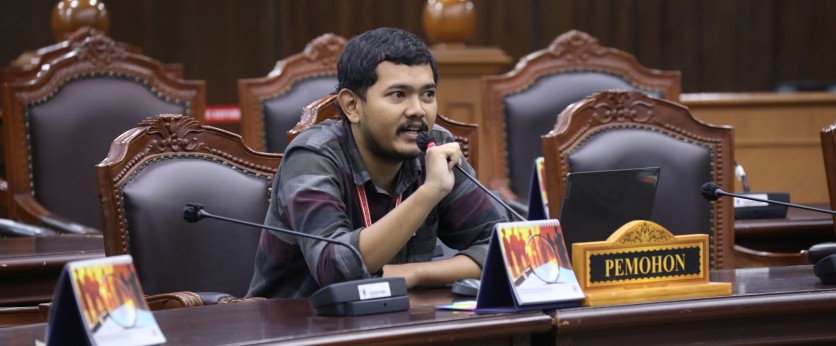
Alif Rahman, the Petitioner in the judicial review of Law No. 13 of 2022 on Lawmaking, conveying the main arguments of his petition at the Constitutional Court’s panel courtroom. Tuesday (11/4/2025). Photo by MKRI/Panji.
JAKARTA (MKRI) — The Constitutional Court (MK) held a judicial review hearing on Tuesday, November 4, 2025, to examine Article 96 paragraphs (1) and (3) of Law No. 13 of 2022 on the Second Amendment to Law No. 12 of 2011 on Lawmaking (UU P3).
Alif Rahman, the Petitioner in Case No. 200/PUU-XXIII/2025, challenged the ambiguity of the term masyarakat (“community”) as used in the provisions under review. He argued that the phrase creates conceptual uncertainty regarding who is actually authorized to take part in the lawmaking process, whether only Indonesian citizens, all citizens regardless of nationality, or “residents” as referred to in Article 26 paragraph (2) of the 1945 Constitution (45C).
“Fundamentally, meaningful participation in the lawmaking process through the active involvement of Indonesian citizens is an integral manifestation of democratic values as well as the principles of a state based on the rule of law,” he stated before the panel presided over by Chief Justice Suhartoyo.
The Petitioner further asserted that clarifying the term masyarakat is essential to safeguarding human rights in political participation, especially the right of citizens to be involved from the planning stage through decision-making during the legislative process.
Alif also referred to international concepts, distinguishing between citizen and society. In his view, meaningful public participation should be limited to citizens rather than the broader and undefined category of “society,” which could potentially encompass individuals without Indonesian nationality.
As a comparative reference, the Petitioner cited the European Union’s practice, which expressly regulates citizen participation in legislative initiatives. This is reflected in Article 11(4) of the Treaty on European Union, which stipulates that only citizens of EU member states may submit initiatives to the European Commission.
Therefore, the Petitioner maintained that expressly defining masyarakat as referring solely to Indonesian citizens is crucial to preserving national legal sovereignty and preventing foreign involvement in Indonesia’s legislative process.
Responding to the petition, Constitutional Justice Daniel Yusmic P. Foekh advised the Petitioner to ensure the systematic consistency of the petition. Overall, he found the structure aligned with the standards set under Constitutional Court Regulation (PMK) No. 7 of 2025.
“This petition, from the subject matter to the petitums, must maintain consistency in citing paragraphs. In the petitums, you must also ensure that the petition includes the State Gazette and the Supplement to the State Gazette. I notice this has not been included, although it is necessary to indicate whether the norm being challenged appears in the main text or in the explanation. Norms in the main text are published in the State Gazette, while those in the explanation are included in the Supplement. Nevertheless, under the Court’s filing standards, the State Gazette and its Supplement form an inseparable unit and must therefore both be included,” Daniel explained.
The panel granted the Petitioner 14 days to revise the petition. The revision must be submitted to the Court no later than Monday, November 17, 2025, at 12:00 PM Western Indonesian Time.
Author: Utami Argawati
Editor: Lulu Anjarsari P.
PR: Raisa Ayuditha M.
Translator: Yuanna Sisilia
Disclaimer: The original version of the news is in Indonesian. In case of any differences between the English and the Indonesian versions, the Indonesian version will prevail.
Tuesday, November 04, 2025 | 15:42 WIB 165