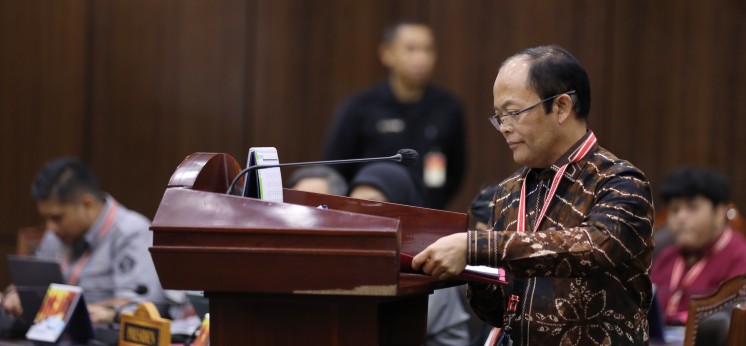
The Head of the Language Development and Fostering Agency, Hafidz Mukhsin, delivers the Government’s statement during the continued judicial review hearing of Law Number 24 of 2009 concerning the Flag, Language, and State Emblem, and the National Anthem, on Tuesday (11/18/2025) in the Constitutional Court courtroom. Photo by MKRI/Ifa.
JAKARTA, (MKRI) — In the context of international treaties concluded after the enactment of Law Number 24 of 2009 concerning the Flag, Language, and State Emblem, and the National Anthem (the Language and State Symbols Law), all treaty instruments have included an Indonesian translation as one of their authentic texts. For regional and multilateral agreements, English is generally used as the sole working language.
This explanation was delivered by Head of the Language Development and Fostering Agency, Ministry of Primary and Secondary Education, Hafidz Mukhsin, representing the Government in the continued judicial review hearing of Article 31(1) of the Language and State Symbols Law and Article 1320(4) of the Civil Code. The session combined two petitions: Case Number 173/PUU-XXIII/2025 filed by Feri Kurniawan (Petitioner I) and Fatchurozak (Petitioner II), and Case Number 188/PUU-XXIII/2025 filed by Alfin Ridhano.
“Indonesian translations continue to be produced during the ratification or approval process of international treaties. Introducing sanctions under Article 31(1) of Law Number 24 of 2009 may instead conflict with Article 27 of the 1969 Vienna Convention on the Law of Treaties, which states that a party may not invoke the provisions of its internal law as justification for its failure to perform a treaty,” Hafidz explained.
He added that in the context of regional or multilateral treaties, Indonesian cannot be required as a mandatory authentic text. Such agreements cannot be nullified or declared void merely for not using Indonesian. These instruments follow international conventions to which Indonesia is a bound party.
Hafidz emphasized that for bilateral treaties, the Indonesian Government consistently includes Indonesian as one of the authentic languages. In contrast, organizations such as ASEAN or the United Nations use English for multilateral instruments. “Translation into Indonesian is still conducted during ratification. Examples include the Regional Comprehensive Economic Partnership (RCEP) and the Agreement on Marine Biological Diversity of Areas Beyond National Jurisdiction (BBNJ),” he noted.
Standards for the Use of Indonesian Language
Hafidz further explained that the obligation to use Indonesian in official documents and agreements is implemented through language-of-contract standards, official translation mechanisms, and administrative checks in sectors such as notarial services, procurement, and licensing. These include provisions on prevailing-language clauses, and the option of addenda or novations to ensure textual equivalence even in the absence of sanctions.
“This means the normative effect remains intact. The Language Agency provides capacity-building programs—such as training in document drafting, editorial guidance, and certification for officials signing legal instruments. Strengthening competencies reduces the need for punitive approaches,” Hafidz clarified.
Language Development Index
Hafidz also highlighted the presence of a Language Development Index, which publicly displays achievements by region or institution. This transparency drives compliance through reputation and public accountability, reinforcing the effectiveness of language policy oversight.
“This approach fosters compliance not through fear or sanctions, but through positive attitudes toward the Indonesian language. Public recognition and appreciation mechanisms are more effective in creating lasting behavioral changes within regional governments, private institutions, educational units, and individuals,” he added.
He concluded that these approaches enhance compliance without diminishing the authority of relevant sectors to enforce Indonesian language use. The Government continues to uphold Indonesian language dignity through comprehensive policies and administrative systems.
“Compliance is built through clear standards, language-of-contract requirements, official translations, training programs, public indicators, and recognition mechanisms. Legal effect remains present through administrative systems and generally applicable private-law practices, including judicial decisions,” Hafidz asserted.
Read also:
The Risks of Using Foreign Languages in Memorandums of Understanding
Petitioner Adds Comparison of Foreign Language Memorandum of Understanding
Court Postpones Hearing on the Use of Foreign Languages in the Memorandum of Understanding
Petitioners Seek Legal Annulment Sanction for Memorandums of Understanding That Do Not Use Indonesian Language
Petitioners Affirm Legal Basis for Mandatory Use of Indonesian in MoUs
Background of the Petition
In Case Number 173/PUU-XXIII/2025, Petitioner I—a prospective advocate—argues that Article 31(1) of Law 24/2009 could create constitutional harm because the absence of sanctions generates uncertainty over the validity of agreements drafted solely in a foreign language, thereby affecting his professional obligations.
Petitioner II, a sworn translator, argues that the absence of clear sanctions undermines demand for translation services, significantly reducing his income and legal certainty in performing his profession.
In Case Number 188/PUU-XXIII/2025, Petitioners argue that the ambiguity surrounding the legal consequences of foreign-language agreements obstructs the provision of accurate legal advice in constitutional and public-policy consultations. The uncertainty also affects the livelihoods of language service providers.(*)
Author : Sri Pujianti
Editor : Lulu Anjarsari P.
PR : Fauzan Febriyan
Translator : Agusweka Poltak Siregar
Disclaimer: The original version of the news is in Indonesian. In case of any differences between the English and the Indonesian versions, the Indonesian version prevails.
Tuesday, November 18, 2025 | 19:53 WIB 265