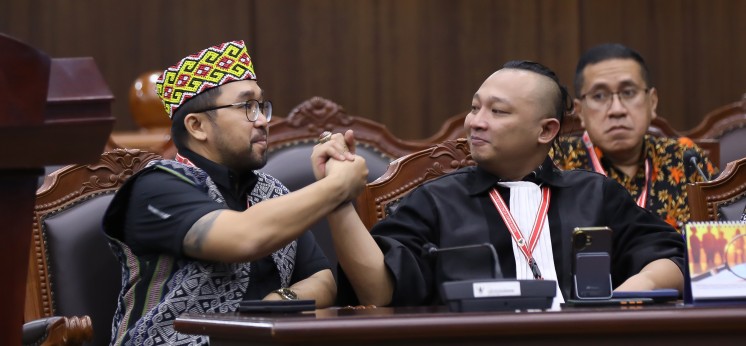
Petitioner Stepanus Febyan Babaro and legal counsel Syamsul Jahidin attending the Decision Pronouncement Hearing on the judicial review of Law No. 3 of 2022 on the State’s Capital City, Thursday (13/11). Photo by MKRI/Ifa.
Jakarta (MKRI) - The panel of Constitutional Court justices delivered an interpretation on the period for the use of Land Rights as regulated in Law No. 3 of 2022 on the State’s Capital City (IKN Law). In this ruling, the Court clarified the cycles regarding Land Rights (HAT), Building Rights (HGB), and Right of Use (HP) under the IKN Law.
“It is hereby declared that Article 16A paragraph (1) of Law No. 3 of 2022 on the State’s Capital City (State Gazette of the Republic of Indonesia Year 2022 No. 41, Supplement to State Gazette No. 6766), as amended by Law No. 21 of 2023 on the Amendment to Law No. 3 of 2022 on the State’s Capital City (State Gazette Year 2023 No. 142, Supplement to State Gazette No. 6898), is contrary to the 1945 Constitution and has no binding legal force except insofar as it is interpreted as follows: ‘In the case of land rights agreed upon as referred to in Article 16 paragraph (7) in the form of cultivation rights, the right shall be granted for a maximum of 35 years; extension, for up to 25 years; and renewal, for up to 35 years, based on criteria and stages of evaluation,’” Chief Justice Suhartoyo delivered Decision No. 185/PUU-XXII/2024 on Thursday, November 13, 2025, in the Plenary Courtroom.
Chief Justice Suhartoyo continued that Article 16A paragraph (2) IKN Law is likewise unconstitutional and not binding unless interpreted to mean: “In the case of agreed land rights as referred to in Article 16 paragraph (7) in the form of building rights, the right shall be granted for a maximum of 30 years; extension, for up to 20 years; and renewal, for up to 30 years, based on criteria and stages of evaluation.” Article 16A paragraph (3) of the IKN Law was contrary to the 1945 Constitution and has no legally binding force as long as it is not interpreted as: “For agreed land rights as referred to in Article 16 paragraph (7) in the form of right of use, the right is granted for up to 30 years; extension for up to 20 years; and renewal for up to 30 years, based on criteria and stages of evaluation.”
“Declares that the Elucidation of Article 16A paragraphs (1), (2), and (3) of Law Number 3 of 2022 on the State’s Capital City (State Gazette of the Republic of Indonesia Year 2022 No. 41, Supplement to the State Gazette of the Republic of Indonesia No. 6766), as amended by Law Number 21 of 2023 on Amendments to Law Number 3 of 2022 on the State’s Capital City (State Gazette of the Republic of Indonesia Year 2023 Number 142, Supplement to the State Gazette of the Republic of Indonesia Number 6898), is contrary to the 1945 Constitution of the Republic of Indonesia and does not have binding legal force,” Chief Justice Suhartoyo delivered the decision of case filed by Stephanus Febyan Babaro, a member of the Dayak community.
The Petitioner had challenged the constitutionality of Article 16A paragraphs (1), (2), and (3) of Law Number 3 of 2022 on the State’s Capital City (IKN Law), focusing on land rights arrangements encompassing Cultivation Rights (HGU), Building Rights (HGB), and Rights of Use within the State’s Capital City area.
Ambiguity
Discussing the petitioner’s challenge to Article 16A paragraph (1) and its Elucidation, Justice Enny Nurbaningsih noted an inconsistency between the article and its explanation. The core norm stipulates that land rights (HGU) are granted for one cycle and can be renewed for a second, giving the impression of a de facto grant for 95 years in a single cycle (and potentially extended to 190 years with a second cycle), whereas the Elucidation outlines a staged approach.
“This creates ambiguity likely to cause misinterpretation, even with provisos requiring criteria and evaluation. The main issue lies in the core norm’s phrasing—‘one cycle, renewable for a second’—which the Court finds tantamount to a simultaneous maximum limit, previously found unconstitutional in Decision No. 21-22/PUU-V/2007,” Justice Enny explained.
Furthermore, Justice Enny explained that the provision of Article 16A paragraph (1) of Law No. 21of 2023 also stipulates a period of ninety-five (95) years for the first cycle of cultivation rights (HGU), with the possibility of granting a second cycle for an additional ninety-five (95) years—accumulating to a combined total of one hundred ninety (190) years.
“This provision is inconsistent with, or tends to weaken, the State’s position in exercising control over land rights as enshrined in Article 33 paragraph (3) of the 1945 Constitution. Upon examining the General Elucidation of Law No. 21 of 2023, the Court notes that one of the principal aims of amending Law No. 3 of 2022 was to introduce a more competitive regime for land rights duration,” Justice Enny said.
Justice Enny added that this arrangement constitutes a special rule (lex specialis) on the duration of land rights applicable only within the State’s Capital City (IKN), designed to enhance the attractiveness of investment in IKN. While the Court understands the government’s efforts to boost investor interest, it emphasized that even special regulations must not contradict constitutional principles, particularly the State’s right of control, which would otherwise diminish sovereignty.
“In this regard, the Court considers it essential to reaffirm that the regulation on land rights is one element in supporting investment appeal; however, what is also needed is for the government to foster a conducive investment climate in accordance with the Constitution, including the realization of legal certainty, the upholding of justice, administrative simplicity, and reduction of high economic costs,” Justice Enny stated.
Justice Enny further observed that the General Elucidation, by establishing a special land rights duration for IKN, may be viewed as discriminatory vis-à-vis efforts to attract investment in other regions, which should be subject to the same legal regime based on Law No. 25 of 2007 as interpreted by the Court.
“For this reason, the use of the phrase through the first cycle and may be granted again for a second cycle in Article 16A paragraph (1) of Law No. 21 of 2023 is not consistent with the government’s goal. Specifically, this phrase is at odds with agrarian and land-related legislation and Law No. 25 of 2007, as previously interpreted by the Court,” she emphasized.
Permit Process
Furthermore, in the context of land rights granted within the IKN, based on Article 16A of Law No. 21 of 2023, the substance relates directly to investment matters, including both domestic and foreign capital. For this reason, Law No. 25 of 2007, as previously interpreted by the Constitutional Court, is rightly referenced in governing the use of land rights for investment purposes, including investments in IKN. Moreover, the Court has affirmed that simplified services and/or licensing for land rights must be available, allowing these rights to be granted, extended, and renewed upon the investor’s application, as previously discussed.
With regard to the provision of such services and/or licenses, the Basic Agrarian Law (UUPA) provides that companies requiring a longer period may be granted cultivation rights (HGU) for up to thirty-five (35) years, and upon request from the holder and considering business conditions, this may be extended for up to twenty-five (25) years.
“However, to support a conducive investment climate while upholding the mandate of the 1945 Constitution, the Constitutional Court under Decision No. 21-22/PUU-V/2007 confirmed that, in addition to the granting and extension of rights, land rights (HAT) may also be renewed upon the holder’s application. Thus, for HGU, the right may be granted, extended, and further renewed. There are three distinct processes, but not simultaneously, as contemplated in the phrase ‘through the first cycle and may be granted again for a second cycle’ as stated in Article 16A paragraph (1) of Law No. 21 of 2023,” Justice Enny clarified.
No Two Cycles
Justice Enny further explained that the conditions for extension and renewal are already regulated in Law No. 21 of 2023, serving as instruments for evaluating the use of land rights (HAT) when extension or renewal is sought. The Constitutional Court’s Decision No. 21-22/PUUV/2007 similarly emphasized the need for criteria in granting, extending, or renewing land rights. In essence, these substantive criteria are intended to ensure that land continues to be managed in line with the purposes for which cultivation rights (HGU) are granted, ultimately serving the greatest prosperity of the people as envisioned in Article 33 paragraph (3) of the 1945 Constitution.
In this context, Justice Enny noted, the Elucidation to Article 16A paragraph (1) of Law No. 21 of 2023 clarifies that HGU may be granted and processed in stages: (1) initial right, for a maximum of 35 years; (2) extension, for a maximum of 25 years; and (3) renewal, for a maximum of 35 years.
“After careful review, the Court finds that the substance of the Elucidation to Article 16A paragraph (1) of Law No. 21 of 2023 and actual practice for granting cultivation rights follows Constitutional Court Decision No. 21-22/PUU-V/2007, providing staged granting, extension, and renewal to support investment progress in Indonesia, without the need for the phrase ‘through the first cycle and may be granted again for a second cycle,’” Justice Enny stated.
Therefore, Justice Enny continued, to achieve harmony between the principal provision and the elucidation, as well as with other legislation, and thereby create legal certainty crucial to investment in and development of the IKN according to the intended amendments through Law No. 21 of 2023, the phrase "through the first cycle and may be granted again for a second cycle" in Article 16A paragraph (1) of Law No. 21 of 2023 must be declared conditionally unconstitutional and not binding unless it is interpreted to mean: “In the event of land rights as referred to in Article 16 paragraph (7) in the form of cultivation rights, rights are granted for up to thirty-five (35) years; extension, for up to twenty-five (25) years; and renewal, for up to thirty-five (35) years, based on criteria and stages of evaluation.”
“In effect, the maximum term of ninety-five (95) years may be achieved only if all criteria and evaluation stages are fulfilled. Thus, the Petitioners’ challenge to the constitutionality of Article 16A paragraph (1) of Law No. 21 of 2023 is legally justified. With the Constitutional Court’s interpretation of Article 16A paragraph (1), the Elucidation to Article 16A paragraph (1) of Law No. 21 of 2023 is rendered unnecessary, having become part of the main norm as interpreted by the Court, and must consequently be declared unconstitutional and not legally binding,” Justice Enny concluded.
Also read:
Duration of Right over Land in New State Capital Deemed Too Lengthy
Two Petitioners Now Challenge Duration of Right over Land in New Capital
Court Delays Expert Testimonies for Case on Right over Land in New Capital
Land Right Duration in IKN Must be Fair and Proportional
The Petitioners believe there are two different regulations regarding the duration of the right to cultivate, the right to build, and the right of use: Article 16A paragraphs (1), (2), and (3) of the IKN Law as well as Article 9 of the Presidential Regulation (Perpres) No. 75 of 2024 on the Acceleration of the Development of the Nusantara Capital City (IKN). They argued that the IKN Law and Presidential Regulation No. 75 of 2024 do not clearly regulate the parties entitled to have the right to cultivate, the right to build, and the right of use. This, they stressed, could allow foreign parties to control land in IKN for a very long period of time. They also emphasized that granting land rights with too long a duration can sacrifice the interests of future generations.
Author : Utami Argawati
Editor : Lulu Anjarsari P.
PR : Fauzan Febriyan
Translator : Rizky Kurnia Chaesario/Yuniar Widiastuti
Disclaimer: The original version of the news is in Indonesian. In case of any differences between the English and the Indonesian versions, the Indonesian version will prevail.
Thursday, November 13, 2025 | 14:56 WIB 2018