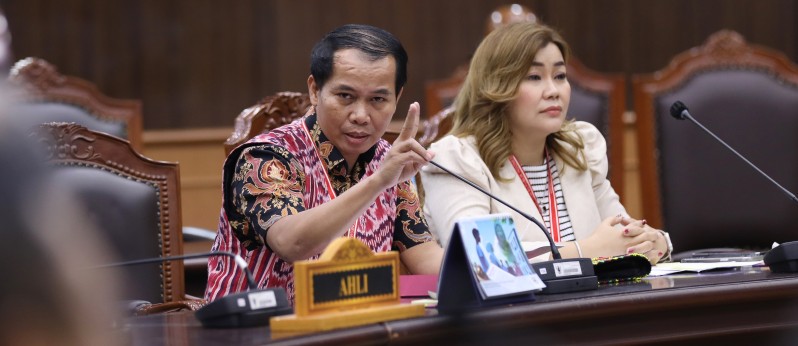
Salfius Seko and Erika Siluq, experts presented by Petitioners, delivering their testimony during the continued judicial review hearing of Law No. 21 of 2023 on the State’s Capital City, Wednesday (25/06). Photo by MKRI/Ifa.
Jakarta (MKRI) – The Constitutional Court (MK) resumed the material judicial review hearing of Law No. 21 of 2023 on the Amendment to Law No. 3 of 2022 on the State’s Capital City (IKN Law) on Wednesday, June 25, 2025. Experts presented by the Petitioners and the Government attended the plenary hearing to provide their testimony on the provision of Article 16A of the IKN Law on the land right period in IKN for Case No. 185/PUU-XXII/2024.
Erika Siluq, a law lecturer at Universitas 17 Agustus 1945 (UNTAG) Samarinda, considered that the provision of the agrarian law regarding land rights should refer to existing statutory regulations. “The provision is more acceptable to society in general and adheres to the principles of fairness, expediency, and respect for traditions as the norms and identity of the Indonesian nation,” Erika stated.
Erika argued that the land rights duration, which covers a wide area for too long, as stipulated in Article 16A of the IKN Law, may close the community's access to the right to improve their economy. This contradicts Article 27 and Article 33 of the 1945 Constitution of the Republic of Indonesia.
Meanwhile, Salfius Seko stated that the cultivation right (hak guna usaha) for 180 years will generally destroy the local community's livelihoods, especially those of the Dayak community. The longer the investment, the more the common interest will be marred by individual interests. Violation of the livelihood will tip the balance of harmony. Hence, the community foundation will be broken.
Permissible for National Strategic Goals
On the same occasion, the Government presented Wicipto Setiadi, a Professor of Law at the Faculty of Law, UPN Veteran Jakarta, who emphasized that the provision in Article 16A of the IKN Law does not signify a relinquishment of state sovereignty over land. Instead, it remains within the framework of state control in accordance with the doctrine of state control. He explained that land rights such as the Right to Cultivate (HGU), Right to Build (HGB), and Right of Use (Hak Pakai) are limited in nature, conditional, and may be revoked by the state at any time.
He emphasized that the IKN Law serves as a lex specialis which allows for deviations from the general provisions of the Basic Agrarian Law (UUPA), in pursuit of national strategic objectives. The 95-year duration scheme does not constitute a transfer of power, but rather a conditional and phased granting of rights intended to support the successful development of the new capital city for the greatest benefit of the people. This provision, he asserted, was designed to uphold legal certainty, social justice, and the sustainability of national development.
“The 95-year period is not an automatic grant but is conditional and implemented in two cycles. Each phase is subject to evaluation by the IKN Authority. This is not a form of power transfer, but rather a mechanism to ensure legal certainty in the development of IKN as a national strategic project,” explained Wicipto.
He further added that Article 16A constitutes a form of affirmative action commonly practiced in global development efforts, particularly to attract long-term investments that require legal certainty regarding land use.
Echoing this, Nurhasan Ismail, another expert presented by the Government, stated that the guarantee of land rights is provided at the stage of the land utilization agreement, not during the initial grant of land rights by the government.
In his written statement, he argued that Article 16A a quo is not suitable for judicial review by the Constitutional Court, as its normative substance constitutes the content of a Land Utilization Cooperation Agreement between the IKN Authority and third parties. This relationship is entirely civil in nature, and in addition to being subject to the principle of freedom of contract, it also adheres to the provisions of the IKN Law and relevant land legislation. Based on the elucidation of Article 16A a quo, the extension or renewal of land rights in both the first and second cycles proceeds in a normal manner, as applied in other locations—namely, in stages: initial grant, extension, and renewal—thus it cannot be considered in contradiction with the 1945 Constitution of the Republic of Indonesia.
With the existence of specific criteria as conditions for approval or rejection of extensions or renewals, as formulated in Article 16A paragraph (5) of Law No. 21 of 2023, such provisions are consistent with those applied elsewhere. Furthermore, the law permits the revocation of land rights, and therefore, it cannot be deemed to conflict with prevailing land laws or the 1945 Constitution.
Also read:
Duration of Right over Land in New State Capital Deemed Too Lengthy
Two Petitioners Now Challenge Duration of Right over Land in New Capital
Court Delays Expert Testimonies for Case on Right over Land in New Capital
The Petitioners believe there are two different regulations regarding the duration of the right to cultivate, the right to build, and the right of use: Article 16A paragraphs (1), (2), and (3) of the IKN Law as well as Article 9 of the Presidential Regulation (Perpres) No. 75 of 2024 on the Acceleration of the Development of the Nusantara Capital City (IKN). They argued that the IKN Law and Presidential Regulation No. 75 of 2024 do not clearly regulate the parties entitled to have the right to cultivate, the right to build, and the right of use. This, they stressed, could allow foreign parties to control land in IKN for a very long period of time. They also emphasized that granting land rights with too long a duration can sacrifice the interests of future generations.
For this reason, the Petitioners requested that the constitutional justices grant the petition in its entirety; and that Article 16A paragraphs (1), (2), and (3) of the IKN Law be declared unconstitutional or be interpreted to mean that the maximum duration of the right to cultivate and the right to use be limited to 25 years while the right to build be limited to 20 years.
Author : Utami Argawati
Editor : Lulu Anjarsari P.
PR : Fauzan Febriyan
Translator : Rizky Kurnia Chaesario/Yuniar Widiastuti
Disclaimer: The original version of the news is in Indonesian. In case of any differences between the English and the Indonesian versions, the Indonesian version will prevail.
Wednesday, June 25, 2025 | 13:26 WIB 396