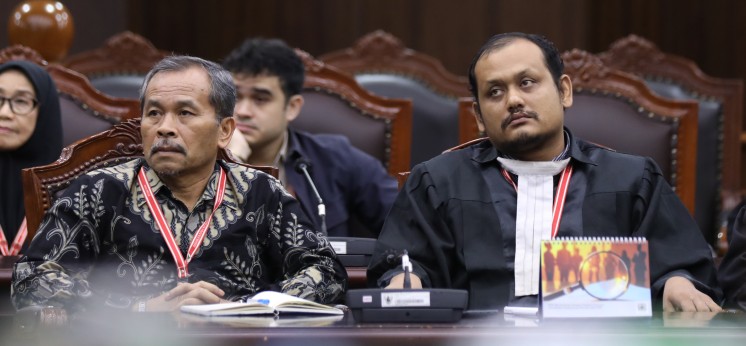
Principal Petitioner Arslan Abd Wahab and his legal counsel attending the ruling hearing of the judicial review of Law No. 23 of 2011 on Zakat Management, Thursday (11/13/2025) in the Court’s plenary courtroom. Photo by MKRI/Ifa.
JAKARTA (MKRI) — Adding the phrase “except for Aceh Province” would, in fact, create legal uncertainty in zakat management in Aceh. The Explanation of Article 15 of Law No. 23 of 2011 merely clarifies that the term Baitul Mal is used in Aceh to refer to provincial and regency/municipal BAZNAS.
This legal consideration was delivered by Constitutional Justice Arief Hidayat when reading the Constitutional Court’s ruling on the material judicial review of Article 44 of Law No. 23 of 2011 on Zakat Management against Article 18B paragraph (1) and Article 28D paragraph (1) of the 1945 Constitution. The petition was filed by Arslan Abd Wahab, a retired state civil apparatus who served as the Head of the Aceh Tengah Regency Financial Agency from 2022 to 2024. The Ruling Hearing for Case No. 140/PUU-XXIII/2025 was held on Thursday, November 13, 2025.
Justice Arief explained that Article 44, which the Petitioner challenges, is part of the Closing Provisions of Law No. 23 of 2011. Under Law No. 12 of 2011 on Lawmaking, closing provisions are placed in the final chapter or, if no chapters are used, in the final articles.
Regarding the Petitioner’s request to add the phrase “except for Aceh Province”, Justice Arief emphasized that such an addition bears no relevance to the nature of closing provisions. Introducing an exception clause would disrupt legal coherence and generate uncertainty. At the national level, BAZNAS reports zakat management activities in all provinces and regencies/municipalities to the Minister, something that also applies to Baitul Mal Aceh.
“Were the Petitioner’s request granted, it would not only distort the normative structure of Law No. 23 of 2011, but also leave Aceh without a legal basis to regulate zakat administration through its qanun. Law No. 11 of 2006 merely places zakat as part of regional own-source revenue (PAD), while the operational regulation of zakat management by Baitul Mal is delegated to a qanun. Therefore, Law No. 23 of 2011 continues to govern zakat management in Aceh, where the managing institution is Baitul Mal,” Arief said.
No Legal Basis for the Requested Addition
The Court also held that inserting the phrase “except for Aceh Province” into Article 44 lacks a sound legal foundation. The Petitioner’s alleged harm did not result from the contested article but from an alleged abuse of authority in managing zakat funds, part of Aceh Tengah’s PAD, regulated under Article 180 paragraph (1)(d) of Law No. 11 of 2006.
“This matter is already addressed under Articles 37 and 40 of Law No. 23 of 2011, which strictly prohibit individuals from possessing, pledging, granting, selling, or transferring zakat, infak, alms, or other religious social funds under their management. Violations carry imprisonment and/or fines,” Arief stated.
Harmonizing Zakat Regulation Within Aceh’s Special Autonomy
Justice Arief further noted that both Law No. 11 of 2006 and Law No. 23 of 2011 are included in the 2025–2029 National Legislation Program. Therefore, it is crucial for lawmakers to synchronize and harmonize zakat regulations in the context of Aceh’s special autonomy within the framework of the Unitary State of the Republic of Indonesia.
Based on the above legal considerations, the Court concluded that the Petitioner’s arguments challenging the constitutionality of Article 44 lack legal merit.
“Adjudicating, the Court rejects the petition in its entirety,” Chief Justice Suhartoyo declared when reading out the verdict.
Also read
In Aceh, Zakat Constitutes Locally Generated Revenue
House: Zakat Regulation as Local Revenue Reflects Aceh’s Special Status
Petitioner Strengthens Legal Standing in Judicial Review of Law on Zakat Management in Aceh
Aceh's Privilege in Zakat Management
Case No. 140/PUU-XXIII/2025 was filed by Arslan Abd Wahab, a retired state civil apparatus who served as the Head of the Aceh Tengah Regency Financial Agency from 2022 to 2024. At the Preliminary Hearing on Friday, August 22, 2025, the Petitioner’s legal counsel Zulkifli argued that the application of Article 44 had harmed the Petitioner in performing his duties related to financial management in Aceh Tengah, which operates under the special provisions of Law No. 11 of 2006 on Aceh Governance.
The Petitioner was responsible for authorizing expenditure flows, particularly disbursements funded by the 2022 Special Allocation Fund (DAK), which were required to be completed by December 31, 2022. Failure to do so would risk the cessation of future DAK transfers from the central government.
Due to this issue, the Petitioner was found guilty by the Takengon District Court (Decision No. 74/Pid.Sus/2024/PN Tkn) and sentenced to three months in prison without detention, a ruling upheld by the Aceh High Court (Decision No. 543/PID.SUS/2024/PT BNA) with a one-year sentence, and later by the Supreme Court (Decision No. 5381 K/PID.SUS/2025), which rejected both the Petitioner’s and the Public Prosecutor’s cassation appeals.
Zulkifli warned that inconsistent interpretation of the article could expose all financial officials in Aceh regency/municipal and provincial to criminal liability concerning zakat funds classified as PAD, as experienced by the Petitioner.
The Petitioner asked the Court to declare Article 44 of Law No. 23 of 2011 conditionally unconstitutional unless interpreted to mean that all regulations concerning zakat management predating the law remain in force except in Aceh Province.
Explore the Case: Case No. 140/PUU-XXIII/2025 (in Bahasa Indonesia)
Writer: Sri Pujianti
Editor: N. Rosi
PR: Andhini SF
Translator: Yuanna Sisilia
Disclaimer: The original version of the news is in Indonesian. In case of any differences between the English and the Indonesian versions, the Indonesian version will prevail.
The Complete Decision: Decision for Case No. 140/PUU-XXIII/2025 (in Bahasa Indonesia)
Thursday, November 13, 2025 | 15:45 WIB 223