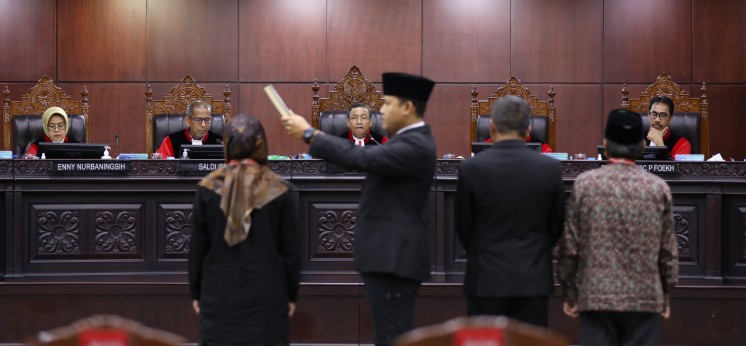
Witnesses and experts taking the oath before the panel at the judicial review hearing of Law No. 23 of 2011 on Zakat Management, Wednesday (10/15). Photo by MKRI/Ifa.
JAKARTA (MKRI) – The Constitutional Court (MK) convened another judicial review hearing of Article 44 of Law No. 23 of 2011 on Zakat Management against Article 18B paragraph (1) in conjunction with Article 28D paragraph (1) of the 1945 Constitution on Wednesday, October 15, 2025.
This fourth hearing of Case No. 140/PUU-XXIII/2025, filed by Arslan Abd Wahab, a retired state civil servant who served as Head of the Central Aceh Regency Financial Agency from 2022 to 2024, heard the statements of the Petitioner’s expert and witness as well as the President’s expert.
Aceh’s Distinctive Legal Status
The Petitioner’s expert, Zainal Abidin, emphasized the need to recognize Aceh’s special status, which cannot be equated with other regions. He underlined that Aceh and Islam are inseparable, as Islam forms the foundation of the province’s special autonomy.
In line with this status, the central government grants Aceh privileges in the spheres of religion, customary law, and education, as well as a recognized role for the ulama in policymaking, as stipulated in Article 3 paragraph (2) of Law No. 44 of 1999 on the Implementation of the Special Status of the Province of the Special Region of Aceh.
Building upon this religious privilege, Aceh enacted several sharia-based bylaws (qanun), including Aceh Qanun No. 10 of 2018 on Baitul Mal, as amended by Aceh Qanun No. 3 of 2021. To uphold Islamic law in the province, the Mahkamah Syar’iyah (Sharia Court) was established.
“In Aceh, we regard the Law on the Governing of Aceh as the highest law below the Constitution. This law occupies the top position in the internal hierarchy of legislation in Aceh, as reflected in Article 269 of Law No. 11 of 2006,” Zainal explained.
“Any statutory regulations directly related to Aceh’s special autonomy, at the provincial or district/city level, must conform to this law. Should there be any plan to amend it, prior consultation with and consideration by the Aceh Legislative Council (DPRA) are required.”
National Zakat Management
At this hearing, the President/Government presented Nazaruddin A. Wahid of UIN Ar-Raniry Banda Aceh as an expert. He explained that Islam teaches the obligation of zakat as both an act of worship and a form of social responsibility.
As it falls within the public sphere, government involvement in zakat management is necessary. Therefore, he stressed, the government’s role in managing zakat must be viewed from a national perspective, not limited only to the Province of Aceh.
At the national level, zakat management was initially governed by Law No. 38 of 1999, later replaced by Law No. 23 of 2011, both of which apply throughout Indonesia. Meanwhile, by virtue of its special autonomy under Law No. 11 of 2006, the Aceh Government has authority over matters relating to religion or Islamic law (syariat Islam), customary practices, ulama or ulama councils, and natural resources.
Exercising this authority, the Aceh Government enacted Aceh Qanun No. 10 of 2018, later revised by Aceh Qanun No. 3 of 2021.
The qanun affirms, referring to Law No. 11 of 2006, that zakat constitutes locally generated revenue (PAD). Accordingly, Article 180 letter (d) of that law explicitly stipulates that zakat forms part of regional revenue. The qanun reiterates this, making zakat a principal duty of the regional government.
Regarding disbursement, the Baitul Mal Secretariat must process zakat funds in line with the procedures stipulated in Qanun No. 10 of 2018. The Secretariat, with approval from the Baitul Mal Board, submits disbursement requests to the Aceh Financial Management Authority (PPKA) for zakat and/or infaq funds. No party may divert zakat funds, as they are a trust from the muzakki (payers) to be distributed to mustahik (eligible recipients).
“No one may transfer or manage zakat except institutions designated under Qanun No. 10 of 2018, which is reinforced by Governor Regulation No. 8 of 2022,” Nazaruddin asserted.
Referring to Law No. 23 of 2011, Law No. 11 of 2006, and Aceh Qanun No. 10 of 2018, he explained that these legal frameworks share the same philosophical foundation, implementing Islamic law (syarak) as contained in the Qur’an and Hadith so that it can be readily practiced by Muslims.
Aceh’s distinctiveness, he added, lies in its legal authority and foundation, particularly in the management institutions, the recognition of zakat as locally generated revenue, and its productive distribution to beneficiaries.
Utilizing Cash Surplus
The Court also heard the testimony of the Petitioner’s witness, Nafisah Elviana, who explained that in Fiscal Year 2022/2023, as the Authorized Representative of the Regional General Treasurer, she managed regional finances by depositing all revenues into a single treasury account held at a commercial bank.
Regarding fund transfers within the Central Aceh Regency Regional Treasury Account at the end of 2022 and early 2023, Nafisah said these adjustments were made following the government’s financial response to the COVID-19 pandemic since 2020.
Nafisah further stated that the regional government faced a budget deficit, meaning it lacked sufficient funds to pay invoices submitted by the Regional Work Units (SKPK) to the Central Aceh Regency Financial Management Agency. This occurred because the regional revenue target for that fiscal year was not met, leaving the local government obligated to pay outstanding 2021 expenditures that burdened 2022 revenue.
As a result, by the end of 2022, many payment requests (SPM) from SKPK were postponed, including activities funded by central and provincial government transfers. The available funds were prioritized for essential expenditures such as holiday allowances (THR), 13th-month salaries, and health worker incentives, which ideally should have been financed from other sources.
“The only funds available were the remaining budget balance (SiLPA) and locally generated revenue (PAD) in the Regional Treasury Account (RKUD). The Regional General Treasurer (BUD) therefore instructed the authorized officer to promptly process SPM payments using these funds.
Delaying them would result in audit findings and debts the following year, increasing the deficit. In accordance with Minister of Home Affairs Regulation (Permendagri) No. 77 of 2020 on Technical Guidelines for Financial Management, the BUD covered the cash shortfall and optimized cash surpluses, including arranging funds for implementing the Regional Budget (APBK),” Nafisah explained.
Also read:
Aceh’s Special Status in Zakat Management
Petitioner Strengthens Legal Standing in Judicial Review of Aceh’s Zakat Management Law
House of Representatives: Regulation of Zakat as Regional Revenue Reflects Aceh Government’s Special Authority
Case No. 140/PUU-XXIII/2025 was filed by Arslan Abd Wahab, a retired state civil apparatus who served as Head of the Central Aceh Regency Financial Agency from 2022 to 2024.
At the preliminary hearing on Friday, August 22, 2025, the Petitioner’s legal counsel, Zulkifli, argued that the enforcement of the disputed provision had harmed his client in managing the finances of the Central Aceh Regency Government in Aceh Province, which enjoys special autonomy under Law No. 11 of 2006 on the Governing of Aceh.
He explained that the Petitioner was authorized to manage and/or regulate the cash flow of the Regency’s expenditures, particularly the transfer of treasury funds derived from locally generated revenue (PAD).
Accordingly, the Petitioner was required to make payments for expenditures funded by the 2022 Special Allocation Fund (DAK) no later than 31 December 2022. Failure to do so would result in the central government withholding DAK transfers to the Regency in the following fiscal year.
As a result, the Petitioner, who managed or regulated expenditures involving zakat funds categorized as PAD, was found guilty under the Takengon District Court Decision No. 74/Pid.Sus/2024/PN Tkn (three months’ imprisonment without detention), which was later amended by the Aceh High Court Decision No. 543/PID.SUS/2024/PT BNA (one year’s imprisonment without detention), and upheld by the Supreme Court Decision No. 5381 K/PID.SUS/2025, which rejected both the Petitioner’s and the public prosecutor’s cassation appeals.
Due to the uncertainty in interpreting the provision, Zulkifli continued, all heads of regional financial agencies and expenditure treasurers at both the district/city and provincial levels in Aceh, as well as members of local budget teams, risk being charged under the same norm. This includes the Petitioner, who is currently a defendant and/or convict in a case related to the management of locally generated revenue (zakat).
In his petition, the Petitioner requested the Constitutional Court to declare Article 44 of Law No. 23 of 2011 on Zakat Management conditionally unconstitutional unless interpreted to read:
“Upon the enactment of this Law, all laws and regulations on zakat management and implementing regulations of Law No. 38 of 1999 on Zakat Management shall remain in effect insofar as they do not contradict the provisions of this Law, except for the Province of Aceh.”
Exploring the Case Record: Case number 140/PUU-XXIII/2025
Author: Sri Pujianti.
Editor: N. Rosi.
PR: Andhini SF.
Translator: Aski V. Rumere / Yuanna Sisilia
Disclaimer: The original version of the news is in Indonesian. In case of any differences between the English and the Indonesian versions, the Indonesian version will prevail.
Wednesday, October 15, 2025 | 17:55 WIB 243