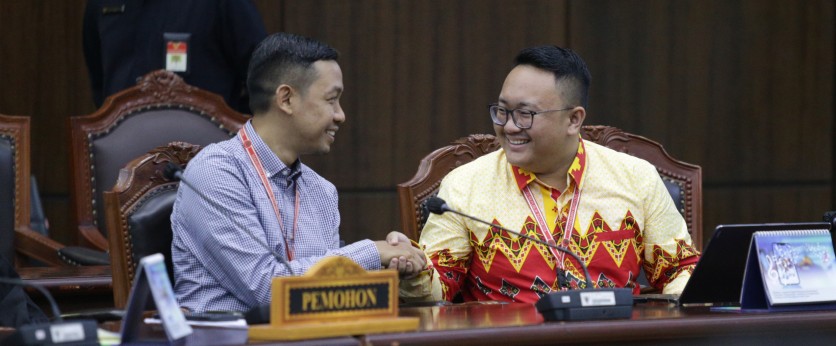
The Petitioners at the ruling hearing for the judicial review of the Parliament Law for case No. 169/PUU-XXII/2024, Thursday (10/30/2025). Photo by MKRI/Bayu.
JAKARTA (MKRI) — In its ruling, the Constitutional Court (MK) emphasized that members and leadership of parliamentary bodies (AKD) in the House of Representatives (DPR) must guarantee women’s representation proportionally, said Deputy Chief Justice Saldi Isra at the ruling hearing for Decision No. 169/PUU-XXII/2024 on Thursday, October 30, 2025, alongside Chief Justice Suhartoyo and six other constitutional justices.
The Court handed down a verdict granting all petitums of Petitioners I, II, and IV. It holds that several articles in Law No. 17 of 2014 on the People’s Consultative Assembly (MPR), House of Representatives (DPR), Regional Representatives Council (DPD), and Regional Legislative Council (DPRD) and Law No. 2 of 2018 on the Second Amendment to Law No. 17 of 2014—also known as the MD3 Law—is conditionally unconstitutional and not legally binding insofar as they are not interpreted to include women’s representation based on proportionality and equal distribution of female members in each parliamentary faction.
The following are the key points of the Decision No. 169/PUU-XXII/2024:
- The Court granted in full the petition of Petitioner I, Petitioner II, and Petitioner IV.
- The Court declared Article 90 paragraph (2) of the MD3 Law inconsistent with the 1945 Constitution and conditionally unconstitutional insofar as it is not interpreted as: “The membership of the Deliberative Body shall be a maximum of 1/10 (one-tenth) of the total members of the House of Representatives, proportionally based on the number of members of each faction, and shall include women’s representation based on proportionality and equal distribution of female members in each faction as determined by the plenary session.”
- The Court declared Article 96 paragraph (2) of the MD3 Law inconsistent with the 1945 Constitution and conditionally unconstitutional insofar as it is not interpreted as: “The number of members of a commission shall be determined in the plenary session in proportion to and equally distributed among the members of each faction, and shall include women’s representation based on proportionality and equal distribution of female members in each faction at the beginning of the membership term, the beginning of the session year, and at each session period.”
- The Court declared Article 103 paragraph (2) of the MD3 Law inconsistent with the 1945 Constitution and conditionally unconstitutional insofar as it is not interpreted as: “The membership of the Legislative Body shall be at most 2 (two) times the number of members of a commission, reflecting both the factions and the commissions, and shall include women’s representation based on proportionality and equal distribution of female members in each faction.”
- The Court declared Article 108 paragraph (3) of the MD3 Law inconsistent with the 1945 Constitution and conditionally unconstitutional insofar as it is not interpreted as: “The composition and membership of the Budget Committee as referred to in paragraph (1) shall consist of members from each commission elected by the respective commissions, taking into account proportional representation and factional nominations, and shall include women’s representation based on proportionality and equal distribution of female members in each faction.”
- The Court declared Article 114 paragraph (3) of the MD3 Law inconsistent with the 1945 Constitution and conditionally unconstitutional insofar as it is not interpreted as: “The number of members of the Committee for Inter-Parliamentary Cooperation shall be determined in the plenary session of the House according to proportionality and equal distribution of members of each faction and shall include women’s representation based on proportionality and equal distribution of female members in each faction.”
- The Court declared Article 120 paragraph (1) of the MD3 Law inconsistent with the 1945 Constitution and conditionally unconstitutional insofar as it is not interpreted as: “The House shall establish the composition and membership of the House’s Ethics Council, consisting of all factions and taking into account proportionality and equal distribution of members of each faction, and shall include women’s representation based on proportionality and equal distribution of female members in each faction at the beginning of the membership term and the beginning of the session year.”
- The Court declared Article 151 paragraph (2) of the MD3 Law inconsistent with the 1945 Constitution and conditionally unconstitutional insofar as it is not interpreted as: “The membership of the Household Affairs Body shall consist of no more than 25 (twenty-five) members, nominated by commissions and factions based on proportionality and equal distribution of members of each faction in the commissions, and shall include women’s representation based on proportionality and equal distribution of female members in each faction as determined by the plenary session of the House.”
- The Court declared Article 157 paragraph (1) of the MD3 Law inconsistent with the 1945 Constitution and conditionally unconstitutional insofar as it is not interpreted as: “The House shall determine the composition and membership of special committees based on proportionality and equal distribution of members of each faction and shall include women’s representation based on proportionality and equal distribution of female members in each faction.”
- The Court declared Article 427E paragraph (1) letter b of the MD3 Law inconsistent with the 1945 Constitution and conditionally unconstitutional insofar as it is not interpreted as: “The leadership of the commissions, the Legislative Body, the Budget Committee, the Committee for Inter-Parliamentary Cooperation, the House’s Ethics Council, and the Household Affairs Body shall consist of one chairperson and no more than four deputy chairpersons, elected from and by the members of the respective bodies based on the principle of deliberation for consensus and proportionality according to the balance of members in each faction, and shall include at least 30% (thirty percent) women’s representation.”
- The Court ordered the publication of this decision in the State Gazette of the Republic of Indonesia as appropriate.
- The Court declared the petition of Petitioner III inadmissible.
Affirmative Policy
At the ruling hearing chaired by Deputy Chief Justice Saldi Isra, the Court emphasized that affirmative action constitutes a “national consensus” to ensure the fulfillment of broader human rights as enshrined in the 1945 Constitution. The Court referred to Decision No. 22–24/PUU-VI/2008, which affirmed that affirmative action, as adopted from the Convention on the Elimination of All Forms of Discrimination Against Women (CEDAW), has been constitutionally recognized through Article 28H paragraph (2) of the 1945 Constitution.
The Court held that special treatment for women represents a form of substantive justice, given that, in reality, women remain underrepresented compared to men in almost all areas of governance. Therefore, the implementation of women’s representation quotas in political institutions is part of the realization of equality and justice as guaranteed by Article 28D paragraph (1) and Article 28H paragraph (2) of the 1945 Constitution.
“Therefore, if there is an imbalance among different groups, it is possible to introduce special measures to achieve equilibrium among those groups within the state. In this regard, Article 28H paragraph (2) of the 1945 Constitution stipulates that ‘every person shall have the right to receive facilities and special treatment to obtain equal opportunities and benefits in order to achieve equality and justice.’”
Women’s Representation
The Court affirmed that the legal policy of women’s representation has been part of Indonesia’s democratic system since the inclusion of the 30% minimum quota for women in the establishment and management of political parties as stipulated in the Political Party Law. This principle is also embodied in the fulfillment of women’s quotas in the list of legislative candidates at all levels of election.
In its considerations, the Court agreed with the Petitioners’ argument that politics of presence in each parliamentary body with focus areas would encourage women’s participation and contribution of perspectives unique to women (politics of ideas).
Moreover, Indonesia is among the countries committed to the Sustainable Development Goals (SDGs), which explicitly include gender equality and women’s empowerment as crucial global targets, one of which is to ensure full and equal participation of women in leadership at all levels of decision-making in political, economic, and public life.
Accordingly, the balanced and equitable inclusion of women members of the House of Representatives should be viewed as part of the national agenda to strengthen women’s political representation. Furthermore, women’s proportional presence in each parliamentary body facilitates collective efforts by female members to advocate for women’s rights across all areas of national life. To that end, institutional arrangements must be improved comprehensively, beginning from the recruitment of legislative candidates aligned with the capacities required in each parliamentary body.
“To ensure women’s representation in parliamentary bodies, practices must be established so that women’s representation is not concentrated within certain factions. In fact, it has been observed that some commissions have very few women, as female members are disproportionately assigned to commissions on social affairs, child protection, and women’s empowerment,” said Deputy Chief Justice Saldi.
Therefore, he continued, to ensure women’s balanced representation in all parliamentary bodies, the Court considers that concrete institutional and political mechanisms must be implemented. Two measures may be taken: first, the House may adopt strict internal rules (such as the Rules of Procedure) requiring each faction to assign female members in accordance with their capacity. If a faction has more than one representative in a parliamentary body, at least 30% of them must be women. Factions thus play a crucial role, as the composition of parliamentary bodies is determined by them. This can be achieved by establishing internal affirmative gender policies within each faction.
In this context, when appointing members to parliamentary bodies, factions must ensure proportional balance and equitable distribution of female members across commissions. Second, factions must also implement fair rotation and distribution so that female members are not confined to social, child protection, and women’s empowerment commissions but are also represented in commissions on economy, law, energy, defense, and other sectors. The House’s Deliberative Body also plays an important role in periodically evaluating the composition of parliamentary bodies and providing recommendations for adjustment if gender imbalance occurs among factions or commissions.
Based on these legal considerations, the Court concluded that the composition of parliamentary bodies—including the Deliberative Body, Commissions, Legislative Body, Budget Committee, Committee for Inter-Parliamentary Cooperation, Ethics Council, Household Affairs Body, and special committees—must include women’s representation based on proportionality and equal distribution of female members in each faction. Therefore, the Court found the Petitioners’ arguments concerning the unconstitutionality of Article 90 paragraph (2), Article 96 paragraph (2), Article 103 paragraph (2), Article 108 paragraph (3), Article 114 paragraph (3), Article 120 paragraph (1), and Article 151 paragraph (2) of Law No. 17 of 2014 legally well-founded.
Affirmative Measures in Parliamentary Bodies
Furthermore, the Court held that the proportional representation of women in the leadership of parliamentary bodies brings perspectives of gender equality and justice into the legislative policymaking process. However, when leadership positions are filled through election from among members in a single package proposed by factions through deliberation for consensus, without regard to the 30% minimum quota for women, the implementation of women’s representation becomes neglected.
Under the current regime of the MD3 Law, any member of a parliamentary body may nominate themselves for leadership based on deliberation for consensus. If this process results in the absence of women leaders, it creates a condition where women are dominated by men. This, in turn, makes the implementation of women’s representation in leadership positions difficult to achieve. Therefore, the absence of a provision requiring at least 30% of leadership positions in parliamentary bodies to be held by women is unconstitutional. Conversely, such a quota provides fair legal certainty, as the 30% formula is measurable and clear in its implementation.
Also read:
Women Representation in Parliamentary Apparatuses Questioned
Constitution Disobedience in the Arrangement of Women's Representation in the Parliamentary Apparatuses
Govt Response to Petition on Female Representation in Parliamentary Apparatuses
Experts Talks the Need to Increase Women’s Representation in Parliament
The case No. 169/PUU-XXII/2024 was filed by the Indonesian Women Coalition, the Association for Elections and Democracy (Perludem), Kalyanamitra, and Titi Anggraini. They argued that provisions in the Law had factually harmed the Petitioners’ constitutional rights, especially in relation to women’s representation in legislative institutions. They highlighted the low women representation in the leadership of parliamentary bodies (AKD), which is still under 30 percent for the 2024-2029 term.
Author : Utami Argawati
Editor : N. Rosi
PR : Fauzan F.
Translator : Yuniar Widiastuti (NL)
Disclaimer: The original version of the news is in Indonesian. In case of any differences between the English and the Indonesian versions, the Indonesian version will prevail.
Thursday, October 30, 2025 | 14:43 WIB 736