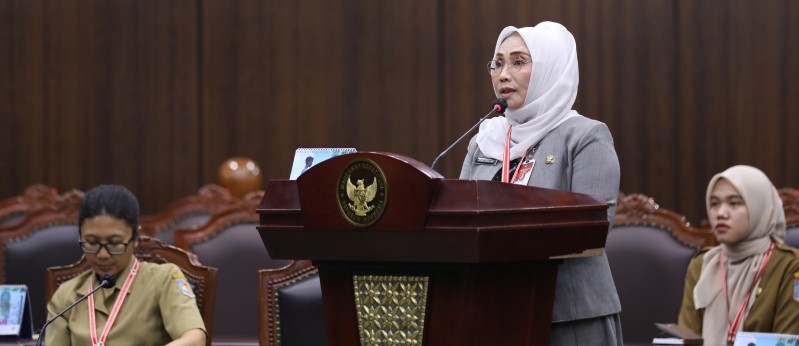
Acting advisor for government administration to the Ministry of Home Affairs Rochayati Basra testifying on behalf of the Government at a judicial review hearing of the Parliament Law, Tuesday (6/24/2025). Photo by MKRI/Ifa.
JAKARTA (MKRI) — The Constitutional Court (MK) held the fourth judicial review hearing of Law No. 17 of 2014 on the People’s Consultative Assembly (MPR), House of Representatives (DPR), Regional Representatives Council (DPD), and Regional Legislative Council (DPRD), also known as the MD3 Law, on Tuesday, June 24, 2025. The case No. 169/PUU-XXII/2024 was filed by the Indonesian Women Coalition, the Association for Elections and Democracy (Perludem), Kalyanamitra, and Titi Anggraini.
The Petitioners argue that provisions in the Law have factually harmed their constitutional rights, especially in relation to women’s representation in legislative institutions. They highlighted the low women’s representation in the leadership of parliamentary apparatuses (AKD), which is still under 30 percent for the 2024-2029 term.
They challenge Article 90 paragraph (2), Article 96 paragraph (2), Article 108 paragraph (3), Article 120 paragraph (1), Article 151 paragraph (2), and Article 157 paragraph (1) of Law No. 17 of 2014 on MD3. They proposed that the provisions be interpreted to create balance in the composition of women members in House bodies and commissions, such as the deliberative body, the legislative body, and the budget body, where the minimum women representation is 30 percent.
Filling Parliamentary Apparatuses’ Vacancies
Before Deputy Chief Justice Saldi Isra and the other constitutional justices, representing the Government, acting advisor for government administration to the Ministry of Home Affairs Rochayati Basra emphasized that Indonesia, as a rule of law, guarantees the protection of human rights, including the increase of women’s representation in parliament through a 30-percent affirmative action policy.
“This affirmative action policy constitutes a form of special treatment that is constitutional, as provided for in Article 27 paragraph (1) and Article 28H paragraph (2) of the 1945 Constitution, and also serves as the implementation of international human rights conventions that Indonesia has ratified,” she explained.
However, she stressed that affirmative action must not conflict with the principle of popular sovereignty, which forms the foundation of a democratic state. The Government maintained that the allocation of positions within the House’s apparatuses is an internal matter that should be proportionally aligned with the respective party factions, and is not intended to hinder women’s representation.
Selection Based on Meritocracy
Basra further explained that the provisions of the MD3 Law grant factions the flexibility to appoint parliamentary apparatus leadership based on meritocracy—that is, based on competence and integrity, rather than solely on gender.
“If the 30-percent quota were to be applied rigidly, despite the fact that the number of female members in the House has yet to reach that threshold, it would pose practical challenges in its implementation. Therefore, it would be more appropriate to regulate women’s quota in more general legislation, such as the Election Law or the Political Party Law,” she stated.
She emphasized that the absence of a specific provision on women’s representation in the MD3 Law does not preclude women from assuming leadership roles within the House. On the contrary, it creates broader opportunities based on individual capability and quality.
Fostering Women in Politics
According to the Government, increasing women’s representation in the House would be more effectively achieved through strengthening the role of political parties in preparing competent female aspirants. Relying solely on quotas is deemed insufficient to bring about substantive political change.
“Women must be systematically prepared through political education and leadership training so that their presence in parliament is not merely symbolic, but genuinely impactful in influencing the direction of policymaking,” Basra asserted.
Also read:
Women Representation in Parliamentary Apparatuses Questioned
Constitution Disobedience in the Arrangement of Women's Representation in the Parliamentary Apparatuses
At the preliminary hearing on Tuesday, December 10, 2024, the Petitioners argued that provisions in the Law had factually harmed their constitutional rights, especially in relation to women’s representation in legislative institutions. They highlighted the low women representation in the leadership of parliamentary apparatuses (AKD), which is still under 30 percent for the 2024-2029 term.
The Petitioners argue against two issues: arrangement on women representation in AKD leadership and the distribution of AKD women members proportionally following the number of women in each faction. They also proposed that the provisions be interpreted to create balance in the composition of women members in House bodies and commissions, such as the deliberative body, the legislative body, and the budget body, where the minimum women representation is 30 percent.
The Petitioners believe the imbalance reflects structural constraints that hinder inclusive women participation in politics. They hope the Constitutional Court declare those articles in Law No. 17 of 2014 unconstitutional and necessitate an interpretation that guarantee women representation in parliament.
Author : Utami Argawati
Editor : N. Rosi
PR : Fauzan F.
Translator : Yuniar Widiastuti (NL)
Disclaimer: The original version of the news is in Indonesian. In case of any differences between the English and the Indonesian versions, the Indonesian version will prevail.
Tuesday, June 24, 2025 | 12:39 WIB 287