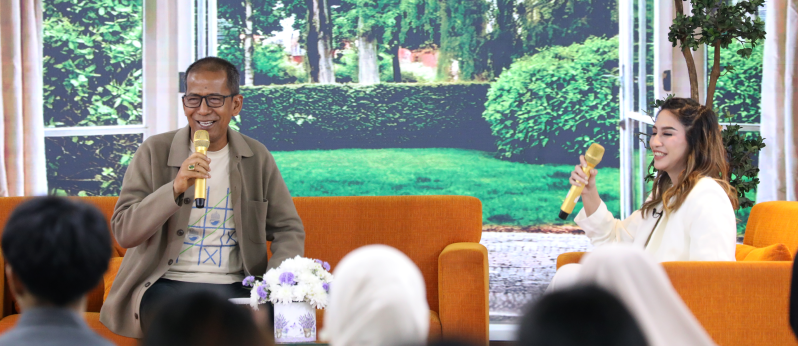
The Court’s fourth “Ngopi Bareng Courtizen” on “Can Young People Change the Country’s Direction?” featuring Deputy Chief Justice Saldi Isra, Tuesday (10/28/2025). Photo by MKRI/Fauzan.
JAKARTA, MKRI — To commemorate Youth Pledge Day, the Constitutional Court (MK) held its fourth informal meetup “Ngopi Bareng Courtizen Edition 4” (literal translation: “drinking coffee together with courtizens”) under the theme “Can Young People Change the Country’s Direction?” at its main building on Tuesday, October 28, 2025. The forum served as a platform for dialogue between the Court and the younger generation, especially its social media followers and law enthusiasts—to strengthen constitutional and democratic literacy while reinforcing national spirit. This program aims to bring the Court closer to the public by raising awareness that the Constitution is not only a legal foundation, but also a guide for life as a nation and state.
Deputy Chief Justice Saldi Isra and author Okki Sutanto delivered keynote speeches. They shared their perspectives on the importance of youth involvement in shaping the country’s future and upholding constitutional values amid rapid global changes.
In the dialogue moderated by news personality Fanni Imaniar, Deputy Chief Justice Saldi Isra highlighted the growing participation of young people in filing judicial review petitions to the Court.
“When I first started serving, almost no young people filed judicial review petitions. But today, more and more are courageous enough to come to the Court and advocate for constitutional issues relevant to the public,” he said.
He cited several young figures who played a key role in fostering a new awareness that the Constitutional Court serves as a space for citizens to uphold the Constitution. He referred specifically to Constitutional Court Decision No. 62/PUU-XXII/2024, which annulled the presidential threshold. After more than 30 petitions had been submitted by various groups, the provision in Law No. 7 of 2017 on General Elections was declared unconstitutional following a petition filed by a group of university students.
“Those 30 petitions were all rejected by the Court, but then came a wave of change. A group of young people from Sunan Kalijaga State Islamic University Yogyakarta submitted a petition, and it was granted. For the first time in the Court’s history, the presidential threshold was declared unconstitutional,” he explained.
Deputy Chief Justice Saldi Isra said this reflects a shift in how the Court views democratic and constitutional issues. “Perhaps internal developments within the Constitutional Court have also brought clearer understanding of presidential threshold regulations,” he added.
He noted that young people are now more confident in voicing their aspirations through constitutional petitions. “The process is now far more open. There is no longer any barrier or obstacle, no excuse that Jakarta is too far to reach the Constitutional Court,” he stated, adding that the Court continues to improve its accessibility. “Cases can be filed online, and hearings can be attended virtually. Distance is no longer a barrier for youth participation,” he emphasized.
Youth: Critical, Engaged, Adaptive
Author and speaker Okki Sutanto observed that young people today show increasing political and social participation, particularly through social media and community research.
“Youth are no longer mere observers, they are active agents of social change influencing the direction of public policy,” he said.
Drawing from his experience in the Bijak Memilih campaign, which promotes youth involvement in local elections, Okki stressed that critical and idealistic youth leadership has always been part of Indonesia’s history.
“From the era of Kartini and Soekarno to the Youth Pledge generation, young people have always been at the forefront,” he stated.
Okki highlighted the importance of literacy and empathy. “Read widely, and engage with diverse communities. That is how we learn empathy and understand others’ struggles. With knowledge and concern for others, young people can grow into a generation with wisdom and strong character,” he said.
He also commended the Court’s efforts to reach out to youth. “The Court’s initiatives to educate and engage young people are good, but should continue expanding so more youths understand the Court’s important role. Success stories of judicial review filed by youth should be highlighted more often as a source of inspiration,” he concluded.
Learning Directly from the Court
In addition to the discussion session, participants referred to as courtizens also had the opportunity to directly observe a plenary session of the Constitutional Court. They were invited to understand how constitutional judicial proceedings are carried out transparently and professionally.
They also joined a guided tour of the Constitution History Center, learning about Indonesia’s constitutional development through historical documents, archives, and interactive multimedia exhibits. Their enthusiasm was evident as they traced key milestones from the drafting of the 1945 Constitution to the evolution of modern constitutional law.
During a session in the Cinema Room, head of the Public Relations and Protocol Bureau Pan Mohamad Faiz Kusuma Wijaya explained the Court’s role in Indonesia’s constitutional system.
“Since its establishment in 2003, filing petitions with the Court has been completely free of charge. Today, the entire process can be done online, including case registration and access to hearings via streaming,” he said.
The Court Without a Fence
Faiz also explained the architectural philosophy behind the fence-less Court building. “A building without a fence reflects the Court’s openness to the public and its commitment to transparency. The nine pillars in front symbolize the nine constitutional justices who guard the institution’s integrity,” he stated.
He emphasized the Court’s commitment to safeguarding the rule of constitutional law, especially in resolving election disputes.
“The Constitutional Court is the final authority for election disputes. Therefore, we must ensure elections are honest, fair, and dignified. The Court bears an immense responsibility because its decisions shape the direction of the nation,” he said.
Inspiring Constitutional Awareness in Youth
Throughout the event, participants actively voiced their ideas and questions. Many students said they gained a deeper understanding of the Constitution, not only as a legal document, but as a moral guide for national life.
Through this fourth “Ngopi Bareng Courtizen,” the Constitutional Court hoped that the spirit of Youth Pledge Day continues to inspire young Indonesians to strengthen democracy and uphold constitutional values nationwide.
Author : Utami Argawati
Editor : Lulu Anjarsari P.
Translator : Aski V. Rumere/YW
Disclaimer: The original version of the news is in Indonesian. In case of any differences between the English and the Indonesian versions, the Indonesian version will prevail.
Tuesday, October 28, 2025 | 17:36 WIB 277