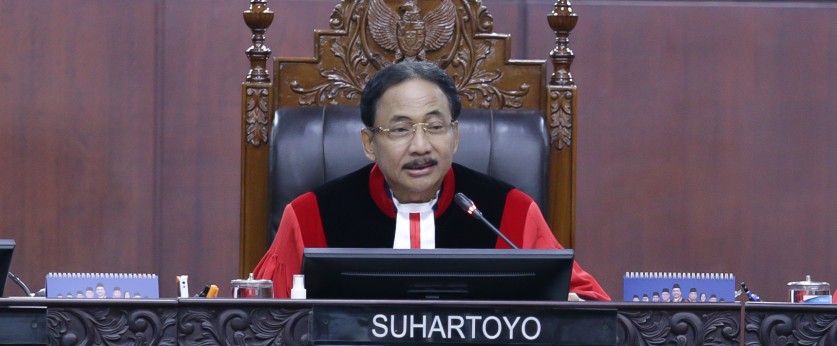
Chief Justice Suhartoyo delivered the verdict for case No. 62/PUU-XXII/2024 on the judicial review of the Election Law, Thursday (1/2/2025). Photo by MKRI/Bayu.
JAKARTA (MKRI) —The threshold for proposing a presidential ticket (presidential threshold) as stated in Article 222 of Law No. 7 of 2017 on General Elections (Election Law) is not only considered a violation of political rights and sovereignty of the people but also of morality, rationality, and reflects intolerable injustice and is unconstitutional. This reason is the basis for the Court’s shift from its stance in previous decisions on to the judicial review of the presidential threshold.
“The shift does not only concern the amount or percentage of the threshold but what is far more fundamental is that the threshold for proposing presidential and vice-presidential candidates (presidential threshold), regardless of the amount or percentage, violates Article 6A paragraph (2) of the 1945 Constitution of the Republic of Indonesia,” said Deputy Chief Justice Saldi Isra when reading out the legal considerations for Case No. 62/PUU-XXII/2024.
The ruling hearing was held on Thursday, January 2, 2025 in the plenary courtroom. The Court held that the Petitioners’ petition on the unconstitutionality of the provision on presidential threshold legally-grounded.
“[The Court] declares the norm of Article 222 of Law No. 7 of 2017 on General Elections (State Gazette of the Republic of Indonesia of 2017 No. 182, Supplement to State Gazette of the Republic of Indonesia No. 6109) contradict the 1945 Constitution of the Republic of Indonesia and have no binding legal force,” said Chief Justice Suhartoyo alongside the other eight constitutional justices.
Voters’ Constitutional Rights Limited
In its legal considerations, the Court asserted that it found that several presidential elections had been dominated by certain political parties that nominated presidential tickets. This could limit the voters’ constitutional right to have acceptable presidential ticket alternatives.
In addition, upon carefully observation of Indonesia’s recent politics, where the presidential threshold had always been maintained, the Court believes that there is a tendency to keep only two presidential tickets in the election.
This is despite the fact that the public had always been easily polarized since the first direct presidential election. If not anticipated, this could threaten Indonesia’s unity in diversity. If this arrangement continued, the presidential election may only see a single presidential ticket. Such a trend can be seen in the regional elections, where single candidates or empty boxes emerge from time to time.
The Court believes maintaining the presidential threshold under Article 222 of the Election Law could potentially restrict the implementation of direct presidential elections by the people where voters can choose from among many alternatives of presidential tickets.
“If that happens, the real meaning of Article 6A paragraph (1) of the 1945 Constitution will be lost or at least shifted from one of the objectives of the constitutional amendment, that is to perfect the basic rules on the guarantee of the implementation of popular sovereignty and to improve public participation to keep up with the development of democracy,” Deputy Chief Justice Saldi stated.
Number of Presidential Tickets
Furthermore, the Court also considered that even though the norm on the presidential threshold in Article 222 of the Election Law had been declared unconstitutional, as a country with a presidential system where there are multiple parties, the potential number of presidential tickets and political parties participating in the election must still be taken into account.
However, in its legal considerations for this decision, the Court affirmed that the nomination of presidential tickets is a constitutional right for all political parties participating in the relevant election. In the revision of the Election Law, the legislatures can regulate so that there are not too many tickets, which could potentially undermine the implementation of the direct presidential election.
The Court also considered that although constitutionally Article 6A paragraph (4) of the 1945 Constitution has anticipated the possibility of a second round of presidential election, the number of presidential tickets does not guarantee a positive impact on the development and sustainability of Indonesia’s presidential democratic processes and practices.
Constitutional Engineering
In this decision, the Court also provides guidelines for the legislatures to conduct constitutional engineering to prevent the emergence of too many presidential tickets by close examination of the following matters:
First, all political parties participating in the election have the right to propose a presidential and vice-presidential candidate pair.
Second, the nomination of a presidential ticket by a political party or a coalition of political parties participating in the election is not based on a percentage of the number of seats in the House of Representatives (DPR) or the acquisition of valid votes nationally.
Third, in proposing a presidential ticket, political parties participating in the election may join as long as the coalition participating in the election does not lead to the dominance of any political party, which leads to limited presidential tickets and limited choices for voters.
Fourth, political parties participating in the election that do not propose a presidential ticket are subject to prohibition from participating in the next election.
Fifth, the formulation of the intended constitutional engineering, including changes to the Election Law, involves the participation of all parties who have a concern for the implementation of elections, including political parties that do not gain seats in the House, by applying the principle of meaningful public participation.
Based on the legal considerations above, the Court held that Article 222 of the Election Law not in line with the principles of equality before the law, the right of collective action, and fair legal certainty under Article 27 paragraph (1), Article 28C paragraph (2), Article 28D paragraph (1), and Article 28I paragraph (2) of the 1945 Constitution of the Republic of Indonesia. Therefore, according to the Court, the Petitioners’ arguments are legally justified in their entirety. However, two constitutional justices had dissenting opinions on the case.
Also read:
Four Students Revise Petition on Open Legal Policy and Presidential Threshold
Four Lecturers Propose New Interpretations of Presidential Threshold
Gerindra, PKB Rejects Petition Requesting Change to Presidential Threshold
Petitioners’ Expert: Presidential Threshold Undemocratic
The petition was filed by four students of the Sharia and Law Faculty of the State Islamic University (UIN) Sunan Kalijaga, i.e. Enika Maya Oktavia and friends. They argued that the principle of “one man, one vote, one value” has been disregarded by the presidential threshold. The “one value” principle is flouted because votes are not necessarily equal. Ideally, votes follow the period of the election. However, in the case of the presidential threshold, votes are used for two elections, which could lead to the distortion of representation in democracy. Therefore, this shows an imbalance or deviation from the periodic principle where the value of votes should follow each election period proportionally.
Three other petitions also challenged the presidential threshold: No. 129/PUU-XXI/2023 by Gugum Ridho Putra, No. 87/PUU-XXII/2024 by four lecturers (former Bawaslu chairman Muhammad, Dian Fitri Sabrina, S. Muchtadin Al Attas, and Muhammad Saad), No. 101/PUU-XXII/2024 by the Network for Democracy and Electoral Integrity (Netgrit) represented by Hadar Nafis Gumay and Titi Anggraini.
The decision can be accessed here.
Author : Lulu Anjarsari P.
Editor : A. Dodi Haryadi
PR : Fauzan Febriyan
Translator : Dinita Oktavia/Yuniar Widiastuti (NL)
Disclaimer: The original version of the news is in Indonesian. In case of any differences between the English and the Indonesian versions, the Indonesian version will prevail.
Thursday, January 02, 2025 | 15:48 WIB 4450