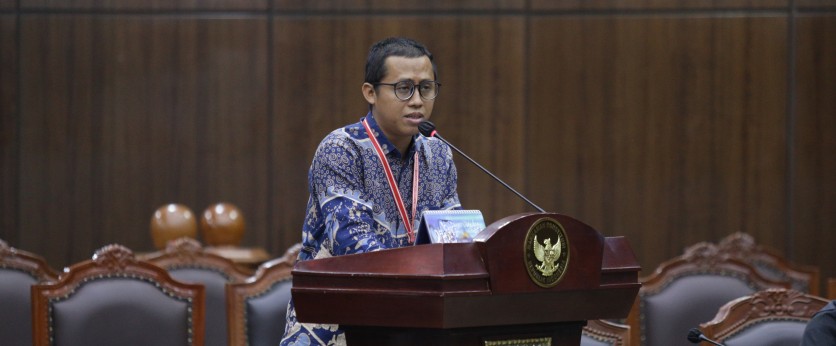
Session for cases No. 135/PUU-XXIII/2025 and No. 137/PUU-XXIII/2025 on the Personal Data Protection Law to hear the Petitioners’ witness and expert, Wednesday (10/22/2025). Photo by MKRI/Bayu.
JAKARTA (MKRI) — Journalist and head of the East Nusa Tenggara (NTT) Bureau of Metro Rakyat.com Markus Erasmus Tengajo testified as a witness for Petitioners of case No. 135/PUU-XXIII/2025 on the judicial review of Article 65 paragraph (2) in conjunction with Article 67 paragraph (2) of Law No. 27 of 2022 on Personal Data Protection (PDP Law). He shared his reporting experience that ultimately led to legal proceedings and his detention at the West Manggarai Resort Police.
“I was detained for ten days until the case was settled through reconciliation, or what the Police referred to as restorative justice, in which the complainant withdrew their police report while I was asked never to broadcast my investigative work that had become the subject of dispute. I agreed to this given the pressure I had experienced and the need to return to work as soon as possible,” Tengajo said at the hearing, which he attended virtually, on Wednesday, October 22, 2025.
He recounted that around late 2023 to early 2024, he and his media team conducted an in-depth investigation into allegedly illegal mining activities in Komodo District, West Manggarai Regency. Before the report was published, he received information that the company involved objected to the materials gathered for publication.
Around February 2024, Tengajo received a summons from the West Manggarai Police to appear as a witness in a case on the alleged disclosure of another person’s personal data. The first summons was issued on March 1, 2024, and he complied with it, alongside several other journalists.
Then, in August 2024, he received another summons—this time for questioning as a suspect. He was charged with a violation of Article 65 paragraph (2) in conjunction with Article 67 paragraph (2) of the PDP Law on the grounds that he had unlawfully disclosed another person’s personal data. He was subsequently detained at the West Manggarai Police Headquarters.
“While in detention, I was placed with other detainees in a confined space. I experienced psychological distress because I felt that my journalistic work should not be treated as a criminal offense,” Tengajo stated.
He explained that fellow journalists, professional organizations, and the Nusa Komodo Legal Aid Institute (LBH) came to the West Manggarai Police to provide legal assistance. They also submitted a formal objection to his detention and requested that the case be referred to the Press Council, in accordance with the mechanism for resolving journalistic disputes stipulated in the memoranda of understanding (MoU) between the Press Council and the Indonesian National Police, No. 2/III/2017 and 3/III/2017.
However, at that time, the Police continued with the legal process. Tengajo said that the legal aid institute viewed his detention as evidence of the authorities’ non-compliance with law enforcement guidelines concerning the press and urged the chief of police to take corrective measures. Similar support came from journalist communities in Flores and Kupang, who considered the detention a threat to press freedom.
“I do not intend to offer any legal opinion regarding the article being reviewed, as that is beyond my capacity as a witness. However, I hope my experience can serve as a concrete illustration of how the application of this provision has led to someone performing legitimate journalistic duties facing detention and a taxing legal process,” Tengajo emphasized.
At today’s hearing, the Constitutional Court (MK) also heard the testimony of Indra Rahmatullah, a lecturer at Syarif Hidayatullah State Islamic University Jakarta, as an expert for the Petitioner of case No. 137/PUU-XXIII/2025 on the judicial review of Article 56 paragraphs (1), (2), (3), and (4) of the PDP Law. Indra explained that, according to the General Data Protection Regulation (GDPR), the transfer of personal data outside the European Union (EU) or the European Economic Area (EEA) may only be conducted if the protection mechanisms guarantee a level of data protection equivalent to that in the EU, including adequacy decisions, sufficient safeguards, and specific exceptions.
Before the enactment of the PDP Law in Indonesia, two subordinate regulations already addressed this matter: Government Regulation No. 80 of 2019 on Trade through Electronic Systems, and Bank Indonesia Regulation No. 23/6/PBI/2021 on Payment Service Providers. After the enactment of the PDP Law, cross-border data transfer was regulated under Article 56. However, to date, the implementing government regulation has not yet been issued. As a result, cross-border personal data transfer continues to create legal uncertainty and inadequate legal protection for data subjects.
“[I believe] various countries have adopted different policies to regulate the terms and conditions for cross-border personal data transfers, which poses a challenge for Indonesia in strengthening digital sovereignty, as developing countries are generally in a more vulnerable and weaker position compared to developed nations,” Indra added.
Also read:
Journalists, Illustrator Seek Exception from Ban on Personal Data Disclosure
Petitioners: Cross-Border Personal Data Transfer Poses Greater Risk
Ministry: Ban on Personal Data Disclosure Does Not Restrict Journalists, Scholars, Artists
Ban on Personal Data Disclosure in PDP Law Requires Strict Interpretation
The Petitioners in case No. 135/PUU-XXIII/2025 are academic Prof. Masduki, illustrator/cartoonist Amry Al Mursalaat, the Alliance of Independent Journalists (AJI) Indonesia, and the Southeast Asia Freedom of Expression Network (SAFEnet), who are members of civil society coalition for freedom of information and personal data operating under the name SIKAP. They challenge Article 65 paragraph (2) and Article 67 paragraph (2) of the PDP Law, which they believe have allowed for broad and imprecise interpretation, posing a threat to their constitutional rights, as their professional activities often require the disclosure of personal data in order to fulfil the public’s right to information.
Meanwhile, the Petitioner of case No. 137/PUU-XXIII/2025, lawyer and law lecturer Rega Felix, challenges Article 56 paragraphs (1), (2, (3) and (4) of the PDP Law. He contends that these provisions fail to recognize popular sovereignty as the true owner of personal data sovereignty, treating the transfer of personal data merely as a technical matter without acknowledging its far-reaching impact on citizens’ lives.
The petition is prompted by an agreement between the Government of Indonesia and the United States concerning the transfer of citizens’ personal data as part of a reciprocal trade agreement. According to the Petitioner, if the Government interprets Article 56 of the PDP Law unilaterally, it could result in broad and fundamental constitutional harm to the Indonesian people, including the Petitioner, in violation of Article 28G paragraph (1) of the 1945 Constitution.
Author : Mimi Kartika
Editor : Lulu Anjarsari P.
PR : Tiara Agustina
Translator : Yuniar Widiastuti (NL)
Disclaimer: The original version of the news is in Indonesian. In case of any differences between the English and the Indonesian versions, the Indonesian version will prevail.
Wednesday, October 22, 2025 | 13:05 WIB 315