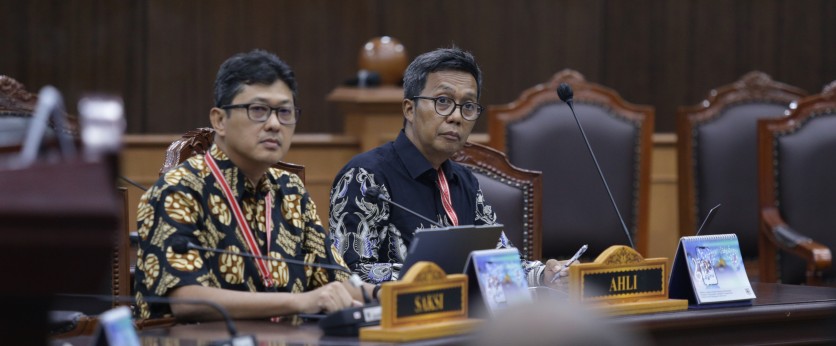
Experts testifying for cases No. 135/PUU-XXIII/2025 and No. 137/PUU-XXIII/2025 on the Personal Data Protection Law, Wednesday (10/8/2025). Photo by MKRI/Bayu.
JAKARTA (MKRI) — The Constitutional Court (MK) held the fourth hearing for the material judicial review of Article 65 paragraph (2) and Article 67 paragraph (2) of Law No. 27 of 2022 on Personal Data Protection (PDP Law) to present the testimonies of experts/witness of Petitioners of case No. 135/PUU-XXIII/2025 on Wednesday, October 8, 2025 in the plenary courtroom. Criminal law expert of Bina Nusantara University Ahmad Sofian and constitutional law expert of Gajah Mada University Herlambang Perdana Wiratraman testified as experts.
Ahmad stated that a strict and clear (lex stricta) interpretation by the Constitutional Court is necessary to prevent misinterpretation of Article 65 paragraph (2) in conjunction with Article 67 paragraph (2) of the PDP Law. Such interpretation must ensure that the acts deemed unlawful under both provisions are understood as acts unlawful in the formal sense within criminal law, and that individuals exempted under the PDP Law or other laws, when disclosing another person’s personal data, cannot be categorized as committing a criminal act and therefore cannot be prosecuted.
“So long as Law No. 27 of 2022 on Personal Data Protection and other laws stipulate that the act of disclosing another person’s personal data does not constitute an unlawful act, the subjects of the offense cannot be criminally charged for disclosing such data,” Ahmad added.
Article 65 paragraph (2) of the PDP Law reads: “Any person is prohibited from unlawfully disclosing Personal Data that does not belong to them.” Article 67 paragraph (2) states: “Any person who intentionally and unlawfully discloses Personal Data that does not belong to them as referred to in Article 65 paragraph (2) shall be subject to imprisonment of up to 4 (four) years and/or a fine of up to Rp4,000,000,000.00 (four billion rupiah).”
Ahmad noted that while Articles 15 paragraph (1), 20 paragraph (2) letter e, and 50 of the PDP Law provide exceptions for the processing of personal data, these articles pose difficulties for law enforcement officers in relating them to the criminal provisions in Article 65 paragraph (2) in conjunction with Article 67 paragraph (2) of the same law. These provisions are not automatically applied when a criminal report is filed concerning an alleged offense under Article 65 paragraph (2) in conjunction with Article 67 paragraph (2) of the PDP Law. Investigators may require significant time to interpret these provisions, creating potential for wrongful prosecution or what the public calls “criminalization.”
Similarly, Law No. 40 of 1999 on the Press, Law No. 12 of 2012 on Higher Education, and Law No. 5 of 2017 on the Advancement of Culture may serve as interpretive references to establish that the disclosure of personal data in the context of journalistic, academic, or artistic work cannot be deemed an unlawful act. These three laws, however, are not easily understood by law enforcement officers and often require expert interpretation when criminal reports are filed under Article 65 paragraph (2) in conjunction with Article 67 paragraph (2) of the PDP Law.
“There are differing interpretations regarding the element of unlawfulness itself, particularly concerning Article 65 paragraph (2) and Article 67 paragraph (2) of Law No. 27 of 2022 on Personal Data Protection,” said Ahmad.
Freedom of Press, Academia, and Arts
Kemudian, Herlambang Perdana Wiratraman mengatakan kerja jurnalis diberikan kebebasan melakukan upaya penelusuran informasi dalam rangka jurnalisme investigatif, tak terkecuali membongkar data pribadi. Pers dalam kerjanya, juga bukan tanpa batas, karena pers tunduk pembatasannya pada mekanisme hukum pers yang melandasi kerja-kerja jurnalistik berbasis Kode Etik Jurnalistik (KEJ), sebagai cerminan bersikap independen dan profesional, menghasilkan berita yang akurat, berimbang, dan tidak beritikad buruk.
Herlambang Perdana Wiratraman stated that journalists are granted the freedom to pursue information in the course of investigative journalism, including the disclosure of personal data. Nevertheless, journalistic activities are not without limits, as the press is bound by legal mechanisms based on the Journalistic Code of Ethics (KEJ), which upholds independence and professionalism and ensures that reporting is accurate, balanced, and conducted in good faith.
Herlambang added that journalists are obligated to verify information, remain balanced, refrain from judgment, and apply the presumption of innocence. Verifying information implies performing check and recheck on the accuracy of facts. The Journalistic Code of Ethics expressly addresses personal data protection in Article 9, which states: “Indonesian journalists respect a source’s right to privacy, except for matters of public interest.”
“With the press law framework grounded in the [Journalistic Code of Ethics], Articles 65 paragraph (2) and 67 paragraph (2) should be interpreted to exclude the phrase ‘unlawfully’ in relation to journalistic work, as this is meant to safeguard the right to freedom of the press,” said Herlambang.
He further argued that the concept of unlawfulness in connection with personal data under Article 65 paragraph (2) and Article 67 paragraph (2) of the PDP Law is irrelevant and inconsistent with the development of legal doctrine and the Surabaya Principles on academic freedom. Beyond legal reasoning, the theoretical foundation of human rights itself serves as the principal basis for advancing academic freedom, as it stems from scholarly traditions aimed at promoting humanity.
He also explained that the interpretive exclusion of Article 65 paragraph (2) and Article 67 paragraph (2) of the PDP Law should extend to artistic expression. As Eberle (2017) notes, art deserves protection because it advances knowledge and the pursuit of truth, represents an act of self-realization, enables scrutiny of government, and serves as a safety valve to release social or individual pressures.
Also read:
Journalists, Illustrator Seek Exception from Ban on Personal Data Disclosure
Petitioners: Cross-Border Personal Data Transfer Poses Greater Risk
Ministry: Ban on Personal Data Disclosure Does Not Restrict Journalists, Scholars, Artists
The Petitioners in case No. 135/PUU-XXIII/2025 are academic Prof. Masduki, illustrator/cartoonist Amry Al Mursalaat, the Alliance of Independent Journalists (AJI) Indonesia, and the Southeast Asia Freedom of Expression Network (SAFEnet), who are members of civil society coalition for freedom of information and personal data operating under the name SIKAP. They challenge Article 65 paragraph (2) and Article 67 paragraph (2) of the PDP Law, which they believe have allowed for broad and imprecise interpretation, posing a threat to their constitutional rights, as their professional activities often require the disclosure of personal data in order to fulfil the public’s right to information.
Meanwhile, the Petitioner of case No. 137/PUU-XXIII/2025, lawyer and law lecturer Rega Felix, challenges Article 56 paragraphs (1), (2, (3) and (4) of the PDP Law. He contends that these provisions fail to recognize popular sovereignty as the true owner of personal data sovereignty, treating the transfer of personal data merely as a technical matter without acknowledging its far-reaching impact on citizens’ lives.
The petition is prompted by an agreement between the Government of Indonesia and the United States concerning the transfer of citizens’ personal data as part of a reciprocal trade agreement. According to the Petitioner, if the Government interprets Article 56 of the PDP Law unilaterally, it could result in broad and fundamental constitutional harm to the Indonesian people, including the Petitioner, in violation of Article 28G paragraph (1) of the 1945 Constitution.
Author : Mimi Kartika
Editor : Lulu Anjarsari P.
PR : Tiara Agustina
Translator : Yuniar Widiastuti (NL)
Disclaimer: The original version of the news is in Indonesian. In case of any differences between the English and the Indonesian versions, the Indonesian version will prevail.a
Wednesday, October 08, 2025 | 13:59 WIB 2043