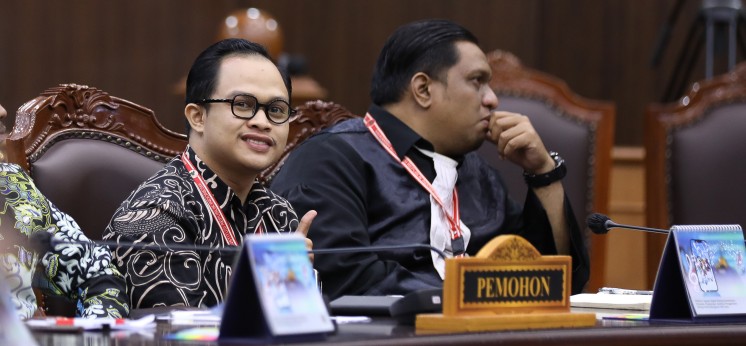
Petitioners’ legal counsel, Kafin Muhammad, of Case No. 9/PUU-XXIII/2025 attending the Decision Pronouncement Hearing of the judicial review of Law No. 11 of 2021 on the Attorney General’s Office, Thursday (16/10). Photo by MKRI/Ifa.
JAKARTA (MKRI) – The Constitutional Court (MK) declared two petitions for judicial review of Law No. 11 of 2021 on the Amendment to Law No. 16 of 2004 on the Attorney General’s Office of the Republic of Indonesia (AGO Law) inadmissible. The rulings—Decision No. 9/PUU‑XXIII/2025 and Decision No. 67/PUU‑XXIII/2025—were delivered during a plenary session on Thursday, October 16, 2025, in the Plenary Courtroom. The hearing was presided over by Chief Justice Suhartoyo, accompanied by eight other constitutional justices.
“The Court declares the petitioners’ petition inadmissible,” stated Chief Justice Suhartoyo when reading out the ruling.
Also read:
Prosecutors’ Immunity Right Conditionally Contradicts the 1945 Constitution
Loss of Object
In its legal considerations, the Court explained that both petitions concerned Article 8 paragraph (5) of the AGO Law, which stipulates that the summoning, examination, search, arrest, and detention of prosecutors may only be carried out with the approval of the Attorney General. However, this provision had already been reviewed and decided earlier under Case No. 15/PUU‑XXIII/2025, pronounced on October 16, 2025, in which the Court declared Article 8 paragraph (5) conditionally unconstitutional.
“Considering that, based on Constitutional Court Decision No. 15/PUU‑XXIII/2025, the norm in Article 8 paragraph (5) of the AGO Law has been declared conditionally unconstitutional and has binding legal force as of the pronouncement of that decision, the Court finds that the present petitions no longer have an object of review. Therefore, both petitions must be declared to have lost their object,” explained Justice Daniel Yusmic P. Foekh while reading out the Court’s legal considerations.
Consequently, Justice Daniel continued, the substance of the petitioners’ petitions would not be examined further.
Also read:
Petitioners Question Prosecutors’ Unlimited Immunity
Advocates Revise Petition on Prosecutors’ Immunity
Guaranteeing Legal Protection for Prosecutors and Their Families
Prosecutors Legal Protection Urgency
The Government, Police, Prosecutor’s Office, and Persaja on the Prosecutor’s Immunity Review
Supreme Court Highlights Potential Prosecutorial Impunity
Petitioners’ Expert Argues Unlimited Immunity Leads to Impunity
Potential Double-Standard Legal Treatment for Prosecutors
Permission from the Attorney General Hinders Law Enforcement
Prosecutors’ Distinct Characteristic Compared to General Civil Servants
Expert: Prosecutors’ Right to Immunity Is Limited
Case No. 9/PUU-XXIII/2025 was filed by advocates Agus Salim and Agung Arafat Saputra. They challenge Article 8 paragraph (5) of the Prosecution Law, which reads, “In exercising their duties and authority, summon, inspection, search, arrest, and detention against a prosecutor may only be executed with Attorney General’s approval.”
At the preliminary hearing on Wednesday, March 5, legal counsel Ibnu Syamsu Hidayat argued that the article has given prosecutors absolute immunity, thus could potentially hinder supervision and increase the risk of abuse of authority.
“The article has led to absolute immunity of prosecutors, so that control or supervision over the performance of prosecutors has become difficult. It could potentially lead to abuse of authority, ‘superpower’ practices, and even corruption acts. Therefore, there must be a clear limit on the right to immunity of law enforcement apparatuses,” Ibnu said.
The Petitioners compared the right to immunity of prosecutors and that of advocates, which is regulated under Article 16 of Law No. 18 of 2003 on Advocates. The article stipulates that advocates cannot be prosecuted either civilly or criminally in carrying out their professional duties in good faith for the defense of clients in court.
The Petitioners believe that there should also be a similar limit on the right to immunity of prosecutors in order to preserve the principle of equality before the law. “This phrase is highly catch-all and has no legal certainty. It makes it easy for something that prosecutors should not do to be claimed as something within the execution of their duties and authority,” Ibnu stressed.
Therefore, in the petitums, the Petitioners request that the Court grant their petition. They also ask that the Court declare Article 8 paragraph (5) of the Prosecution Law unconstitutional.
Also read:
Prosecutors’ Overlapping Authorities Questioned
Petitioners Strengthen Arguments on the Cause of Prosecutor’s Authority Overlap
Meanwhile, Case No. 15/PUU-XXIII/2025 was filed by activist/university student Agus Setiawan, advocate Sulaiman, and the Civil Youth Alliance (Perhimpunan Pemuda Madani). They challenge Article 11 paragraph (1) and paragraph (2), Article 30B letter a, Article 35 paragraph (1) letters g and letter e of the Prosecution Law. They argue that the articles are contrary to Article 30 paragraphs (3) and (4) of the 1945 Constitution. Under Article 11A of the Prosecution Law, the implementation of the prosecutor’s duties, as referred to in paragraph (1), may be conducted with concurrent positions as long as they relate to the competence and authority of the prosecutor. According to the Petitioners, this is contrary to Article 24 paragraphs (1) and (3) of the 1945 Constitution because the extension of the prosecutor’s duties to occupy or fill positions outside the prosecutorial institution undermines the freedom and independence of the institution.
“Authorizing the prosecutor to fill any position without a firm and clear regulation will make the Prosecution Office a multifunctional institution that causes damage to the independence of the Prosecution Office,” Agus Setiawan explained at the preliminary hearing on Thursday, March 3.
Article 35 paragraph (1) letter e of Law No. 21 of 2021 gives the authority to the attorney general to submit technical legal considerations to the Supreme Court in the cassation examination within the scope of general courts, state administrative courts, religious courts, and military courts. According to the Petitioners, the said attorney general’s authority was a form of legalized covert intervention through the interpretation of the phrase “legal technical.”
The Petitioners also questioned the extension of the prosecutor’s duties and authorities in Article 35 paragraph (1) letter g of the Prosecution Law to coordinate, control, and conduct investigation, examination, and prosecution of criminal offenses, which may lead to overlapping authorities. Sulaiman added that the prosecutors’ authority in the examination should be limited to specific criminal offenses stipulated under law and regulations.
Also read:
Advocates Question Disparity between Prosecutors and Other Law Enforcement Officials in Attorney General’s Office Law
Petition on Prosecutors’ Immunity Right Revised
Lastly, Petition No. 67/PUU-XXIII/2025 was filed by advocates Harmoko and Juanda. At the preliminary hearing on Friday, May 16, they argued that Article 8 paragraph (5) of the Prosecution Law has given prosecutors immunity, meaning prosecutors may commit a crime when carrying out their duties and exercising their authority. Meanwhile, summoning, examining, searching, arresting, and detaining may only be conducted with permission from the attorney general. According to the Petitioners, this article gave the prosecutor disparate treatment from other law enforcers, such as judges, police, and advocates. The norm was also deemed not to provide exceptions to the qualifications and types of crimes prosecutors may commit.
Meanwhile, despite having an immunity right, as stipulated in Article 16 of the Advocates Law and further emphasized by the Constitutional Court Decision No. 26/PUU-XI/2013, advocates must be examined and apprehended without written permission from the chairmen of advocate organizations or other parties when carrying out their professional duties in good faith but violating the law. With the different treatment, the provisions in Article 8 paragraph 5 of the Prosecution Law contradict Article 27 paragraph (1), Article 28D paragraph (1), and Article 28I paragraph (2) of the 1945 Constitution, which recognize the principle of equality before the law.
The Petitioners also request that the Court declare Article 8 paragraph (5) of Law No. 11 of 2021 on the Amendment to Law No. 16 of 2004 on the Prosecution unconstitutional and not legally binding as long as it is not interpreted as “In carrying out its duties and authorities, summoning, examination, searching, arresting, and detaining prosecutors can only be made with the written approval of the President and if the President does not give the written approval within a maximum period of 30 (thirty) days from the receipt of the application letter, the investigation process followed by detention can be carried out immediately.”
Author : Utami Argawati
Editor : N. Rosi
PR : Raisa Ayuditha Marsaulina
Translator : Rizky Kurnia Chaesario, Yuniar Widiastuti
Disclaimer: The original version of the news is in Indonesian. In case of any differences between the English and the Indonesian versions, the Indonesian version will prevail.
Thursday, October 16, 2025 | 19:10 WIB 294