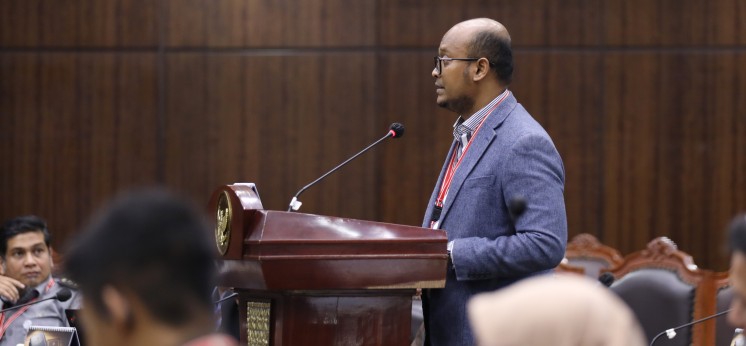
Jakarta (MKRI) – The Constitutional Court (MK) resumed the judicial review hearing of Law No. 11 of 2021 on the Amendment to Law No. 16 of 2004 on the Attorney General’s Office of the Republic of Indonesia (AGO Law) on Tuesday, July 15, 2025. The hearing was held in the Plenary Courtroom to hear testimony from the Supreme Court (MA) as a Related Party. It consolidated the examination of three cases: No. 9/PUU-XXIII/2025, No. 15/PUU-XXIII/2025, and No. 67/PUU-XXIII/2025.
Rizkiansyah Panca Yunior Utomo, Judicial Judge of the Legal and Public Relations Bureau of the Supreme Court, delivered the testimony. He highlighted several controversial provisions under the AGO Law, notably Article 8 paragraph (5), which stipulates that summons, examination, search, arrest, and detention of prosecutors can only be carried out with the Attorney General’s approval. He noted that while this aims to provide legal protection and uphold prosecutorial independence, its application must be strictly limited to prevent impunity. It should remain consistent with the rule of law and the principle of equality before the law.
Rizkyansyah also mentioned Article 11A paragraphs (1) and (3), which pertain to the assignment of prosecutors outside their prosecution duties. He clarified that such assignments must remain within the scope of prosecutors’ authority as openbaar ministerie, representing the interests of the state and society as outlined in Article 30. As such, the prosecutorial intelligence functions, as stipulated in Article 30B, must be interpreted as judicial intelligence, supporting law enforcement and justice based on Pancasila and the 1945 Constitution.
Furthermore, Rizkiansyah emphasized the importance of clear boundaries in the exercise of these powers, especially regarding the Attorney General’s authority to provide legal technical opinions at the cassation stage. This could open the door to intervention in judicial decisions.
In addition, Rizkiansyah also asserted that the Attorney General’s authority to coordinate, control, investigate, and prosecute cases involving both civil and military jurisdiction, as stipulated in Article 35 paragraph (1), cannot be interpreted as a domination over the other institutions. These powers must be viewed as a coordinative function of prosecutors acting as public prosecutors, rather than as a single, controlling authority over ongoing legal processes.
Also read:
Petitioners Question Prosecutors’ Unlimited Immunity
Advocates Revise Petition on Prosecutors’ Immunity
Guaranteeing Legal Protection for Prosecutors and Their Families
Prosecutors Legal Protection Urgency
The Government, Police, Prosecutor’s Office, and Persaja on the Prosecutor’s Immunity Review
Case No. 9/PUU-XXIII/2025 was filed by advocates Agus Salim and Agung Arafat Saputra. They challenge Article 8 paragraph (5) of the Prosecution Law, which reads, “In exercising their duties and authority, summon, inspection, search, arrest, and detention against a prosecutor may only be executed with Attorney General’s approval.”
At the preliminary hearing on Wednesday, March 5, legal counsel Ibnu Syamsu Hidayat argued that the article has given prosecutors absolute immunity, thus could potentially hinder supervision and increase the risk of abuse of authority.
“The article has led to absolute immunity of prosecutors, so that control or supervision over the performance of prosecutors has become difficult. It could potentially lead to abuse of authority, ‘superpower’ practices, and even corruption acts. Therefore, there must be a clear limit on the right to immunity of law enforcement apparatuses,” Ibnu said.
The Petitioners compared the right to immunity of prosecutors and that of advocates, which is regulated under Article 16 of Law No. 18 of 2003 on Advocates. The article stipulates that advocates cannot be prosecuted either civilly or criminally in carrying out their professional duties in good faith for the defense of clients in court.
The Petitioners believes that there should also be a similar limit on the right to immunity of prosecutors in order to preserve the principle of equality before the law. “This phrase is highly catch-all and has no legal certainty. It makes it easy for something that prosecutors should not do to be claimed as something within the execution of their duties and authority,” Ibnu stressed.
Therefore, in the petitums, the Petitioners requested that the Court grant their petition. They also asked that the Court declare Article 8 paragraph (5) of the Prosecution Law unconstitutional.
Also read:
Prosecutors’ Overlapping Authorities Questioned
Petitioners Strengthen Arguments on the Cause of Prosecutor’s Authority Overlap
Case No. 15/PUU-XXIII/2025 was filed by Agus Setiawan (Activist/University Student), Sulaiman (Advocate), and Civil Youth Alliance (Perhimpunan Pemuda Madani). The petitioners challenged Article 11 paragraph (1) and paragraph (2), Article 30B letter a, Article 35 paragraph (1) letter g and letter e of the General Attorney’s Office Law. The Petitioners argued that the articles were contrary to Article 30 paragraph (3) and paragraph (4) of the 1945 Constitution. Based on the provisions of Article 11A of the Attorney General’s Office Law, the Prosecutor’s duties implementation, as referred to in paragraph (1), may be conducted with concurrent positions as long as they relate to the competence and authority of the Prosecutor. According to the Petitioners, this is contrary to Article 24 paragraph (1) and paragraph (3) of the 1945 Constitution because the extension of the Prosecutor’s duties to occupy or fill positions outside the prosecutorial institution undermines the freedom and independence of the institution.
“Authorizing the prosecutor to fill any position without a firm and clear regulation will make the Prosecutor’s Office a multifunctional institution that causes damage to the independence of the Prosecutor’s Office,” Agus Setiawan explained during the panel hearing on Thursday, March 3, 2025.
Article 35 paragraph (1) letter e of Law No. 21 of 2021 gives the authority to the Attorney General to submit technical legal considerations to the Supreme Court in the cassation examination within the scope of general courts, state administrative courts, religious courts, and military courts. According to the Petitioners, the said Attorney General’s authority was a form of legalized covert intervention through the interpretation of the phrase “legal technical.”
The Petitioners also questioned the extension of the prosecutor's duties and authorities in Article 35 paragraph (1) letter g of the Attorney General’s Office Law to coordinate, control, and conduct investigations, examinations, and prosecutions of criminal offenses, which may lead to overlapping authorities. Sulaiman added that the prosecutors’ authority in the examination should be limited to specific criminal offenses stipulated under law and regulations.
Also read:
Advocates Question Disparity between Prosecutors and Other Law Enforcement Officials in Attorney General’s Office Law
Petition on Prosecutors’ Immunity Right Revised
Petition No. 67/PUU-XXIII/2025 was filed by Harmoko and Juanda who work as advocates. In the preliminary hearing on Friday, May 16, 2025, the petitioners argued that Article 8 paragraph (5) of the AGO Law gave prosecutors immunity, meaning prosecutors may commit a crime when carrying out their duties and exercising their authority. Meanwhile, summoning, examining, searching, arresting, and detaining may only be conducted with permission from the Attorney General. According to the Petitioners, this article gave the prosecutor disparate treatment from other law enforcers, such as judges, police, and advocates. The norm was also deemed not to provide exceptions to the qualifications and types of crimes prosecutors may commit.
Meanwhile, despite having an immunity right, as stipulated in Article 16 of the Advocates Law and further emphazied by the Constitutional Court Decision No. 26/PUU-XI/2013, advocates must be examined and apprehended without written permission from the chairmen of advocate organizations or other parties when carrying out their professional duties in good faith but violating the law. With the different treatment, the provisions in Article 8 paragraph 5 of the Prosecutor's Office Law contradict Article 27 paragraph (1), Article 28D paragraph (1), and Article 28I paragraph (2) of the 1945 Constitution, which recognized the principle of equality before the law.
Then the Petitioners also requested that the Court declare the provisions of Article 8 paragraph (5) of Law No. 11 of 2021 on the Amendment to Law No. 16 of 2004 on the Attorney General's Office of the Republic of Indonesia contradict the 1945 Constitution of the Republic of Indonesia and have no binding legal force as long as it is not interpreted as “In carrying out its duties and authorities, summoning, examination, searching, arresting, and detaining prosecutors can only be made with the written approval of the President and if the President does not give the written approval within a maximum period of 30 (thirty) days from the receipt of the application letter, the investigation process followed by detention can be carried out immediately.”
Author: Utami Argawati
Editor: N. Rosi
PR: Raisa Ayuditha Marsaulina
Translator: Rizky Kurnia Chaesario/Yuniar Widiastuti
Disclaimer: The original version of the news is in Indonesian. In case of any differences between the English and the Indonesian versions, the Indonesian version will prevail.
Tuesday, July 15, 2025 | 12:08 WIB 275