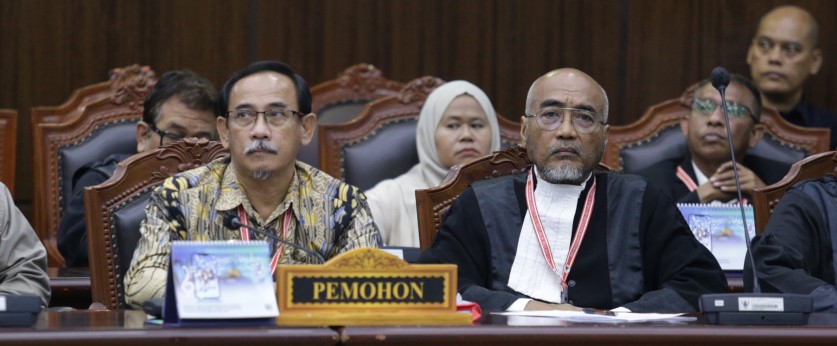
The Petitioners’ legal counsels at the ruling hearing for the judicial review of Law No. 31 of 1999 on the Eradication of the Criminal Acts of Corruption for case No. 163/PUU-XXIII/2025, Thursday (10/16/2025). Photo by MKRI/Bayu.
JAKARTA (MKRI) — The Constitutional Court (MK) handed down Decision No. 163/PUU-XXIII/2025 on the material judicial review petition of Article 21 of Law No. 31 of 1999 on the Eradication of the Criminal Acts of Corruption (Anti-Corruption Law), as amended by Law No. 2001. The Court declared the petition inadmissible. It argued that the petition was premature as the petitums comprised the request for reinterpretation of the article following articles under Law No. 1 of 2023 on the Criminal Code (KUHP), which is not yet in effect.
“There is no doubt for the Court to declare the Petitioners’ petition premature,” said Deputy Chief Justice Saldi Isra at the ruling hearing on Thursday, October 16, 2025 in the plenary courtroom.
In their petitums, the Petitioners petitioned the Court to declare Article 21 of the Anti-Corruption Law conditionally unconstitutional and have no binding legal force insofar as it is not interpreted in accordance with the criminal provisions stipulated in Articles 278, 281, 282, 283, 284, 285, 286, 287, 288, 289, 290, 291, 293, 294, 295, 296, and 299 of Law No. 1 of 2023 on the Criminal Code (KUHP). However, Law No. 1 of 2023 will only take effect starting January 2, 2026 after a transition period of three years since its promulgation on January 2, 2023.
Deputy Chief Justice Saldi Isra stated that if the said articles of Law No. 1 of 2023, which serve as the basis for the Petitioners’ interpretation, have been declared constitutional by the Court, it would be tantamount to the Court affirming the concurrent applicability of two Criminal Codes—the existing one and the forthcoming one. Such a situation, if permitted, would in fact create ambiguity and legal uncertainty in the enforcement of criminal law.
Also read:
Advocates Request Annulment of Elastic Anti-Corruption Article
Five Advocates Revise Petition Against Article 21 of Anti-Corruption Law
Five advocates—Irianto Subiakto, Anggara Suwahju, Emir Zullarwan Pohan, Zainal Abidin, and Febi Yonesta (Petitioners I-V)—filed the petition. They argued that Article 21 of the Anti-Corruption Law could lead to potential harm to their constitutional rights, which they believed had been drafted without clear limitations and with overly elastic wording, thus carrying the risk of excessive application, potential abuse of power, and undermines the principles of legality, legal certainty, and lex certa in criminal law.
They believed the phrase “prevents, obstructs, or sabotage directly or indirectly” had failed to meet the requirement of clarity of formulation as mandated by the Lawmaking Law. Meanwhile, the offense defined in Article 21 of the Anti-Corruption Law contains overly elastic wording, creating room for multiple interpretations in practice.
Article 21 of the Anti-Corruption Law reads: “Any person who intentionally prevents, obstructs, or directly or indirectly sabotage an investigation, prosecution, or examination of a suspect, defendant, or witness in a corruption case in a court of justice shall be liable to a prison term of no less than 3 (three) years and no more than 12 (twelve) years, and/or a fine of no less than Rp150,000,000.00 (one hundred and fifty million rupiah) and no more than Rp600,000,000.00 (six hundred million rupiah).”
The Petitioners argued that the application of Article 21 leaves interpretation of “prevents, obstructs, or sabotage” entirely to the subjective judgment of investigators, prosecutors, or judges. There is no clear definition of what conduct qualifies as preventing, obstructing, or sabotaging an investigation, prosecution, or trial proceedings that can be considered unlawful.
Author : Mimi Kartika
Editor : Nur R.
PR : Andhini S. F.
Translator : Yuniar Widiastuti (NL)
Disclaimer: The original version of the news is in Indonesian. In case of any differences between the English and the Indonesian versions, the Indonesian version will prevail.
Thursday, October 16, 2025 | 14:38 WIB 196