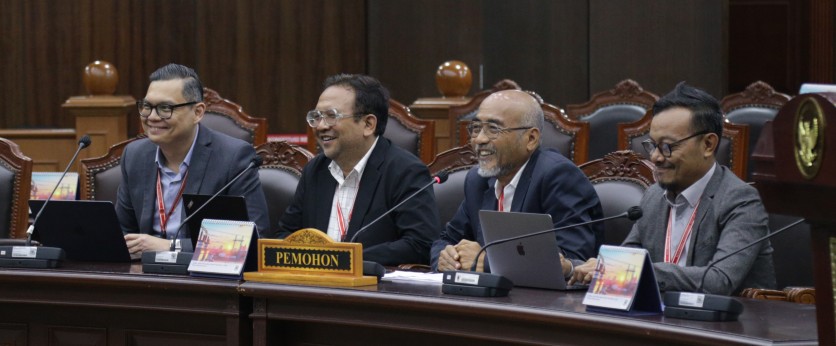
The Petitioners at the preliminary hearing for the judicial review of Law No. 31 of 1999 on the Eradication of the Criminal Acts of Corruption, Wednesday (9/24/2025). Photo by MKRI/Bayu.
JAKARTA (MKRI) — Five advocates have filed a material judicial review petition of Article 21 of Law No. 31 of 1999 on the Eradication of the Criminal Acts of Corruption (Anti-Corruption Law), as amended by Law No. 2001, to the Constitutional Court (MK). The Petitioners of case No. 163/PUU-XXIII/2025 believe the article, which the argue was drafted without clear limitations and with overly elastic wording, carries the risk of excessive application, potential abuse of power, and undermines the principles of legality, legal certainty, and lex certa in criminal law.
“The formulation is highly vague and open to multiple interpretations; that phrase can be stretched in any direction and ends up becoming an elastic clause vulnerable to arbitrary use,” said Petitioner II Anggara Suwahju at the preliminary hearing on Wednesday, September 24, 2025 at the Constitutional Court. He attended the hearing alongside Petitioner I Irianto Subiakto, Petitioner III Emir Zullarwan Pohan, and Petitioner V Febi Yonesta. Petitioner IV Zainal Abidin was absent from the session.
According to the Petitioners, the phrase “prevents, obstructs, or directly or indirectly sabotage” fails to meet the requirement of clarity of formulation as mandated by the Lawmaking Law. Meanwhile, the offense defined in Article 21 of the Anti-Corruption Law contains overly elastic wording, creating room for multiple interpretations in practice.
Article 21 of the Anti-Corruption Law states: “Any person who intentionally prevents, obstructs, or directly or indirectly sabotage an investigation, prosecution, or examination of a suspect, defendant, or witness in a corruption case in a court of justice shall be liable to a prison term of no less than 3 (three) years and no more than 12 (twelve) years, and/or a fine of no less than Rp150,000,000.00 (one hundred and fifty million rupiah) and no more than Rp600,000,000.00 (six hundred million rupiah).”
The Petitioners argued that the application of Article 21 leaves interpretation of “prevents, obstructs, or sabotage” entirely to the subjective judgment of investigators, prosecutors, or judges. There is no clear delineation of what conduct qualifies as preventing, obstructing, or sabotaging an investigation, prosecution, or trial proceedings that can be considered unlawful.
The Petitioners asked the Court to declare Article 21 of the Anti-Corruption Law, as amended by Law No. 20 of 2001, unconstitutional and without binding legal force.
The case was heard by a panel chaired by Justice Enny Nurbaningsih, with Constitutional Justices Anwar Usman and Ridwan Mansyur as panel members. Justice Ridwan highlighted the Petitioners’ request that Article 21 be declared unconstitutional and not legally binding. He cautioned that granting such a request could lead to a legal vacuum.
“Your wording in the petitum points two and three could potentially create a legal vacuum if granted by the Court. Please examine carefully whether you might end up undermining the article itself,” he advised.
He further emphasized that petitums (petitioners’ demands) must be supported by clear arguments and reasoning. If the relief sought is not directly related to the substance of the petition—let alone unsupported by legal standing—the petition may be deemed vague or unclear.
Before adjourning the session, Justice Enny announced that the Petitioners would have 14 days to revise the petition, which must be submitted no later than Tuesday, October 7 at 12:00 WIB to the Registrar’s Office.
Author : Mimi Kartika
Editor : Nur R.
PR : Andhini S.F.
Translator : Yuniar Widiastuti (NL)
Disclaimer: The original version of the news is in Indonesian. In case of any differences between the English and the Indonesian versions, the Indonesian version will prevail.
Wednesday, September 24, 2025 | 17:07 WIB 189