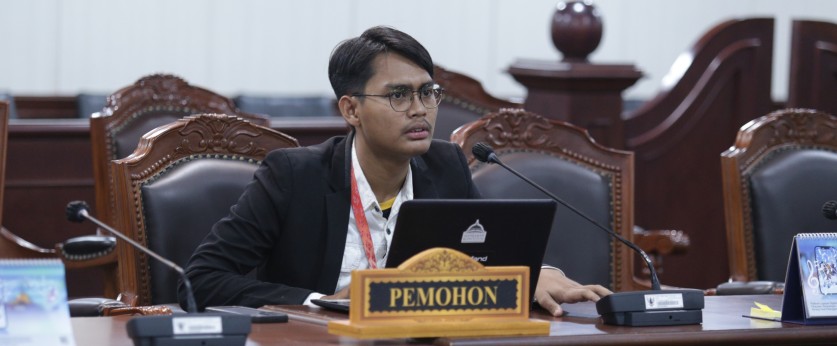
The Petitioners’ counsel at the petition revision hearing of the judicial review of Law No. 1 of 2025 on State-Owned Enterprises for case No. 169/PUU-XXIII/2025, Monday (10/13/2025). Photo by MKRI/Bayu.
JAKARTA (MKRI) — The Constitutional Court (MK) held the second material judicial review hearing of Law No. 1 of 2025 on the Third Amendment to Law No. 19 of 2003 on State-Owned Enterprises (BUMN Law) on Monday, October 13, 2025. The hearing to examine the revisions to petition by Iqro’ Katsir and Alif Alvian Mawaddi Hamid for Case No. 169/PUU-XXIII/2025 was presided over by Constitutional Justices Arief Hidayat (chair), Anwar Usman, and Enny Nurbaningsih. At the hearing, counsel A. Fahrur Rozi conveyed the Petitioners’ wish to withdraw the petition, which they had previously requested through a letter sent to the Court on Monday, October 6.
“Today’s hearing is to confirm with the Petitioners that case No. 169/PUU-XXIII/2025 has been officially withdrawn through a letter dated October 6, 2025, signed by the Petitioners’ counsel. Today’s hearing is hereby adjourned,” said Justice Arief from one of the Court’s panel courtrooms.
Also read: Two Non-tenured Contract Teachers Challenge Dual-Position Practices in SOE Governance
At the preliminary hearing on September 29, 2025, the Petitioners argued that the dividend contributions to state revenue remain small and disproportionate to Indonesia’s abundant natural resources, and that suboptimal SOE governance reduces the state’s capacity to generate non-tax revenue needed to fulfill constitutional obligations—particularly funding for education. Counsel A. Fahrur Rozi argued that this creates a paradox whereby a resource-rich nation lacks sufficient budgetary capacity to meet its constitutional duties in education.
They further stated that good management of SOEs will generate high dividends, thereby increasing non-tax state revenues. In line with this, such state revenues will strengthen the state’s capacity to allocate the education budget in accordance with the constitutional mandate as guaranteed by Article 28C paragraph (1) and Article 31 paragraph (4) of the 1945 Constitution.
Contrary to the Petitioners’ right to good corporate governance, Articles 27B and 56B as currently worded leave room for dual-office practices within SOE governance structures. Those provisions, Fahrur said, do not explicitly disqualify certain positions from being held concurrently by commissioners or supervisors, which implicitly permits individuals to occupy overlapping roles—such as being a SOE commissioner/supervisor while holding structural offices within government—thereby creating potential conflicts of interest and weakening accountability.
Author : Sri Pujianti
Editor : N. Rosi
PR : Andhini S. F.
Translator : Yuniar Widiastuti (NL)
Disclaimer: The original version of the news is in Indonesian. In case of any differences between the English and the Indonesian versions, the Indonesian version will prevail.
Monday, October 13, 2025 | 16:14 WIB 224