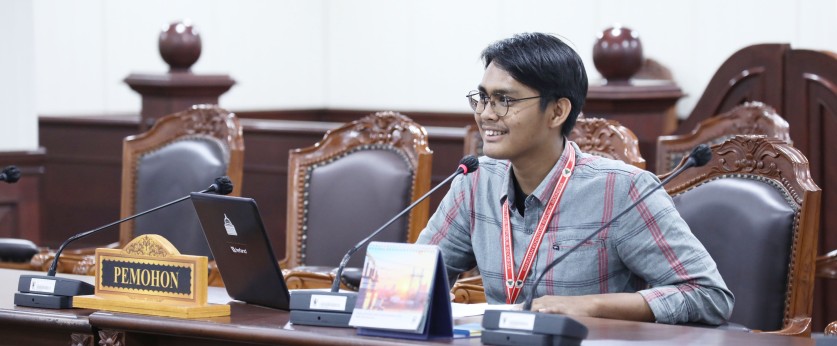
the formal judicial review of Law No. 1 of 2025 on State-Owned Enterprises, Monday (9/29/2025). Photo by MKRI/Panji.
JAKARTA, (MKRI) – Non-tenured contract teachers Iqro' Katsir and Alif Alvian Mawaddi Hamid have filed a material judicial review petition of Law No. 1 of 2025 on the Third Amendment to Law No. 19 of 2003 on State-Owned Enterprises (BUMN Law) to the Constitutional Court (MK). The preliminary hearing for case No. 169/PUU-XXIII/2025, taking place on Monday, September 29, 2025 in one of the Court’s panel courtrooms, was chaired by Constitutional Justice Arief Hidayat.
A. Fahrur Rozi, acting as counsel for the petitioners, argued that the contested provisions violate Article 28D paragraph (1) of the 1945 Constitution. Article 27B of the SOE Law provides that “the Board of Commissioners is prohibited from concurrently holding positions as: a. members of the Board of Directors, Board of Commissioners, or Supervisory Board in other SOEs, SOE subsidiaries and their derivatives, and regional-owned enterprises; and/or b. other positions in accordance with statutory provisions.” Article 56B contains a similar prohibition applicable to the Supervisory Board, adding a prohibition on concurrently holding positions that could give rise to conflicts of interest.
Fahrur told the court that SOE dividend contributions to state revenue remain small and disproportionate to Indonesia’s abundant natural resources, and that suboptimal SOE governance reduces the state’s capacity to generate non-tax revenue needed to fulfill constitutional obligations—particularly funding for education. He argued that this creates a paradox whereby a resource-rich nation lacks sufficient budgetary capacity to meet its constitutional duties in education.
“In their capacity as teachers, the petitioners have the right to develop themselves and meet basic needs for the welfare of humanity as guaranteed by Article 28C paragraph (1) of the 1945 Constitution. Therefore, the state has a constitutional duty to prioritize education spending of at least 20% of the national and regional budgets as required by Article 31 paragraph (4),” Fahrur said, linking a demand for better SOE governance to the state’s ability to honor education funding mandates.
Fahrur further contended that, contrary to the petitioners’ interest in good corporate governance, Articles 27B and 56B as currently worded leave room for dual-office practices within SOE governance structures. Those provisions, he said, do not explicitly disqualify certain positions from being held concurrently by commissioners or supervisors, which implicitly permits individuals to occupy overlapping roles—such as being a commissioner/supervisor while holding structural offices within government—thereby creating potential conflicts of interest and weakening accountability.
In their petitum, the petitioners ask the Court to declare Article 27B of Law No. 1 of 2025 unconstitutional insofar as it is not interpreted to mean that the Board of Commissioners is prohibited from concurrently holding: (a) positions as members of the Board of Directors, Board of Commissioners, or Supervisory Board in other SOEs, SOE subsidiaries and their derivatives, and regional-owned enterprises; (b) structural and functional positions within central government ministries/agencies and regional governments; (c) party leadership positions, candidacy for or membership of legislative bodies, candidacy for or holding regional executive offices (candidate/head/vice-head of region, head/vice-head of region); (d) any other office that may create a conflict of interest; and/or (e) any other position as regulated by statute. They request an analogous interpretation for Article 56B so that members of Supervisory Boards are clearly barred from the same categories of concurrent offices.
On constitutional injury, Constitutional Justice Enny Nurbaningsih advised the petitioners to pay particular attention to Constitutional Court Decision No. 128/PUU-XXIII/2025. She stressed the need for the petitioners—who are teachers—to demonstrate concretely how diminished SOE dividends caused by dual-office holders have resulted in a measurable reduction in education funding and thus a constitutional loss. “Strengthen all five requirements for constitutional injury,” Enny instructed, pointing to the Court’s established thresholds for legal standing in material review cases.
Justice Anwar Usman observed that the subject matter of this petition bears resemblance to another case whose decision is to be read the same day, and urged the petitioners to study that decision carefully to avoid redundant arguments or an outcome that would be applied mutatis mutandis.
At the close of the hearing, Justice Arief Hidayat granted the petitioners 14 days to perfect their petition. The revised petition must be submitted to the Court no later than Monday, 13 October 2025 at 12:00 WIB, after which the Court will schedule a second hearing to consider the improvements and the petition’s main points.
Author : Sri Pujianti.
Editor : N. Rosi.
PR : Andhini SF.
Translator : Jessica Rivena Meilania/Agusweka Poltak Siregar.
Disclaimer: The original version of the news is in Indonesian. In case of any differences between the English and the Indonesian versions, the Indonesian version will prevail.
Monday, September 29, 2025 | 15:14 WIB 314