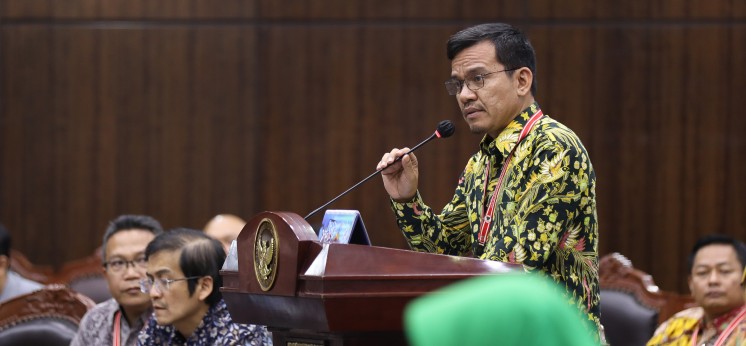
National Human Rights Commission commissioner Saurlin P. Siagian testifying at a judicial review hearing of Law No. 6 of 2023 on Job Creation, Tuesday (10/7/2025). Photo by MKRI/Ifa.
JAKARTA (MKRI) — The National Human Rights Commission (Komnas HAM) and the National Commission on Violence Against Women (Komnas Perempuan) stated that the implementation of the National Strategic Projects (PSN) could potentially violate human rights. Both institutions appeared as amici curiae (information providers) at the eighth hearing for the material judicial review of Law No. 6 of 2023 on the Stipulation of the Government Regulation in Lieu of Law No. 2 of 2022 on Job Creation into Law on Tuesday, October 7, 2025 in the plenary courtroom.
National Human Rights Commission commissioner Saurlin P. Siagian argued that PSN implementation could lead to human rights violations if it fails to uphold legal principles, public participation, protection of vulnerable groups, and environmental sustainability. He emphasized that development should not merely serve as a tool to boost economic statistics but rather as a means to expand citizens’ substantive freedoms—ensuring access to decent living, meaningful participation, and the fulfillment of basic needs. This approach aligns with the UN Declaration on the Right to Development (1986), which recognizes human beings as the central purpose of national development.
In the context of PSN, Siagian explained, a human rights-based approach requires PSN norms and practices to meet minimum standards of legal certainty, meaningful public participation, protection of vulnerable groups, and environmental preservation. Failure to meet any of these criteria risks leading to human rights violations. He further noted that regulatory adjustments made to accelerate PSN implementation are legally vague, as they do not define objective criteria or clear mechanisms for PSN designation.
“This vagueness opens room for multiple interpretations and grants excessive power to the government and business entities, thereby threatening citizens’ constitutional right to legal certainty as guaranteed under Article 28D paragraph (1) of the Constitution. Such norms also contradict Article 1 paragraph (3) of the 1945 Constitution, which enshrines the rule of law, as well as international principles under Article 10 of the Universal Declaration of Human Rights, Article 14 paragraph (1) of the ICCPR, and General Comment No. 16 of the UN Human Rights Committee. The ambiguity of PSN designation under Article 3 letter d of the Job Creation Law limits public access to information and undermines meaningful participation, in violation of Article 28F, which guarantees everyone’s right to seek, obtain, store, process, and convey information,” he explained.
Environmental Impacts
Beyond legal aspects, Komnas HAM also highlighted environmental impacts from several PSN projects, including the Jakarta-Bandung high-speed rail, Wadas, Makassar New Port, the Indonesian Green Industrial Zone, and the Merauke food estate—which have led to the loss of productive farmland, ecosystem damage, and air and water pollution.
“Unsustainable development exacerbates the climate crisis and threatens the right to a healthy environment,” Siagian said. He also criticized the deployment of security forces to safeguard projects in areas such as Rempang, Mandalika, and Merauke, which he described as militarizing development and suppressing public freedom of expression.
In its written testimony, Komnas HAM recommended that the Constitutional Court affirm that all norms in the Job Creation Law must comply with the rule of law and respect human rights. It urged the Court to declare vague norms that enable abuse of power unconstitutional and to interpret the Constitution progressively as a living constitution that safeguards rights to land, environment, and public participation.
Law as Instrument of Violence
Meanwhile, chair of National Commission on Violence Against Women Maria Ulfah shared similar views, particularly regarding the Job Creation Law’s provision on “facilitation and acceleration of PSN.” She explained that PSN status grants legal legitimacy for fast-tracked permits, land acquisition, and the deployment of state apparatus, but at the same time negates the principle of Free, Prior, and Informed Consent (FPIC)—a core human rights standard. This legitimacy, she argued, transforms law into an instrument of violence, masking a logic of dispossession that disproportionately harms women.
“The loss of women’s livelihoods takes many forms: polluted seas due to reclamation in Makassar, seized farmland for andesite mining in Wadas, loss of clean water from Lake Poso damage, forest food resources in Merauke taken away, and the destruction of small businesses through evictions in Mandalika,” Maria stated.
She further explained that monitoring data show more than a thousand women have lost their direct sources of income—illustrating a forced shift from economic independence to dependency.
Eleven PSN-Related Conflict Reports
Maria revealed that between 2020 and 2024, the National Commission on Violence Against Women had received 80 complaints related to natural resource conflicts, land disputes, and evictions. Of these, 11 cases were directly linked to PSN projects.
“First, in Makassar New Port, 300 women fishers lost their livelihoods, followed by a surge in domestic violence. Second, in Bener Dam in Wadas, Central Java, 334 women farmers lost their land. Third, in Mbay Dam in Nagekeo, East Nusa Tenggara, intimidation by security forces led to indigenous women being injured both physically and socially. Fourth, in Poso hydropower plant in Central Sulawesi, 100 women lost access to clean water. Fifth, in Poco Leok geothermal plant in Manggarai, East Nusa Tenggara, women suffered physical and sexual violence. Sixth, due to PT Vale Indonesia in Sorowako, South Sulawesi, dozens of women lost access to clean water. Seventh, the Merauke food estate in South Papua led to hundreds of indigenous women losing forests, food sources, and living spaces. Eighth, at UIII in Depok, West Java, 17 women lost their business land. Ninth, in Mandalika, West Nusa Tenggara, 70 women lost their livelihoods. Tenth, in Rempang Eco City in Batam, Riau Islands, women suffered physical injuries and lost their land. Eleventh, in the new capital city Nusantara, indigenous women experienced verbal harassment and loss of land,” Maria recounted.
The Commission’s monitoring across these cases revealed a consistent pattern: PSN status not only accelerates development but also legitimizes forms of gender-based violence (GBV). Maria described these as new, layered forms of GBV.
“First, physical and psychological violence. In nearly all cases, security forces were deployed not to protect residents but to secure projects and investor interests. At least 15 women were documented to have suffered serious physical injuries—especially in Poco Leok, Rempang, and Mbay—reflecting a deliberate pattern of violence with direct impacts on women’s bodies. Such violence is not merely momentary repression but part of a long-term climate of terror that restricts women’s behavior and mobility,” Maria explained.
In conclusion, Maria asserted that the provisions in the Job Creation Law regulating PSN “facilitation and acceleration” for business interests are discriminatory, violating Article 28H paragraph (2) of the 1945 Constitution, which mandates that PSN benefits should prioritize local communities’ interests. Therefore, the National Commission on Violence Against Women urged the Constitutional Court to grant the Petitioners’ petition.
“If the Constitutional Court holds a different view, we respectfully request a ruling based on fairness (ex aequo et bono) to promote respect for and fulfillment of citizens’ constitutional rights, including women’s human rights,” she emphasized.
Also read:
Ease, Acceleration of National Strategic Projects in Job Creation Law Questioned
Petitioners of National Strategic Projects Acceleration in Job Creation Law Revise Petition
Govt Ensures Environmental Protection Amid Strategic Projects Acceleration
Expert: PSN Acceleration Is at the Expense of Citizens’ Rights
Merauke Residents Challenge Food Estate for Ruining Their Livelihood
The Petitioners of case No. 112/PUU-XXIII/2025—the Indonesian Legal Aid Foundation (YLBHI), the Indonesian Forum for Living Environment (WALHI), and 19 others, consisting of foundations and advocate associations—assert that the provisions in the Job Creation Law, particularly those concerning the facilitation and acceleration of National Strategic Projects (PSN), have undermined the fundamental principles of the rule of law as enshrined in Article 1 paragraph (3) of the 1945 Constitution.
They argue that the provisions on the acceleration and facilitation of PSNs have triggered socio-economic conflicts that infringe upon citizens’ constitutional rights. They contend that the norm is vague, citing ambiguous phrases such as “adjustment of various regulations” and “facilitation and acceleration,” which lack clear operational limits. Such vagueness, they argue, opens the door to the appropriating of public policy for political interests and diminishes the space for meaningful public participation.
Additionally, they also challenge several other provisions within the Job Creation Law, such as Article 123 point 2, Article 124 point 1 paragraph (2), Article 173 paragraphs (2) and (4), and Article 31 paragraph (2). These provisions, they argue, have distorted the concepts of public interest and state control as mandated by Article 33 paragraphs (3) and (4) of the 1945 Constitution.
Accordingly, the Petitioners request that the Constitutional Court declare those provisions of the Job Creation Law unconstitutional and not legally binding. They hope that through this petition, the Court will ensure the accountability of state actors in fulfilling their constitutional obligation to protect the fundamental rights of citizens.
Author : Utami Argawati
Editor : Lulu Anjarsari P.
PR : Fauzan Febriyan
Translator : Yuniar Widiastuti (NL)
Disclaimer: The original version of the news is in Indonesian. In case of any differences between the English and the Indonesian versions, the Indonesian version will prevail.
Tuesday, October 07, 2025 | 14:18 WIB 1330