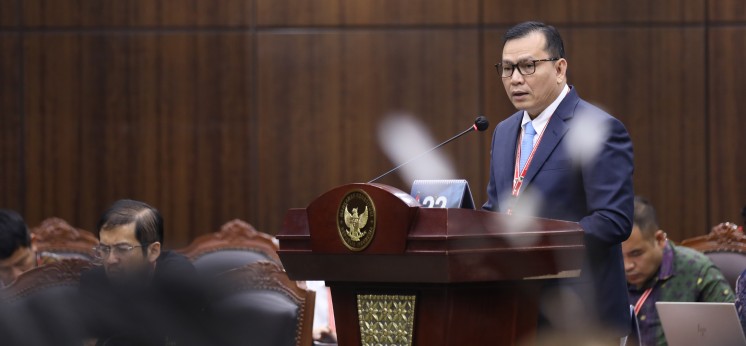
Deputy for Energy and Mineral Resources Coordination Elen Setiadi testifying on behalf of the Government at a judicial review hearing of Law No. 6 of 2023 on Job Creation, Monday (8/25/2025). Photo by MKRI/Ifa.
JAKARTA (MKRI) — The Constitutional Court (MK) held the fourth hearing for the material judicial review of Law No. 6 of 2023 on the Stipulation of the Government Regulation in Lieu of Law No. 2 of 2022 on Job Creation into Law on Monday, August 25, 2025. The case No. 112/PUU-XXIII/2025 was filed by the Indonesian Legal Aid Foundation (YLBHI), the Indonesian Forum for Living Environment (WALHI), and 19 others, consisting of foundations and advocate associations. Before Deputy Chief Justice Saldi Isra and the other constitutional justices, the Government presented their testimony, represented by Deputy for Energy and Mineral Resources Coordination of the Coordinating Ministry for Economic Affairs Elen Setiadi.
In his statement, Elen emphasized that land acquisition for development purposes, including National Strategic Projects (PSN), is intended to accelerate infrastructure development, boost the economy, and create employment opportunities.
“Both PSN and land acquisition are vital and have far-reaching impacts on improving public welfare,” he said in the plenary courtroom.
With respect to coastal development, Elen underscored that environmental protection obligations remain fully applicable under Law No. 27 of 2007 in conjunction with Law No. 1 of 2014 on the Management of Coastal Zones and Small Islands. He noted that provisions safeguarding critical ecosystems such as coral reefs, seagrass beds, and mangroves remain binding, including the requirement to obtain a Marine Spatial Utilization Conformity (KKPRL) document.
Elen explained that Article 18 point 15 of the Job Creation Law in fact regulates the integration of PSN policies with the Coastal Zone and Small Islands Zoning Plan (RZWP3K). The Government maintains that no provision eliminates environmental or coastal protections; rather, the law seeks to harmonize development objectives with ecological considerations.
He further explained that licensing procedures continue to involve public participation through Environmental Impact Assessments (AMDAL) as well as Strategic Environmental Assessments (KLHS).
“The preparation of KLHS also involves the community and stakeholders, as stipulated in Article 18 paragraph (1) of Law No. 32 of 2009. Furthermore, with regard to spatial utilization activities that have already obtained a Spatial Utilization Conformity Recommendation, the applicable mechanism is Environmental Approval, the process of which also requires community involvement pursuant to Article 26 paragraph (1) of Law No. 32 of 2009, which mandates that AMDAL documents be prepared by the proponent with public participation. Accordingly, from the perspective of environmental law, what is required for spatial utilization activities is Environmental Approval, while KLHS is required in the process of preparing spatial and zoning plans,” Elen clarified.
He cautioned that if the Petitioners’ request were granted, it could generate significant adverse consequences for development and the national economy. “Land acquisition processes would become more difficult, national strategic projects would be impeded, economic growth would slow, job opportunities would diminish, and investment would be disrupted,” he warned.
He further added that such conditions could hinder the realization of 2045 Golden Indonesia, the vision of Indonesia as an advanced, equitable, and sustainable nation by its centennial.
Also read:
Ease, Acceleration of National Strategic Projects in Job Creation Law Questioned
Petitioners of National Strategic Projects Acceleration in Job Creation Law Revise Petition
At the hearing in the plenary courtroom, legal counsel Salsabilah Khoirunnisa asserted that the provisions in the Job Creation Law, particularly those concerning the facilitation and acceleration of National Strategic Projects (PSN), have undermined the fundamental principles of the rule of law as enshrined in Article 1 paragraph (3) of the 1945 Constitution.
The Petitioners argue that the provisions on the acceleration and facilitation of PSNs as set forth in Article 3 letter d of the Job Creation Law have triggered socio-economic conflicts that infringe upon citizens’ constitutional rights. They contend that the norm is vague, citing ambiguous phrases such as “adjustment of various regulations” and “facilitation and acceleration,” which lack clear operational limits. Such vagueness, they argue, opens the door to the hijacking of public policy for political interests and diminishes the space for meaningful public participation.
Additionally, they also challenge several other provisions within the Job Creation Law, such as Article 123 point 2, Article 124 point 1 paragraph (2), Article 173 paragraphs (2) and (4), and Article 31 paragraph (2). These provisions, they argue, have distorted the concepts of public interest and state control as mandated by Article 33 paragraphs (3) and (4) of the 1945 Constitution.
Accordingly, the Petitioners requested that the Constitutional Court declare several provisions of the Job Creation Law unconstitutional and not legally binding. They hope that through this petition, the Court will safeguard the accountability of state actors in fulfilling their constitutional obligation to protect the fundamental rights of citizens.
Author : Utami Argawati
Editor : Lulu Anjarsari P.
PR : Fauzan Febriyan
Translator : Yuniar Widiastuti (NL)
Disclaimer: The original versions of the news is in Indonesian. In case of any differences between the English and the Indonesian versions, the Indonesian version will prevail.
Monday, August 25, 2025 | 15:28 WIB 1494