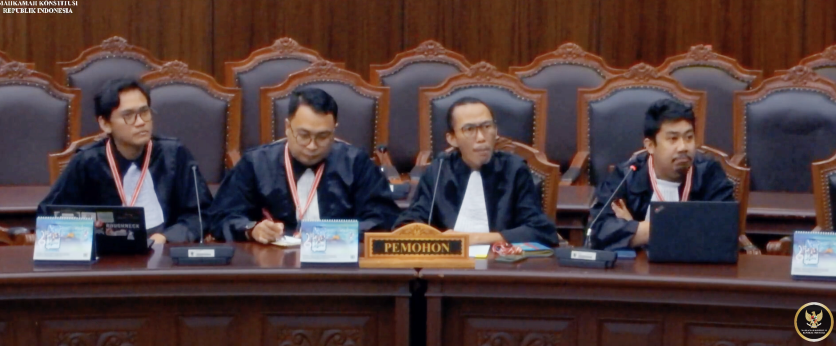
The legal counsel for the petitioners in the judicial review of Law Number 6 of 2023 concerning Job Creation (Ciptaker Law), on Monday (6/10/2025) in the plenary courtroom of the Constitutional Court. Photo: Public Relations/Panji
JAKARTA (MKRI) - The Constitutional Court (Mahkamah Konstitusi, or MK) convened the seventh hearing on Monday, October 6, 2025, in the ongoing judicial review of Law Number 6 of 2023 concerning the enactment of Government Regulation in Lieu of Law (Perppu) Number 2 of 2022 on Job Creation into law—commonly referred to as the Job Creation Law (UU Cipta Kerja).
This judicial review was filed by the Indonesian Forum for the Environment (Wahana Lingkungan Hidup Indonesia, or WALHI), challenging the constitutionality of several provisions: Article 13 letter B; Article 22 points 1, 3, 5, 8–10, and 14–18, and 28 of the Job Creation Law. The agenda for this session was to hear testimony from the President’s expert and fact witnesses.
However, the President’s legal team declared that their expert and witnesses were not yet prepared to testify regarding claims that the Job Creation Law relaxes environmental requirements for businesses, a change deemed by petitioners to pose significant negative externalities and threaten intergenerational environmental justice.
“The agenda was supposed to be the hearing of testimony from the President’s expert and witnesses. However, the President’s legal representatives submitted a letter to the Court requesting a postponement due to scheduling conflicts with the expert witnesses. This will be the final postponement granted. The Court is giving one last opportunity on Monday, October 20, 2025, at 1:30 PM Western Indonesia Time, to hear the President’s expert and witness testimonies. All parties may attend without further summons,” stated Chief Justice Suhartoyo during the Plenary Session for Case Number 100/PUU-XXIII/2025.
Also read:
State’s Role in Supervising Business Licenses and Environmental Management Questioned
Petitioner Affirm State's Key Role in Supervising Business License and Environmental Management
House Absent, Govt Asks to Postpone Hearing on Job Creation Law
Govt: Changing Environmental Permit to Environmental Approval to Reduce Overlapping Bureaucracy
House Absent, Experts Not Ready, Job Creation Law Hearing Postponed
In previous sessions, WALHI argued that the Job Creation Law amends, removes, or introduces new provisions to Law Number 32 of 2009 on Environmental Protection and Management (UU PPLH). The organization contends that the relaxation of environmental requirements for business actors risks serious environmental harm and undermines fairness for future generations.
The Petitioners particularly highlighted persistent environmental degradation and pollution resulting from ongoing industrial and infrastructure development projects. Under the revised law, "environmental permits" are downgraded to "environmental approvals" as a condition for obtaining a business license. Furthermore, not all business activities are required to obtain such approvals, only those deemed risky without clear explanation or guidelines on addressing pollution and environmental damage.
As a result, WALHI claims the law denies them legal certainty, public participation, access to information, and the right to a healthy environment, thereby infringing on the protection, advancement, enforcement, and fulfillment of human rights in the environmental context.
According to the Petitioners, one of the state's fundamental roles is to regulate natural resource management through licensing instruments, ensuring legal certainty for all citizens. However, this authority must be grounded in legislation that prioritizes environmental protection and ensures sustainable and equitable intergenerational use of natural resources.
Author : Sri Pujuanti
Editor : Lulu Anjarsari P.
PR : Andhini Sayu
Translator : SO
Disclaimer: The original version of the news is in Indonesian. In case of any differences between the English and the Indonesian versions, the Indonesian version will prevail.
Monday, October 06, 2025 | 11:31 WIB 139