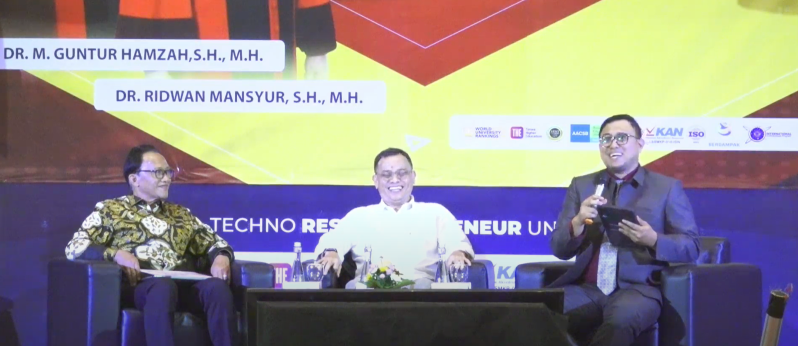
Constitutional Justices Ridwan Mansyur and M. Guntur Hamzah delivering lectures at the academic seminar “The Constitutional Court in the State System” at the National Education University (Undiknas), Denpasar, Saturday (10/4/2025). Photo by MKRI.
DENPASAR (MKRI) — Constitutional Justices M. Guntur Hamzah and Ridwan Mansyur delivered a public lecture titled “The Constitutional Court in the State System” at the National Education University (Undiknas) on Saturday, October 4, 2025. Speaking at the Dwi Tunggal Auditorium, Justice Guntur invited students to understand how Indonesia’s constitutional system positions the Constitutional Court (MK) as part of the judiciary.
Article 24 paragraph (1) of the 1945 Constitution stipulates that judicial power is exercised by the Supreme Court (MA) and the Constitutional Court (MK) to uphold justice in Indonesia. In several countries, only a Supreme Court exists, particularly in those following the Anglo-Saxon legal tradition. Meanwhile, Indonesia adopts a civil law system, but in practice also applies elements of common law—making it a hybrid system. Therefore, the Constitutional Court’s existence is essential.
Furthermore, Justice Guntur explained that the idea of establishing a constitutional court in Indonesia dates back to 1945, although it was not immediately realized due to the country’s early institutional limitations. The establishment of the Constitutional Court was also inspired by the concept of judicial review that developed in Austria and in the United States, particularty the landmark case Marbury v. Madison.
“Given the Constitutional Court’s long journey and vital role, strategic efforts are needed to strengthen constitutional supremacy and Indonesia’s constitutional system. These include promoting the Constitution as a reflection of the people’s collective agreement and the foundation of state law; increasing awareness of citizens’ constitutional rights; reinforcing the Court’s role as the guardian of democracy, state ideology, Constitution, and constitutional justice, the protector of human rights and citizens’ constitutional rights, and the final interpreter of the Constitution; and enhancing compliance with the Court’s decisions,” he explained to the audience.
Concept of Judicial Review
Next, Justice Ridwan Mansyur focused his portion of the lecture on the dualism of judicial review in Indonesia. He explained that the Supreme Court handles judicial review of regulations below the level of law, while the Court reviews laws or regulations equivalent to laws, such as government regulations in lieu of law (perppu).
“In judicial review proceedings at the Constitutional Court, no fees are charged, unlike in other courts. The Constitutional Court provides opportunities for all citizen—including students—to submit petitions. Moreover, in today’s era, the Constitutional Court, which is now familiar to Gen-Z, facilitates case submissions online [and offered online] features, from filing petitions to attending hearings and pronouncing decisions,” he explained. The lecture was also attended by the Dean of the Faculty of Law of Undiknas, Putu Eva Ditayani Antari.
Court Hearing Models
Justice Ridwan further explained that under Constitutional Court Regulation (PMK) No. 1 of 2021 on remote hearings, there are two models of proceedings at the Constitutional Court: offline and online. When offline hearings cannot be held due to certain circumstances, hearings may be conducted online. Remote hearings involve examining, adjudicating, and deciding constitutional cases through video conferencing or other electronic media that enable parties to communicate in real time.
“These hearings are open to the public and can be watched via the Court’s official YouTube channel, and related news is also available on the official website mkri.id. The Court has long utilized technology for case management, administration, and publication of decisions—an invaluable advancement for our shared legal knowledge,” Justice Ridwan added.
During the Q&A session, a lecturer asked about Decision No. 96/PUU-XXII/2024 concerning the Public Housing Savings (Tapera) Law, specifically whether the annulment of the law had been conceptually established in the Court’s procedural framework.
Responding to the question, Justice Guntur stated that the Court has previously annulled entire laws, such as the Cooperative Law. “When a key article affects other provisions, it becomes irrelevant to consider the rest because that core article—the umbrella or heart of the law—has been declared unconstitutional, rendering the remaining provisions inapplicable,” he explained.
Author : Sri Pujianti
Editor : Lulu Anjarsari P.
Translator : Jessica Rivena Meilania/YW
Disclaimer: The original version of the news is in Indonesian. In case of any differences between the English and the Indonesian versions, the Indonesian version will prevail.
Saturday, October 04, 2025 | 13:21 WIB 250