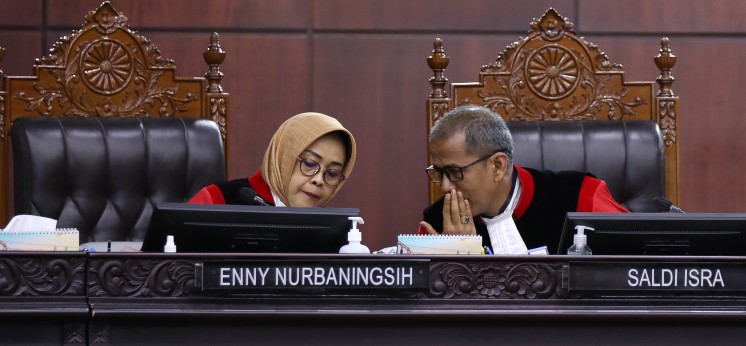
Deputy Chief Justice Saldi Isra and Constitutional Justice Enny Nurbaningsih talking in the midst of the ruling hearing for the formal judicial review of Law No. 4 of 2016 on Public Housing Savings, Monday (9/29/2025). Photo by MKRI/Ifa.
JAKARTA (MKRI) — In Decision No. 96/PUU-XXII/2024, the Constitutional Court (MK) ruled to grant the entire material judicial review of Law No. 4 of 2016 on Public Housing Savings (Tapera Law). In its verdict, the Court declares the Law unconstitutional and not legally binding if not reorganized in accordance with Article 124 of Law No. 1 of 2011 on Housing and Settlement Areas.
“3. [The Court] declares Law No. 4 of 2016 on the Public Housing Savings (State Gazette of the Republic of Indonesia of 2016 No. 55, Supplement to the State Gazette of the Republic of Indonesia No. 5863) remains in force but must be reorganized within no later than two (2) years from the pronouncement of this decision,” stated Chief Justice Suhartoyo.
Mandatory Tapera Participation Overlaps
In its legal considerations, read out by Deputy Chief Justice Saldi Isra, the Court noted that the requirement for workers to become Tapera participants in order to achieve the goal of pooling and providing long-term low-cost funds as set out in Article 2 of Law No. 4 of 2016 creates a contradiction with the accessibility intended in Law No. 1 of 2011. This is especially so because Tapera participants include workers from the low-income community (MBR).
“In fact, even without mandatory participation, workers already have access to services for home ownership, construction, and renovation through various existing schemes,” Justice Saldi said.
The Court found that making Tapera mandatory, especially with sanctions, not only results in overlapping schemes but also risks imposing a double burden, particularly on workers already contributing to existing social security schemes. Tapera is not the only instrument; for example, civil servants (ASN) already have direct access to housing schemes managed by PT Taspen Properti Indonesia (Taspro), while members of the Armed Forces (TNI), the Police, and civil servants within the Ministry of Defense and the Police can access programs under the Foundation for Welfare, Education, and Housing (YKPP) or the Asabri Housing Loan Down Payment (PUM KPR). Beyond these programs, the public also has access to housing finance through various mortgage (KPR) schemes offered by banks under the supervision of the Financial Services Authority (OJK).
Article 7 as Core Norm
Furthermore, in its legal reasoning, delivered by Constitutional Justice Enny Nurbaningsih, the Court emphasized that Article 7 paragraph (1) of Law No. 4 of 2016 constitutes the “spirit” animating the entire law, as its essence lies in the mobilization of funds through mandatory contributions from participants, namely workers. If the word “mandatory” in that provision were to be replaced with “voluntary” as requested by the Petitioners, the entire Tapera mechanism would lose its normative coherence. Sanctions would lose their basis, contribution obligations would become meaningless, and Tapera’s institutional operations would become impossible in light of the law’s intended purpose.
“Therefore, merely changing the wording creates internal disharmony, inconsistency between provisions, and legal uncertainty, which in turn contradicts Article 28D paragraph (1) of the 1945 Constitution. Article 7 paragraph (1) of Law No. 4 of 2016 is in fact the ‘heart’ (core norm) of the entire Tapera system under Law No. 4 of 2016, founded on the principle of mandatory participation,” Justice Enny explained.
Tapera was established as a “savings” concept, but in practice it merely returns the participant’s deposits at the end of membership or upon retirement. Such a scheme is inherently incapable of fulfilling its main purpose: to provide the people with access to adequate and affordable housing. Therefore, lawmakers must redesign the framework for realizing the right to housing by developing concepts such as central public housing, which can address urban land scarcity and provide housing for low-income communities as part of a national system of large-scale, affordable, and sustainable public housing.
“Thus, based on the foregoing legal considerations, the Court finds Article 7 paragraph (1) of Law No. 4 of 2016 unconstitutional,” Justice Enny stressed.
With Article 7 paragraph (1) of Law No. 4 of 2016 declared unconstitutional, the constitutional basis for Article 9 paragraphs (1) and (2) and Article 17 paragraph (1) of Law No. 4 of 2016, which were also challenged by the Petitioners, fell away. Under the principle of accessorium sequitur principale, accessory provisions cannot stand on their own if the principal provision is annulled. Article 9 paragraphs (1) and (2), which regulate the obligation to register workers and self-employed workers as Tapera participants, and Article 17 paragraph (1), which provides that “Tapera contributions shall be paid by employers and workers,” are direct consequences of the main obligation under Article 7 paragraph (1).
The Petitioners also contested the delegating provision in Article 16 of Law No. 4 of 2016, which authorizes the Government to regulate membership and contributions by government regulation. Although the article is merely technical in nature and does not impose obligations, its validity cannot be maintained because the delegating authority no longer has a substantive foundation.
Two-Year Grace Period
The Court deemed it necessary to provide a sufficient grace period for lawmakers to redesign the scheme. In doing so, legislators must carefully consider funding and housing finance systems, ensuring that any mandatory arrangements are instead made optional for employers, workers, and the self-employed, in accordance with principles of social justice, protection of vulnerable groups, compliance with the law, and constitutional rights as guaranteed by the 1945 Constitution.
The Court considered that the immediate annulment of Law No. 4 of 2016 without a transitional period would create legal uncertainty and administrative disruption in the management of contributions and participant assets, as well as potential legal risks for implementing entities such as the Tapera Management Agency and relevant financial institutions. To avoid a legal vacuum, the Court granted lawmakers a maximum of two years to reorganize the scheme in accordance with Law No. 1 of 2011.
Loss of Object
At the same hearing, the Court also ruled on two other judicial review petitions against the Tapera Law, namely Cases No. 86/PUU-XXII/2024 and 134/PUU-XXII/2024. The Court held that the legal considerations of Decision No. 96/PUU-XXII/2024 also apply to these two cases.
Although the Petitioners in those cases did not challenge the constitutionality of Article 7 paragraphs (2) and (3) of Law No. 4 of 2016, since the Law itself had already been declared unconstitutional in Decision No. 96/PUU-XXII/2024, the petitions in Cases No. 86/PUU-XXII/2024 and 134/PUU-XXII/2024 lost their object.
“[Verdict: The Court] adjudicated, to declare the petitions in Cases No. 86/PUU-XXII/2024 and No. 134/PUU-XXII/2024 inadmissible,” stated Chief Justice Suhartoyo.
Also read:
Parameters of Mandatory Public Housing Savings Participation Questioned
Labor Unions Question the Obligation of Workers to Become Tapera Participants
Petitioners Present Survey on Rejection of Public Housing Savings
Petitioners Mention China’s Failed Tapera Program
Government: Obligation to Become Tapera Participants in Line with the Principle of Mutual Cooperation
BP Tapera: Tapera Scheme Is Not a Financial Burden
Expert: Tapera Mandatory Program May Lower Investment and Increase Employment Termination
President’s Expert: Tapera Is Designed to Overcome Housing Inequality
The case No. 96/PUU-XXII/2024 was filed by the Confederation of All Indonesian Labor Unions (KSBSI), represented by national executive board president Elly Rosita Silaban and secretary-general Dedi Hardianto. They challenged Article 7 paragraph (1), Article 9 paragraphs (1) and (2), Article 16, Article 17 paragraph (1), Article 54 paragraph (1), and Article 72 paragraph (1) of the Tapera Law. According to KSBSI, these provisions conflict with Article 28D paragraph (2), Article 28I paragraph (2), and Article 34 paragraph (1) of the 1945 Constitution. They argued that the wages of self-employed workers/laborers remain small, insufficient to meet a decent standard of living, yet they are required to pay substantial social security contributions, including Tapera. As a result, the Tapera program overlaps with the Employment Social Security (BPJS Ketenagakerjaan).
The case No. 86/PUU-XXII/2024 was filed by private employee Leonardo Olefins Hamonangan and MSME businessman Ricky Donny Lamhot Marpaung. The Petitioners challenged Article 7 paragraphs (1) and (2) and Article 72 paragraph (1) letter c of the Tapera Law. They argued that these provisions conflict with Article 28D paragraph (1) and Article 27 paragraph (2) of the 1945 Constitution. They contended that the Tapera obligation drains the income of low-income communities, especially as the cost of living continues to rise while wages are further deducted for BPJS and other expenses.
The case No. 134/PUU-XXII/2024 was several workers’ unions such as filed the Federation of National Worker Unions (FKSPN), Federation of Energy Chemical and Mining Worker Union-Confederation of Indonesian Worker Unions (FSP KEP KSPSI), and the Federation of Tourism and Creative Economy Workers Union-Confederation of Indonesian Worker Unions. They challenged Article 7 paragraph (1), Article 9 paragraph (1), and Article 64 letter a of the Tapera Law. They asserted that these provisions contradict Article 23A, Article 28D paragraph (1), and Article 28H paragraph (1) of the 1945 Constitution. They argued that the mandatory Tapera membership requirement is unconstitutional because it is compulsory and coercive, akin to a tax, while not falling within the category of other mandatory levies authorized by law. Consequently, the provision forces participation from both low-income (MBR) and non-MBR workers alike.
Author : Mimi Kartika
Editor : N. Rosi.
Translator : Yuniar Widiastuti (NL)
Disclaimer: The original version of the news is in Indonesian. In case of any differences between the English and the Indonesian versions, the Indonesian version will prevail.
Monday, September 29, 2025 | 16:45 WIB 1382