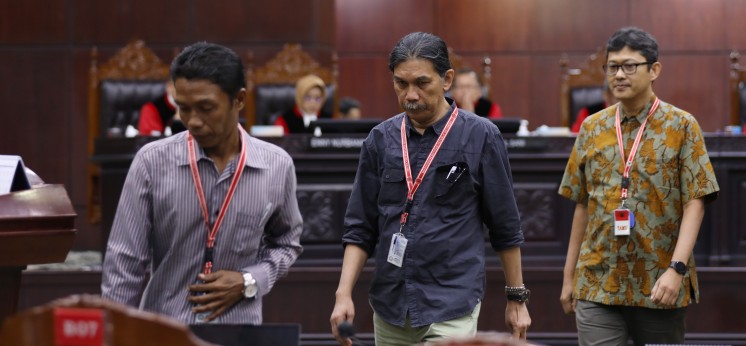
Experts Herlambang P. Wiratraman and Dianto Bachriadi, witness Sukri (right to left) at a judicial review hearing of Law No. 6 of 2023 on Job Creation for case No. 112/PUU-XXIII/2025 postponed, Thursday (9/11/2025). Photo by MKRI/Ifa.
JAKARTA (MKRI) — The Constitutional Court (MK) held the sixth hearing for the material judicial review of Law No. 6 of 2023 on the Stipulation of the Government Regulation in Lieu of Law No. 2 of 2022 on Job Creation into Law on Thursday, September 11, 2025. The case No. 112/PUU-XXIII/2025 was filed by the Indonesian Legal Aid Foundation (YLBHI), the Indonesian Forum for Living Environment (WALHI), and 19 others, consisting of foundations and advocate associations. Chief Justice Suhartoyo and the other eight constitutional justices heard testimonies by two experts and one witness for the Petitioners.
The first expert, constitutional law expert Herlambang P. Wiratraman, argued that the legal character of policies under the Omnibus Law on Job Creation was framed within a neo-liberal legal order. Such a framework requires a democratic political system, particularly to support legal reforms that can be accepted by the market.
“However, the disciplining of democracy becomes a prerequisite to inject legal reform programs and their institutions while remaining friendly to market liberalization. This is what is referred to as the ‘market-friendly legal reform’ paradigm.’ Legal reform programs are packaged within a discourse validated through circuits of power and intellectual legitimacy (among neo-liberal proponents), using common narratives such as human rights, good governance, access to justice, and poverty reduction strategic programs,” he stated.
He added that these market-friendly policies in practice fully liberalize the market—including the labor market, land procurement processes, and policies enabling maximum profit for investors or capital owners. Not surprisingly, the wave of legal reforms with neo-liberal characteristics has rendered Indonesia’s surplus labor force increasingly vulnerable to layoffs.
“This liberalization process has produced pressures and violations of labor rights, clearly contradicting constitutional rights, particularly the right to work and to a decent livelihood (Article 27 paragraph (2)) and the right to fair and proper treatment and remuneration in employment relations (Article 28D paragraph (2)),” Herlambang explained.
He further highlighted that national strategic projects (PSN) under the Omnibus Law on Job Creation are treated as commodities oriented toward investor profits. The policy emphasis on “ease and acceleration,” he said, reflects a tendency of the state to open up investment by sacrificing citizens’ rights, especially those of workers.
He added that while in the early Reform era neoliberalism was largely influenced by international institutions such as the World Bank and the IMF, today pro-investment legal reforms are also driven by the strengthening of oligarchic politics within Indonesia’s constitutional system.
The petitioners also presented law lecturer at Gadjah Mada University and senior researcher at the Agrarian Resource Center (ARC) Dianto Bachriadi as expert. In his testimony, Dianto emphasized the founding ideals of the State as enshrined in the Preamble to the 1945 Constitution: to promote general welfare, realize social justice, and protect the entire nation. He stressed that all development policies must adhere to these constitutional norms.
“In the Preamble to the 1945 Constitution, the State and Government were established with the purpose of advancing general welfare, realizing social justice, and protecting the entire nation. Everything labeled as development must refer back to these fundamental norms of state life as laid out in the Constitution,” he said.
He explained that the provisions on the facilitation and acceleration of PSNs under the Job Creation Law must be reviewed for consistency with the Constitution. He cited legal philosopher Gustav Radbruch in assessing whether the PSN legal concept aligns with the fundamental norms of nationhood as provided in the 1945 Constitution, both before and after its amendments.
He further outlined that initially the PSN concept was regulated only through presidential regulations, beginning with Presidential Regulation No. 3 of 2016 through Presidential Regulation No. 109 of 2020. Toward the end of President Joko Widodo’s term, however, the concept was elevated to the level of legislation through Law No. 11 of 2020 on Job Creation, followed by Government Regulation No. 42 of 2021.
Dianto argued that the legal norms governing PSN under these regulations arose from the president’s authority and unilateral interpretation of “basic needs” and “welfare improvement.” Yet, he argued, no normative explanation or measurable indicators were provided for either aspect. He further noted that Law No. 6 of 2023, which reaffirmed the acceleration of PSNs, failed to provide a clear definition of “national strategic value” as the basis for the policy.
“This law merely stipulates provisions on accelerating national strategic projects as part of investment and business ecosystem development. However, no substantive norm defining the meaning of national strategic value itself is found,” he remarked.
Rempang Eco City
At the same session, the Petitioners also presented witness Sukri, who testified that his once prosperous life had deteriorated following the designation of the Rempang Eco City project as a PSN.
“We, the people of Rempang, were harmed when this PSN was introduced, with intimidation from the Government and police officers,” he said.
Sukri explained that the designation of Rempang as a PSN was carried out from the outset without providing information, consultations, or participation of Rempang residents as directly affected parties. The land procurement process for Rempang Eco City involved forced evictions, conflicts, and even criminalization. The evictions were enforced through the deployment of more than 1,000 police personnel and at least 60 tactical vehicles to mark land boundaries. When residents resisted, the police used tear gas, causing serious health impacts. At least ten students and one teacher from SMP Negeri 22 Galang suffered from respiratory issues, dizziness, and nausea. Additionally, a resident named Siti Hawa became a victim of criminalization and violence for opposing the Rempang Eco City project.
Also read:
Ease, Acceleration of National Strategic Projects in Job Creation Law Questioned
Petitioners of National Strategic Projects Acceleration in Job Creation Law Revise Petition
Govt Ensures Environmental Protection Amid Strategic Projects Acceleration
The Petitioners asserted that the provisions concerning the facilitation and acceleration of national strategic projects (PSNs) and/or the word “PSN” in Article 3 letter d, Article 10 letter u in Article 123 point 2, Article 173 paragraphs (2) and (4), Article 19 paragraph (2) in Article 31 point 1, Article 44 paragraph (2) in Article 124 point 1, Article 19 paragraph (2) in Article 36 point 3, Article 17A paragraphs (1) through (3) in Article 18 point 15, and Article 34A paragraphs (1) and (2) in Article 17 point 18 of the Appendix to Law No. 6 of 2023 on the Stipulation of the Government Regulation in Lieu of Law No. 2 of 2022 on Job Creation. These provisions, they argue, have distorted the concepts of public interest and state control as mandated by Article 33 paragraphs (3) and (4) of the 1945 Constitution.
They argue that the provisions on the acceleration and facilitation of PSNs as set forth in Article 3 letter d of the Job Creation Law have triggered socio-economic conflicts that infringe upon citizens’ constitutional rights. They contend that the norm is vague, citing ambiguous phrases such as “adjustment of various regulations” and “facilitation and acceleration,” which lack clear operational limits. Such vagueness, they argue, opens the door to the appropriating of public policy for political interests and diminishes the space for meaningful public participation.
Accordingly, the Petitioners requested that the Constitutional Court declare those provisions of the Job Creation Law unconstitutional and not legally binding. They hope that through this petition, the Court will ensure the accountability of state actors in fulfilling their constitutional obligation to protect the fundamental rights of citizens.
Author : Utami Argawati
Editor : N. Rosi
Translator : Yuniar Widiastuti (NL)
Disclaimer: The original versions of the news is in Indonesian. In case of any differences between the English and the Indonesian versions, the Indonesian version will prevail.
Thursday, September 11, 2025 | 14:32 WIB 589