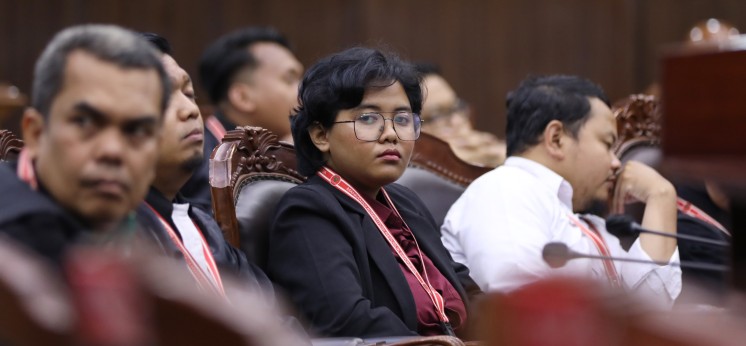
Counsel Ratu Eka Shaira at the ruling hearing for the material judicial review of the Election Law and the Regional Election Law, Thursday (8/28/2025). Photo by MKRI/Ifa.
JAKARTA (MKRI) — The Constitutional Court (MK) declared that the argument portraying the separation of executive and legislative elections as a form of “collective punishment” that is both effective and consistent with presidential principles is unfounded and legally groundless. This opinion is contained in Decision No. 120/PUU-XXIII/2025 on the material judicial review of Article 167 paragraph (3) and Article 347 paragraph (1) of Law No. 7 of 2017 on General Elections and Law No. 10 of 2016 on the Election of Governors, Regents, and Mayors into Law (Pilkada Law) as reinterpreted in the Constitutional Court Decision No. 135/PUU-XXII/2024. The ruling was delivered on Thursday, August 28, 2025.
“The Court must reaffirm that the model of simultaneous elections lies within the corridor of law so long as simultaneity is maintained between elections for members of the national representative bodies (the DPR and DPD) and the presidential/vice-presidential election,” said Deputy Chief Justice Saldi Isra at the ruling hearing for Case No. 120/PUU-XXIII/2025, filed by advocate Zico Leonard Djagardo Simanjuntak.
Article 167 paragraph (3) and Article 347 paragraph (1) of Law No. 7 of 2017, as construed in Constitutional Court Decision No. 135/PUU-XXII/2024, continue to uphold the fundamental principle of simultaneous elections within Indonesia’s presidential system. This is because separating the administration of national-level elections (i.e., elections for members of the House of Representatives or DPR, Regional Representatives Council or DPD, and the president/vice president) from regional-level elections (i.e. elections for members of provincial and regency/city Regional Legislative Council or DPRD, governors/vice governors, regents/vice regents, and mayors/vice mayors) neither undermines the meaning of the president’s direct election by the people nor obstructs the president’s authority as the executive branch, separate from the legislative and judicial branches. Thus, the simultaneity of elections remains consistent with presidential principles.
Moreover, the separation of elections for DPR members, DPD members, and the president/vice president from elections for provincial and regency/city DPRD members, governors/vice governors, regents/vice regents, and mayors/vice mayors still allows the public sufficient space to evaluate the performance of both legislative and executive institutions. In practice, with the interval between the implementation of national elections and local elections—whether two years or up to two and a half years—voters who are dissatisfied with the performance of the DPR, DPD, or the president/vice president may reassess their prior choices and alter their preferences in the subsequent local elections.
The Petitioner’s claim that the simultaneity of elections as determined in Constitutional Court Decision No. 135/PUU-XXII/2024 has created disharmony between the national medium-term development plan (RPJMN) and the regional medium-term development plan (RPJMD) is likewise unfounded and without legal merit. Accordingly, the Court rejected the petition in its entirety.
Also read:
National and Local Elections to Not Be Simultaneous Starting 2029
Petitioner Suggests Presidential-DPR Election Be Separate
In June this year, the Court rendered a decision to separate the organization of the national election of members of DPR, DPD, and president/vice-president (general) from the regional election of members of provincial/regency/city DPRD and governors/regents/mayors and their deputies as reinterpreted in the Constitutional Court Decision No. 135/PUU-XXII/2024. The Petitioner contended that Indonesia should separate executive and legislative elections, as is implemented in South Korea.
He asserted that such a system would strengthen the role of the opposition in parliament in checking and balancing executive power. Conversely, if the House fails to represent the people’s interests, proves unproductive in legislation, or is involved in conflicts of interest, voters could respond by choosing a presidential candidate from a different party in the next election.
Accordingly, in their petitums, the Petitioner requested the Court to declare Article 167 paragraph (3) of the Election Law—“The voting process in an election shall be conducted simultaneously on a public holiday or a day declared a national holiday”—unconstitutional if not interpreted as, “The voting process in an election shall be conducted simultaneously to elect members of the House of Representatives (DPR), the Regional Representatives Council (DPD), the Provincial and Regency/City Legislative Council (DPRD), and subsequently, within a minimum of 2 (two) years and a maximum of 2 (two) years and 6 (six) months after the inauguration of those members, voting shall be conducted simultaneously to elect the president/vice president, governors/vice governors, regents/vice regents, and mayors/vice mayors.”
He also requested the Court to declare Article 347 paragraph (1) of the Election Law—“The voting process in an election shall be conducted simultaneously”—unconstitutional if not interpreted in the same sequenced manner described above.
Author : Mimi Kartika
Editor : N. Rosi
Translator : Yuniar Widiastuti (NL)
Disclaimer: The original version of the news is in Indonesian. In case of any differences between the English and the Indonesian versions, the Indonesian version will prevail.
Thursday, August 28, 2025 | 20:46 WIB 196