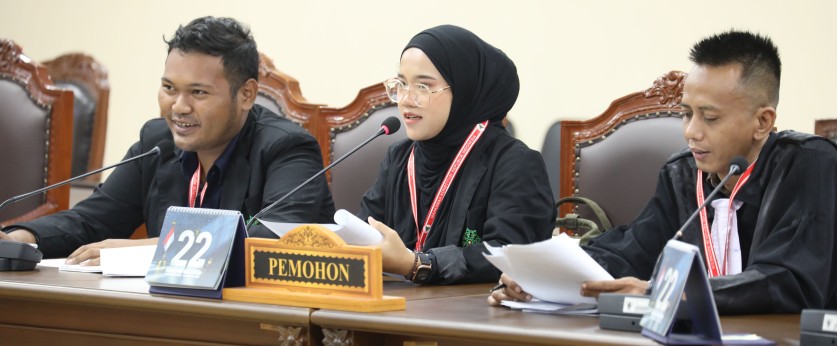
Arina Sa’yin Afifa, Muhammad Adam Arrofiu Arfah, and legal counsel Brahma Aryana presenting the petition at the preliminary hearing for the material judicial review of the Election Law and the Pilkada Law, Friday (8/1/2025). Photo by MKRI/Panji.
JAKARTA (MKRI) — The Constitutional Court (MK) rendered a decision last June to separate the organization of the national election of members of DPR (House of Representatives), DPD (Regional Representatives Council), and president/vice-president (general) from the regional election of members of provincial/regency/city DPRD (Regional Legislative Council) and governor/regent/mayor and their deputy. However, there are at least two new petitions on the material judicial review of the provisions of Article 167 paragraph (3) and Article 347 paragraph (1) of Law No. 7 of 2017 on General Elections and Law No. 10 of 2016 on the Election of Governors, Regents, and Mayors into Law (Pilkada Law) as reinterpreted in the Constitutional Court Decision No. 135/PUU-XXII/2024.
Case No. 120/PUU-XXIII/2025 on Article 167 paragraph (3) and Article 347 paragraph (1) of Law No. 7 of 2017 was filed by advocate Zico Leonard Djagardo Simanjuntak, while case No. 124/PUU-XXIII/2025 was filed by paralegal Brahma Aryana and two law students of Nahdlatul Ulama University Arina Sa’yin Afifa and Muhammad Adam Arrofiu Arfah. The preliminary hearing for those cases took place on Friday, August 1, 2025.
Simanjuntak contended that Indonesia should separate executive and legislative elections, as is implemented in South Korea. He argued that combining the presidential and legislative elections results in the DPR becoming a mere rubber stamp for the executive and the weakening of public accountability, thereby violating the principles of popular sovereignty enshrined in Article 1 paragraph (2) as well as the rule of law enshrined in Article 1 paragraph (3) of the 1945 Constitution.
“If such a system were adopted in Indonesia, a president who performs poorly during the early years of the administration could be corrected by the people in the subsequent legislative election by voting for House members of the opposition parties,” said legal counsel Putu Surya Permana Putra, who attended the hearing remotely.
He asserted that such a system would strengthen the role of the opposition in parliament in checking and balancing executive power. Conversely, if the House fails to represent the people’s interests, proves unproductive in legislation, or is involved in conflicts of interest, voters could respond by choosing a presidential candidate from a different party in the next election.
Putu added that the people could elect a president from a party opposing the House majority as a form of corrective action to ensure a balance of power between branches of government. This would provide constituents with broader and more meaningful space to perform oversight and correction of government conduct.
Accordingly, in their petitums, the Petitioner of case No. 120/PUU-XXIII/2025 requested the Court to declare Article 167 paragraph (3) of the Election Law—“The voting process in an election shall be conducted simultaneously on a public holiday or a day declared a national holiday”—unconstitutional if not interpreted as, “The voting process in an election shall be conducted simultaneously to elect members of the House of Representatives (DPR), the Regional Representatives Council (DPD), the Provincial and Regency/City Legislative Council (DPRD), and subsequently, within a minimum of 2 (two) years and a maximum of 2 (two) years and 6 (six) months after the inauguration of those members, voting shall be conducted simultaneously to elect the president/vice president, governors/vice governors, regents/vice regents, and mayors/vice mayors.”
He also requested the Court to declare Article 347 paragraph (1) of the Election Law—“The voting process in an election shall be conducted simultaneously”—unconstitutional if not interpreted in the same sequenced manner described above.
Conversely, the Petitioners of case No. 124/PUU-XXIII/2025 argued that holding DPRD election as part of the national election and combining them with regional head election violates the constitutional mandate of a five-year electoral cycle. The separation of national and regional elections by a 2 to 2.5-year interval creates a conflict with the five-year periode for DPRD election, resulting in either a vacancy in office or an unconstitutional extension of office terms.
“If DPRD terms do not align with the five-year cycle as elected by the voters or are filled by appointed officials, the constitutional right of voters to directly elect their regional representatives is diminished. The people lose their full right to determine their regional representatives every five years,” said the Petitioners’ legal counsel Girindra Sandino.
Moreover, the Petitioners contended that national elections, particularly presidential elections, tend to generate greater public enthusiasm. Thus, separating national and regional elections does not necessarily ensure increased participation in local elections. Arguments supporting such separation to boost voter turnout, especially at the local level, are not fully supported by comparative data.
They further asserted that changes in electoral design not only affect the strengthening of political parties but also result in significant legal disharmony and conflicts with the Pilkada Law, potentially undermining the Petitioners’ constitutional rights. For example, if a regional election is held in 2031, the legislative seat data used for nominating regional head candidates would be from the 2024 election—seven years old—rendering it outdated and unrepresentative of the current political strength of parties at the local level.
In their petitums, the Petitioners requested the Court to declare that Article 167 paragraph (3) and Article 347 paragraph (1) of the Election Law, as interpreted by Decision No. 135/PUU-XXII/2024, unconstitutional and not legally binding insofar as such interpretation leads to the extension of terms for members of the provincial and regency/city DPRD, governors/vice governors, regents/vice regents, and mayors/vice mayors. The interpretation contradicts the principle of periodic elections “every five years” under Article 22E paragraph (1) of the 1945 Constitution undermines popular sovereignty and the right to vote guaranteed under Articles 1 paragraph (2) and 28D paragraph (1), and violates the constitutional right to legal certainty and equal protection under the law.
They further requested that the Court interpret Article 167 paragraph (3) and Article 347 paragraph (1) of the Election Law as well as Article 3 paragraph (1) of the Regional Election Law to mean that regional elections must still be conducted in a five-year cycle without extending the terms of elected public officials. A transitional regulation must be provided to uphold constitutional period as mandated by the 1945 Constitution and instruct the legislature to revise relevant laws accordingly to ensure consistent periodic elections without prolonging the terms of elected officials and to consider constitutional electoral models that do not compromise fundamental democratic principles.
For reference, in its ruling in Decision No. 135/PUU-XXII/2024, the Constitutional Court declared Article 167 paragraph (3) of the Election Law conditionally unconstitutional and not legally binding unless it is interpreted as: “The voting process in an election shall be conducted simultaneously to elect members of the DPR, DPD, and the President/Vice President, and subsequently, within a minimum of two years and a maximum of two years and six months from the inauguration of the DPR and DPD or the President/Vice President, voting shall be conducted simultaneously to elect members of provincial and regency/city DPRD and governors/vice governors, regents/vice regents, and mayors/vice mayors, on a national public holiday or a day declared a national holiday.”
Furthermore, the Court declared Article 347 paragraph (1) of the Election Law to be conditionally unconstitutional and not legally binding unless similarly interpreted.
Lastly, the Court also declared Article 3 paragraph (1) of Law No. 8 of 2015—concerning the amendment to Law No. 1 of 2015 on the Stipulation of the Government Regulation in Lieu of Law No. 1 of 2014 on Regional Head Elections—conditionally unconstitutional and not legally binding unless interpreted to mean: “Regional elections shall be held simultaneously across the territory of the Republic of Indonesia to elect members of provincial and regency/city Regional Legislative Council and governors/vice governors, regents/vice regents, and mayors/vice mayors within a minimum of two years and a maximum of two years and six months since the inauguration of the House of Representatives and Regional Representatives Council or the President/Vice President.”
Also read: National and Local Elections to Not Be Simultaneous Starting 2029
The hearing was presided over by Deputy Chief Justice Saldi Isra (chair) along with Constitutional Justices Ridwan Mansyur and Arsul Sani. The panel emphasized that each petitioner must explain in detail the normative conflict and causal connection between the challenged provisions and the constitutional provisions serving as the basis of review. The Petitioners must also elaborate the implications of their requested petitums if granted, and substantiate the legal grounds for re-submitting the matter.
Before adjourning the hearing, Deputy Chief Justice Saldi Isra announced that the Petitioners would have 14 days to revise the petition and must submit its soft and hard copy by Thursday, August 14, 2025 at 12:00 WIB.
Author : Mimi Kartika
Editor : Lulu Anjarsari P.
PR : Andhini S.F.
Translator : Yuniar Widiastuti (NL)
Disclaimer: The original version of the news is in Indonesian. In case of any differences between the English and the Indonesian versions, the Indonesian version will prevail.
Friday, August 01, 2025 | 11:13 WIB 513