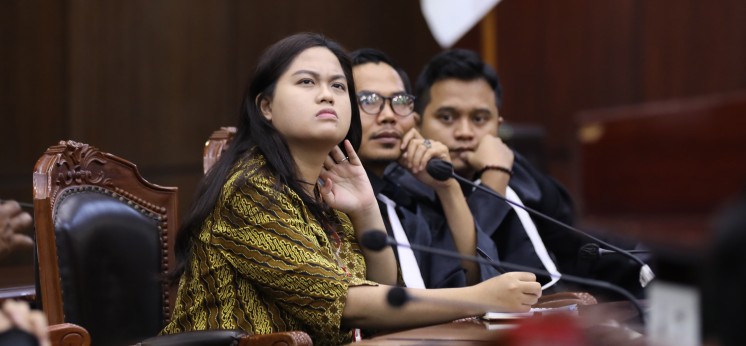
The Petitioners’ counsel Priskila Octaviani at the ruling hearing for the material judicial review of the Lawmaking Law and the Constitutional Court Law, Thursday (8/28/2025). Photo by MKRI/Ifa.
JAKARTA (MKRI) — The Constitutional Court (MK) emphasized that acts of neglect or defiance of its rulings, which are frequently committed by the addressees of such decisions, should not be construed as evidence of the Court’s rulings lacking binding force. Rather, such conduct reflects a lack of legal awareness and compliance on the part of those addressees, as well as a lack of respect for the principles of a democratic rule of law within national life. Accordingly, it is crucial to strengthen legal awareness across all elements of society, including state officials, in order to foster a robust legal culture, consistent with the policies outlined in the National Long-Term Development Plan (RPJPN) 2025–2045.
The statement is part of the Court’s legal consideration, delivered by Constitutional Justice Daniel Yusmic P. Foekh, on the material judicial review of Article 23 paragraph (1) letter b of Law No. 15 of 2019 on the Amendment to Law No. 12 of 2011 on Lawmaking and Article 10 paragraph (1) and Article 11 of Law No. 24 of 2003 on the Constitutional Court. The ruling hearing for Decision No. 129/PUU-XXIII/2025, petitioned by Zico Leonard Djagardo Simanjuntak and Putu Surya Permana Putra, took place on Thursday, August 28, 2025
The Court further noted that one of the measures to achieve this objective is to provide broad public understanding of the importance of adhering to Constitutional Court decisions, which are binding erga omnes, as an expression of compliance with the Court’s authority. On that basis, the Court held that the Petitioners’ arguments concerning Article 23 paragraph (1) letter b of Law No. 15 of 2019 were without legal merit.
Constitutional Complaint
The Court then addressed the Petitioners’ challenge to the constitutionality of Article 10 paragraph (1) of Law No. 24 of 2003, which regulates the powers of the Constitutional Court. The Petitioners argued that the provision is unconstitutional if not interpreted to include the authority to review acts of public officials or state institutions (constitutional complaints), as otherwise it would conflict with Article 24 and Article 28I paragraph (4) of the 1945 Constitution.
The Court held that this issue is substantively identical to the matter addressed in Decision No. 28/PUU-XVII/2019, delivered in an open plenary session on November 28, 2019.
In the case a quo, Justice Foekh explained, the Petitioners’ petitums are essentially the same as that submitted in Cases No. 28/PUU-XVII/2019 and No. 103/PUU-XX/2022. Although the Petitioners added a different constitutional basis for review, i.e. Article 24 of the 1945 Constitution, and supplemented their claims with slightly different arguments, the substance of the petition remains the same as in the two earlier cases.
Therefore, the Court held that the legal considerations set out in its earlier decisions applied mutatis mutandis. As the Court has no compelling reason to depart from its prior jurisprudence, it declared the Petitioners’ arguments in this matter legally unfounded.
Expansion of the Court’s Authority
The Court also considered the Petitioners’ request for an expanded interpretation of Article 11 of Law No. 24 of 2003. They sought a ruling that the provision should empower the Court to issue non-binding constitutional opinions or advisory statements, aimed at preventing uncertainty in constitutional interpretation and encouraging compliance with Constitutional Court decisions.
Having reviewed the petition, the Court explained that said article is in Chapter III on the Authority of the Constitutional Court, specifically in the section regulating its authority. The provision establishes the Court’s competence to take measures necessary for the exercise of its principal jurisdiction as defined in Article 10 paragraph (1) of the same law. Such measures include, among others, summoning state officials, government officers, or citizens to provide information—whether oral, written, or documentary—relevant to the adjudication of constitutional cases within the Court’s jurisdiction.
In the petition a quo, however, the Petitioners asked the Court to reinterpret Article 11 to authorize it to issue “constitutional opinions or advice of a non-binding nature in order to prevent uncertainty in constitutional interpretation and to encourage compliance with Constitutional Court rulings.”
Justice Foekh clarified that this request is essentially equivalent to the Petitioners’ claim concerning Article 10 paragraph (1), which sought to expand the Court’s powers. Within reasonable limits of legal reasoning, adopting such a new interpretation would, in effect, grant the Court additional authority.
He emphasized that, in this regard, any expansion of the Constitutional Court’s jurisdiction, whether core or ancillary powers necessary for the exercise of its principal functions, should be conferred not by the Court itself, but through proper legislative or constitutional processes. For this reason, the Court held that the Petitioners’ arguments regarding the expansion of the Court’s authority under Article 11 of Law No. 24 of 2003, in relation to its principal jurisdiction under Article 10 paragraph (1), as allegedly inconsistent with the 1945 Constitution, were without legal basis.
“[Verdict: The Court] adjudicated, to reject the Petitioners’ petition in its entirety,” said Chief Justice Suhartoyo delivering the verdict from the plenary courtroom.
Also read:
Petitioners Ask for Legislature’s Compliance with Court Decisions
Petitioners Stress Importance of Legislature’s Constitutional Obedience
At the preliminary hearing on Tuesday, August 12, the Petitioners conveyed their losses due to the enforcement of the articles being petitioned. In essence, they seek to strengthen the Constitutional Court’s authority. Through Article 23 paragraph (1) letter b of the Lawmaking Law, they expect mandatory and prompt follow-up on Constitutional Court decisions—not only the verdicts but also on the legal considerations that contain orders, or judicial orders.
Furthermore, through Article 10 paragraph (1) of the Constitutional Court Law, they expect that the Constitutional Court, in its capacity as judicial interpreter, be vested with the power to hear constitutional complaints. With respect to Article 11, they propose that it be expanded to include a non-binding authority to issue legal opinions or fatwa.
In their view, Article 23 paragraph (1) letter b of the Lawmaking Law creates a constitutional loophole that fosters noncompliance, thereby contravening the principle of constitutional supremacy as set out in Article 1 paragraph (3) and Article 24C paragraph (1) of the 1945 Constitution. The phrase “as a consequence of the decision of the Constitutional Court” is, they argue, ambiguous and open to multiple interpretations—unclear as to whether it refers solely to the verdict of a decision or also its legal considerations. This lack of clarity has led to frequent instances of noncompliance, even defiance, particularly by the legislature. Such noncompliance undermines the Constitutional Court’s function as the guardian of the Constitution, as affirmed in Article 24C paragraph (1) of the Constitution.
Therefore, the Petitioners requested the Court to declare Article 23 paragraph (1) letter b of Law No. 15 of 2019 amending Law No. 12 of 2011 on Lawmaking, insofar as the phrase ‘Constitutional Court decision’ is concerned, unconstitutional to the extent that it is not interpreted as requiring the legislature to follow up on Constitutional Court decisions—whether such decisions declare a norm non-binding, conditionally non-binding, unconditionally non-binding, or uphold the validity of a norm but include an order (judicial order) in their legal considerations. The follow-up must include the obligation to implement not only the verdict of the decision but also any legal considerations containing orders, and must be carried out no later than two (2) years from the pronouncement of the decision, or within any other time frame specified in the Constitutional Court decision.”
Author : Sri Pujianti
Editor : N. Rosi
Translator : Yuniar Widiastuti (NL)
Disclaimer: The original version of the news is in Indonesian. In case of any differences between the English and the Indonesian versions, the Indonesian version will prevail.
Thursday, August 28, 2025 | 20:34 WIB 163