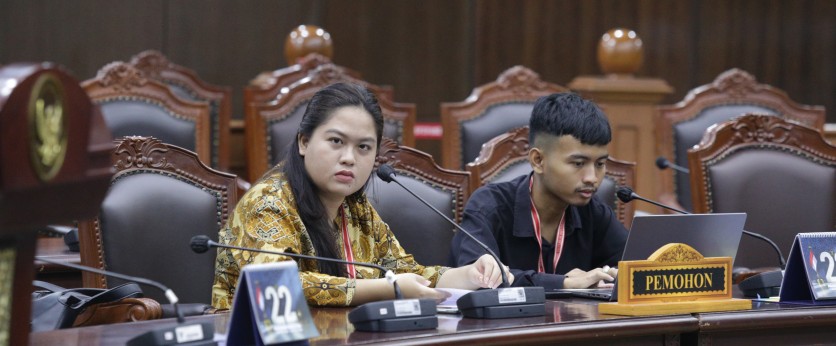
Petitioners at the preliminary hearing of the judicial review of the Lawmaking Law and the Constitutional Court Law for case No. 129/PUU-XXIII/2025, Tuesday (8/12/2025). Photo by MKRI/Bayu.
JAKARTA (MKRI) — Zico Leonard Djagardo Simanjuntak and Putu Surya Permana Putra challenge the material of Article 23 paragraph (1) letter b of Law No. 15 of 2019 on the Amendment to Law No. 12 of 2011 on Lawmaking and Article 10 paragraph (1) and Article 11 of Law No. 24 of 2003 on the Constitutional Court before the Constitutional Court (MK). The preliminary hearing for case No. 129/PUU-XXIII/2025 was presided over by a panel chaired by Chief Justice Suhartoyo on Tuesday, August 12, 2025.
Through legal counsels Leon Maulana Mirza Pasha, Halim Rahmansah, and Priskila Octaviani, the Petitioners presented the principal arguments of their petition, outlining the harm they had suffered from the enforcement of the contested provisions.
Article 23 paragraph (1) letter b of the Lawmaking Law reads, “The National Legislation Program (Prolegnas) shall include an open cumulative list consisting of: b. as a consequence of the decision of the Constitutional Court.”
Article 10 paragraph (1) of the Constitutional Court Law reads, “The Constitutional Court shall hold jurisdiction of first and final instance, whose decisions are final, to: a. review laws against the 1945 Constitution of the Republic of Indonesia; b. resolve disputes over the authority of state institutions whose powers are granted by the 1945 Constitution; c. decide on the dissolution of political parties; and d. resolve disputes over the results of general elections.”
Article 11 of the Constitutional Court Law reads, “For the purpose of exercising the powers referred to in Article 10, the Constitutional Court shall have the authority to summon state officials, government officials, or members of the public to provide testimony.”
In essence, the Petitioners seek to strengthen the Constitutional Court’s authority. Through Article 23 paragraph (1) letter b of the Lawmaking Law, they expect mandatory and prompt follow-up on Constitutional Court decisions—not only the verdicts but also on the legal considerations that contain orders, or judicial orders.
Furthermore, through Article 10 paragraph (1) of the Constitutional Court Law, they Petitioners that the Constitutional Court, in its capacity as judicial interpreter, be vested with the power to hear constitutional complaints. With respect to Article 11, they propose that it be expanded to include a non-binding authority to issue legal opinions or fatwa.
In their view, Article 23 paragraph (1) letter b of the Lawmaking Law creates a constitutional loophole that fosters noncompliance, thereby contravening the principle of constitutional supremacy as set out in Article 1 paragraph (3) and Article 24C paragraph (1) of the 1945 Constitution. The phrase “as a consequence of the decision of the Constitutional Court” is, they argue, ambiguous and open to multiple interpretations—unclear as to whether it refers solely to the verdict of a decision or also its legal considerations. This lack of clarity has led to frequent instances of noncompliance, even defiance, particularly by the legislature. Such noncompliance undermines the Constitutional Court’s function as the guardian of the Constitution, as affirmed in Article 24C paragraph (1) of the Constitution.
Constitutional Complaint
The Petitioners also argue that Article 10 paragraph (1) of the Constitutional Court Law allows the Court to act only at the normative level. They contend that the Court should adopt the constitutional complaint mechanism to strengthen its role as the guardian of the Constitution. A constitutional complaint is, in their view, part of constitutional review, and constitutional review is itself an essential mechanism of constitutionalism—the primary requirement of a state based on the rule of law.
They emphasize that the constitutional complaint is crucial for ensuring constitutional justice, particularly in addressing acts or legal products that cannot be challenged through the existing judicial review mechanism. At present, the Constitutional Court’s authority is limited to reviewing laws against the Constitution, whereas in practice, constitutional violations often arise from legal instruments and actions outside the scope of statutory laws, such as Supreme Court rulings, Supreme Court circulars, agency regulations, presidential or ministerial decrees, and even actions by public officials that clearly infringe upon the citizens’ constitutional rights.
The Petitioners also argue that Article 11 of the Constitutional Court Law does not adequately ensure the exercise of the powers provided for in Article 10. They contend that Article 11 should be interpreted as granting the Constitutional Court authority to issue legal opinions or fatwa. These two provisions, they argue, should serve as the legal basis for the Court to take measures that support the exercise of its functions. The authority to issue such opinions would help prevent uncertainty in constitutional interpretation and promote compliance with Constitutional Court decisions.
Legal Opinions
By analogy with the fatwa of the Supreme Court, which provides guidance for resolving legal issues, the fatwa of the Constitutional Court could be focused on offering guidance, directions, and parameters for implementing Constitutional Court decisions. This is important because, although Constitutional Court decisions are final and binding, their implementation in practice often faces challenges. Such authority would benefit not only the Court—by ensuring its decisions are better understood—but also the addressees of its decisions, such as legislators, who could use the guidance to draft amendments consistent with the constitutional framework established by the Court’s ruling.
Priskila Octaviani outlined the Petitioners’ petitums requesting the Court: “To declare Article 23 paragraph (1) letter b of Law No. 15 of 2019 amending Law No. 12 of 2011 on Lawmaking, insofar as the phrase ‘Constitutional Court decision’ is concerned, inconsistent with the 1945 Constitution of the Republic of Indonesia to the extent that it is not interpreted as requiring the legislature to follow up on Constitutional Court decisions—whether such decisions declare a norm non-binding, conditionally non-binding, unconditionally non-binding, or uphold the validity of a norm but include an order (judicial order) in their legal considerations. The follow-up must include the obligation to implement not only the verdict of the decision but also any legal considerations containing orders, and must be carried out no later than two (2) years from the pronouncement of the decision, or within any other time frame specified in the Constitutional Court decision.”
The Petitioners further request that the Court declare Article 10 paragraph (1) of Law No. 24 of 2003 on the Constitutional Court inconsistent with the 1945 Constitution to the extent that it is not interpreted as: “The Constitutional Court shall have jurisdiction of first and final instance, whose decisions are final, to: a. review laws against the 1945 Constitution of the Republic of Indonesia; b. review actions of public officials or state institutions that contradict the 1945 Constitution; c. resolve disputes over the authority of state institutions whose powers are granted by the 1945 Constitution; d. decide on the dissolution of political parties; and e. resolve disputes over the results of general elections.”
They also request that Article 11 of Law No. 24 of 2003 be declared inconsistent with the 1945 Constitution insofar as the phrase “for the purpose of exercising its powers” is concerned, unless it is interpreted as granting the Constitutional Court the authority to issue non-binding constitutional opinions or fatwa in order to prevent uncertainty in constitutional interpretation and to promote compliance with the Court’s decisions.
Comparison with Other Countries
In his remarks, Constitutional Justice Daniel Yusmic P. Foekh advised the Petitioners to provide examples from other jurisdictions where not only the verdicts but also the legal considerations of constitutional court decisions are binding. “The legal considerations must also be binding on the addressees of the Constitutional Court’s decisions so that they may conduct further elaboration and study on the matter,” he explained.
Constitutional Justice M. Guntur Hamzah also noted that the legal arguments presented in the petition needed to be strengthened by demonstrating their constitutional conflict. “If the Lawmaking Law and the Constitutional Court Law indeed contravene the Constitution, then this must be clearly contested. As it stands, the petition expresses the issue in general terms,” he remarked.
At the end of the session, Chief Justice Suhartoyo announced that the Petitioners would have 14 days to revise the petition, which must be resubmitted no later than Monday, August 25 at 12:00 WIB to the Registrar’s Office. The Court will then schedule the second hearing to hear the revisions to the petition.
Author : Sri Pujianti
Editor : Lulu Anjarsari P.
PR : Raisa Ayuditha M.
Translator : Yuniar Widiastuti (NL)
Disclaimer: The original version of the news is in Indonesian. In case of any differences between the English and the Indonesian versions, the Indonesian version will prevail.
Tuesday, August 12, 2025 | 16:11 WIB 212