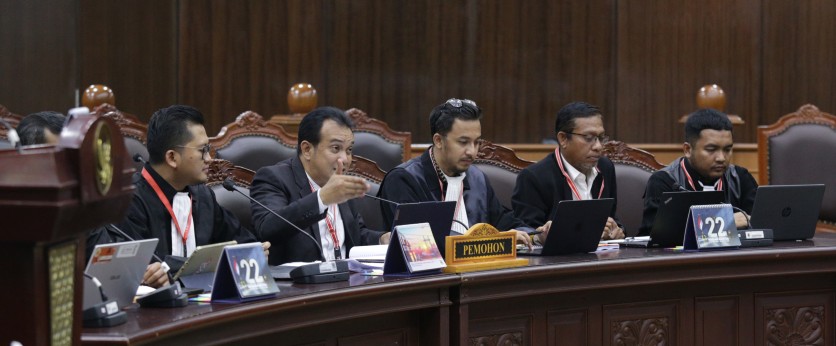
Petitioner’s Legal Counsel Present at Hearing for Amended Petition in Case No. 131/PUU-XXIII/2025, Tuesday (08/26/2025). Photo by MKRI/Bay
JAKARTA, (MKRI) – The Constitutional Court (MK) once again held a judicial review hearing on Law No. 7 of 2017 concerning General Elections (Election Law) and Law No. 17 of 2014 concerning the MPR, DPR, DPD, and DPRD (MD3 Law) against the 1945 Constitution of the Republic of Indonesia. The case, registered as No. 131/PUU-XXIII/2025, was heard on Tuesday (08/26/2025) in the Court’s Plenary Room with the agenda of hearing the petition’s revisions.
The petition was filed by the Labor Party, challenging several provisions: Article 414(1) as interpreted by MK Decision No. 116/PUU-XXI/2023, Article 415(1), and Article 415(2) of the Election Law, as well as Article 82(3) of the MD3 Law.
During the hearing, Said Salahudin, counsel for the Labor Party (Petitioner), explained that the revisions mainly focus on elaborating the legal standing of the party. He emphasized that the Court’s jurisdiction was not in dispute, while the explanation of the Petitioner’s legal standing now spans 15 pages (pages 11–25 of the petition).
“The Petitioner has refined its explanation of legal standing, particularly in relation to meeting the five constitutional loss requirements established by the Court in Decision No. 006/PUU-III/2005, Decision No. 11/PUU-V/2007, and subsequent rulings,” said Said.
In its legal standing argument, the Petitioner essentially outlined that the Labor Party has a realistic chance of securing more votes in the 2029 Elections, citing its significant performance in the 2024 Elections. As a new political party, it managed to surpass several established and new parties in various electoral districts. To reinforce this claim, the Petitioner attached 17 supporting tables in its amended petition.
Read also: Labor Party Challenges Parliamentary Threshold
The petition challenges Article 414(1) of the Election Law, which states: “A political party contesting the election must secure at least 4% of the total valid national votes to qualify for seat allocation in the DPR.”
This provision was previously interpreted in MK Decision No. 116/PUU-XXI/2023 (29 February 2024) as constitutional for the 2024 DPR Elections and conditionally constitutional for the 2029 and subsequent DPR Elections, provided that the parliamentary threshold norm and its percentage figure are revised in line with required criteria.
According to counsel, the central constitutional issue is the parliamentary threshold, namely the minimum vote requirement for political parties to qualify for seat distribution in the DPR.
“The Petitioner acknowledges that the threshold is still considered constitutional and within the realm of the legislature’s open legal policy,” said Said.
However, the Petitioner referred to MK Decision No. 62/PUU-XXII/2024, in which the Court reopened review space and even annulled the presidential threshold, a policy it had previously deemed part of open legal policy. The Petitioner argued that the Court’s stance can evolve, as seen in Decision No. 14/PUU-XI/2013 in conjunction with Decision No. 116/PUU-XXI/2023, which affirm the Court’s authority to re-examine provisions previously declared constitutional if they later conflict with political rights, popular sovereignty, or principles of rationality.
Thus, the Petitioner argued that the parliamentary threshold, though once deemed an open legal policy, could now be subject to reinterpretation, just like the presidential threshold, if it contradicts fundamental constitutional principles.
Parliamentary Threshold Based on Electoral Districts
The Petitioner argued that limiting representation solely through a national threshold is disproportionate. As a result, certain groups lose representation not because they lack genuine support, but merely due to statistical cutoffs. This creates representational distortion, favors large parties, suppresses political pluralism, and hinders political regeneration in parliament.
They also pointed out the inconsistency between a proportional electoral system and the existence of a parliamentary threshold. A proportional system is designed to minimize wasted votes and ensure proportionality between vote share and seats. By contrast, majoritarian systems deliberately discard losing votes. For that reason, the Petitioner argued that applying a threshold within a proportional system is contradictory and results in electoral injustice, undermining citizens’ equality before the law.
Citing data from the 2019 and 2024 Elections, the Petitioner suggested that the 4% threshold might only be relevant if applied at the electoral district (dapil) level, not on a national scale.
In its petitum, the Petitioner asked the Court to declare the challenged provisions unconstitutional and not legally binding. Essentially, the Labor Party requested the Court to abolish the national parliamentary threshold.
However, should the Court deem a threshold necessary, the Petitioner submitted an alternative petitum: the threshold should be applied per electoral district (dapil) rather than based on the total national valid votes.
Author : Utami Argawati.
Editor : Nur R.
Translator : Agusweka Poltak Siregar.
Disclaimer: The original version of the news is in Indonesian. In case of any differences between the English and the Indonesian versions, the Indonesian version prevails.
Tuesday, August 26, 2025 | 16:57 WIB 488