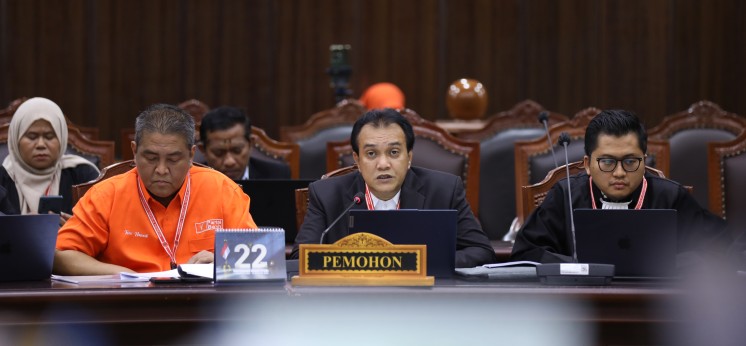
Legal counsel, Said Salahudin, along with the Secretary General of the Labor Party, Ferri Nuzarli, attending the preliminary hearing of the judicial review of the law on the parliamentary threshold, Wednesday (13/08). Photo by MKRI/Ifa.
Jakarta (MKRI) – Labor Party submitted a material judicial review of Article 414 paragraph (1) as had been interpreted by the Constitutional Court’s Decision No. 116/PUU-XXI/2023 dated February 29, 2024, Article 415 paragraph (1), and Article 415 paragraph (2) of Law No. 7 of 2017 on the General Elections (General Elections Law) and Article 82 paragraph (3) of Law No. 17 of 2014 on the People’s Consultative Assembly, the People’s Representatives Council, the Regional Representatives Council, and Regional People Representatives Council (MD3 Law) against the 1945 Constitution of the Republic of Indonesia. The preliminary hearing of Case No. 131/PUU-XXIII/2025 was held on Wednesday, August 13, 2025.
Article 414, paragraph (1) of the General Elections Law reads, “Political Parties participating in the election must meet a vote threshold of at least 4% (four percent) of the total valid votes nationally to be included in the determination of the allocation of seats in the House of Representatives (DPR).” This norm has been interpreted by the Constitutional Court Decision No. 116/PUU-XXI/2023, dated February 29, 2024, as follows:
“Declares that the norm of Article 414 paragraph (1) of Law No. 7 of 2017 on General Elections (State Gazette of the Republic of Indonesia Year 2017 No. 182, Supplement to the State Gazette of the Republic of Indonesia No. 6109) is constitutional as long as it remains applicable for the 2024 DPR elections and constitutionally conditional for implementation in the 2029 DPR elections and subsequent elections as long as changes have been made to the parliamentary threshold norm and the amount or percentage of the parliamentary threshold by referring to the stipulated requirements.”
Sahid Salahudin, as the legal counsel of the Labor Party, during the hearing, stated that the constitutional issue being challenged in the petition was regarding the minimum number of votes for the political parties to be included in the determination of the seat in the House of Representatives, known as the parliamentary threshold. “The Petitioner realizes that the provision on the parliamentary threshold is deemed constitutional, and the Constitutional Court declared it as the authority of the lawmakers or open legal policy,” he said.
However, the Petitioner referred to the Constitutional Court Decision No. 62/PUU-XXII/2024, which opens the opportunity for reconsideration and, further, revokes norms that were previously declared as open legal policy, such as those related to the presidential threshold. According to the Petitioner, the Court’s standing may change, as referred to Decision No. 14/PUU-XI/2013 juncto Decision No. 116/PUU-XXI/2023, which emphasizes that the Court has the authority to reconsider the material or substance of law, including those previously declared constitutional, as long as it is violating political rights, the popular sovereignty, and the principle of rationality.
Therefore, the Petitioner argued that the provisions on the parliamentary threshold, which were previously considered as open legal policy by the Court, may be given a new interpretation, similar to the Presidential threshold, which is not absolute as an open legal policy, if it contradicts the political rights, the popular sovereigny, and the principle of rationality.
Representation Loss
In the petition, the Petitioner presents that based on the votes acquired by political parties for the House of Representatives in the 2024 General Election, there are 17.304.303 votes or 11,3 percent that were not converted to the number of seats. This figure reflects wasted votes on a large scale, which directly causes the loss of political representation in several regions.
The petitioner asserts that one of the main objectives of the democratic system and elections is to ensure fair representation. However, the national threshold provision actually causes legitimate votes of the people to fail to produce representatives in parliament. According to the petitioner, this violates the principle of representative democracy, results in a homogeneous parliament, and distorts the election results from their original form.
The threshold rule is also considered contrary to the principle of popular sovereignty and the principle of electoral justice. Consequently, only parties that exceed the threshold are entitled to be counted in the determination of seats in the House of Representatives (DPR) and to form factions. In contrast, the votes of parties below the threshold are disregarded. The petitioner believes this condition renders the popular mandate channeled through political parties meaningless.
Parliamentary Threshold Based on Electoral Districts
The petitioner considers that limiting representation solely based on a threshold is a disproportionate measure. Representation of particular community groups is lost only due to statistical factors, not because of the absence of real support from voters. This situation creates representation distortion, benefits large parties, narrows political pluralism, and hampers political regeneration and renewal in parliament.
The petitioner also highlights the inconsistency between the application of the proportional electoral system and the existence of the parliamentary threshold. The proportional system is essentially intended to minimize wasted votes and ensure proportional representation between the percentage of votes obtained and the number of seats. In contrast, the majoritarian system discards losing votes. Therefore, the petitioner argues that the threshold in the proportional system is a contradiction that causes injustice in the election process and results, as well as reduces the equality of citizens before the law. Based on data from the 2019 and 2024 elections, the petitioner states that a 4 (four) percent threshold is only relevant if applied at the level of electoral districts (dapil), not nationally.
In the petition, the petitioner requests the Constitutional Court to declare the challenged articles incompatible with the 1945 Constitution of the Republic of Indonesia (UUD NRI 1945) and therefore void. Essentially, the petitioner asks the Constitutional Court to abolish the national parliamentary threshold rule. However, suppose the Constitutional Court deems the parliamentary threshold rule necessary. In that case, the petitioner submits an alternative petition requesting the enforcement of a parliamentary threshold based on electoral districts, not based on the national valid votes.
Responding to the Petitioner’s petition, Justice Daniel Yusmic P. Foekh advised the Petitioner to strengthen the legal standing. At the end of the hearing, the justices allowed the petitioner to revise the petition in 14 days. The revised petition must be submitted no later than Tuesday, August 26, 2025, at 12.00 local time.
Author: Utami Argawati
Editor: Nur R.
Translator: Rizky Kurnia Chaesario
Read more:
Petition No. 131/PUU-XXIII/2025 in Indonesian
Disclaimer: The original version of the news is in Indonesian. In case of any differences between the English and the Indonesian versions, the Indonesian version will prevail.
Wednesday, August 13, 2025 | 16:22 WIB 1091