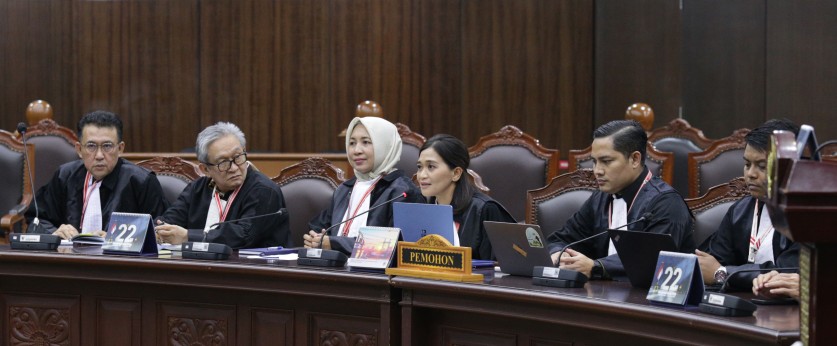
The Petitioner’s legal counsels at the revision hearing for the material judicial review of Law No. 31 of 1999 on the Eradication of the Criminal Acts of Corruption for case No. 136/PUU-XXIII/2025, Tuesday (8/26/2025). Photo by MKRI/Bayu.
JAKARTA (MKRI) — Hasto Kristiyanto, the Petitioner in case No. 136/PUU-XXIII/2025, conveyed the revisions to the material judicial review petition of Article 21 of Law No. 31 of 1999 on the Eradication of the Criminal Acts of Corruption (Anti-Corruption Law), as amended by Law No. 2001, to the Constitutional Court (MK). Having been sentenced to three years and six months’ imprisonment and a fine of Rp250 million, substitutable by three months’ detention, after being found guilty of bribery in connection with the obstruction of justice in the corruption case of suspect Harun Masiku, he argued that corruption does not constitute a crime against humanity.
“There is an additional argument we included at the end of the petition, namely that corruption is not a crime against humanity,” said legal counsel Annisa Ismail at the petition revision hearing on Tuesday, August 26, 2025 in the plenary courtroom.
Annisa explained that corruption is not a new phenomenon but a global one. The Petitioner contends that corruption does not qualify as an extraordinary crime, let alone as a violation of human rights, as is often promoted by certain groups without fully understanding its meaning or scope, aside from serving short-term interests.
She noted that in countries such as the Netherlands, the criminalization of bribery as a form of corruption is regulated under the Dutch Penal Code, as is the case in France and Germany. In essence, corruption may be described as the misuse of public office for personal gain, whether by requesting, receiving, or extorting benefits.
This also extends to private actors who actively offer bribes to secure favorable policies or competitive advantages. Even in instances where no bribe is involved, acts of patronage, nepotism, collusion, diversion of state assets, or embezzlement of state revenue may still amount to corrupt practices.
In relation to Article 21 of the Anti-Corruption Law, which is classified as “another criminal act related to corruption,” it becomes clear that the act is not inherently part of corruption offenses. Even if it were assumed—quod non—that Article 21 fell within the scope of corruption, it would still be excessive and disproportionate for the penalties under Article 21 to exceed those prescribed for core corruption offenses under the same law.
Accordingly, the Petitioner asserts that the penalties under Article 21 of the Anti-Corruption Law, as applied against him, are not only disproportionate compared to certain primary offenses in the statute, but also give rise to a new form of injustice. He maintains that Article 21 has been interpreted and applied in a disproportionate manner, creating legal uncertainty and thereby contravening the principles of a just rule of law.
“Article 21 violates Article 28D paragraph (1). We also invoke Article 57 to underscore the importance of limiting the scope of Article 21 by adding the element of unlawfulness so that the provision meets the requirements of lex stricta, lex scripta, and lex certa,” Annisa emphasized.
Article 21 of the Anti-Corruption Law provides: “Any person who intentionally prevents, obstructs, or directly or indirectly sabotage the investigation, prosecution, and examination of suspects or defendants or witnesses in corruption cases in a court of justice shall be subject to imprisonment for a minimum of three (3) years and a maximum of twelve (12) years, and/or a fine of not less than Rp150,000,000.00 (one hundred and fifty million rupiah) and not more than Rp600,000,000.00 (six hundred million rupiah).”
In his petitums, the Petitioner requests the Court to declare Article 21 of the Anti-Corruption Law unconstitutional and not legally binding insofar as it is not interpreted to mean: “Any person who intentionally prevents, obstructs, or directly or indirectly sabotage the investigation, prosecution, and examination of suspects or defendants or witnesses in corruption cases in a court of justice by means of physical violence, threats, intimidation, intervention, and/or promises of undue benefit, shall be subject to imprisonment for a minimum of three (3) years and/or a fine of not less than Rp150,000,000.00 (one hundred and fifty million rupiah) and not more than Rp600,000,000.00 (six hundred million rupiah).” He also requests that the Court declare the word “and” in the phrase “the investigation, prosecution, and examination in a court of justice” in said article unconstitutional and not legally binding if not interpreted to mean that it is cumulative in nature, meaning that the act of preventing, obstructing, or sabotaging must occur in all three stages: investigation, prosecution, and trial.
Also read: Former House Member Hasto Kristiyanto Challenges Anti-Corruption Law
The former House of Representatives (DPR) member and PDI-P (Indonesian Democratic Party of Struggle) politician filed the petition as he believes the content of the article to be in violation of his constitutional rights as guaranteed by the 1945 Constitution. He had been named a suspect and charged with a criminal act in violation of Article 21 of the Anti-Corruption Law in conjunction with Article 65 paragraph (1) of the Criminal Procedure Code (KUHAP), but received an amnesty from President Prabowo Subianto. Amnesty is a pardon by the head of state to individuals or groups who have committed particular crimes.
Author : Mimi Kartika
Editor : N. Rosi
PR : Raisa Ayuditha Marsaulina
Translator : Yuniar Widiastuti (NL)
Disclaimer: The original version of the news is in Indonesian. In case of any differences between the English and the Indonesian versions, the Indonesian version will prevail.
Tuesday, August 26, 2025 | 19:18 WIB 302