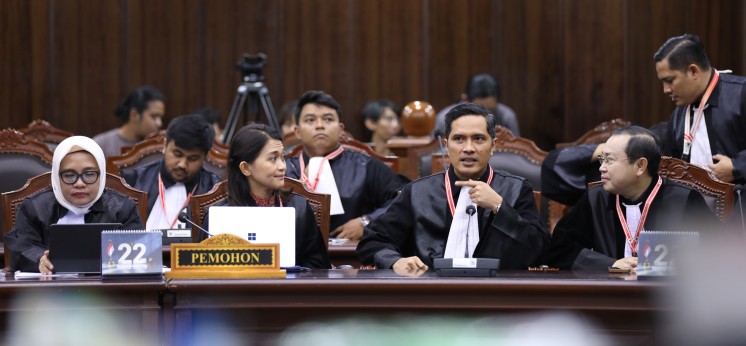
The Petitioner’s legal counsels at the preliminary hearing for the material judicial review of Law No. 31 of 1999 on the Eradication of the Criminal Acts of Corruption, Wednesday (8/14/2025). Photo by MKRI/Ifa.
JAKARTA (MKRI) — Former House of Representatives (DPR) member Hasto Kristiyanto has filed for the material judicial review of Article 21 of Law No. 31 of 1999 on the Eradication of the Criminal Acts of Corruption (Anti-Corruption Law), as amended by Law No. 2001, to the Constitutional Court (MK). He believes the content of the article to be in violation of his constitutional rights as guaranteed by the 1945 Constitution.
The Petitioner has been named a suspect and charged with a criminal act in violation of Article 21 of the Anti-Corruption Law in conjunction with Article 65 paragraph (1) of the Criminal Procedure Code (KUHAP). He contends that, in practice, Article 21 is interpreted disproportionately, even creating legal uncertainty, thereby conflicting with the principles of a just rule of law.
“Criminal law in general—including, but not limited to, Article 21 of the Anti-Corruption Law—can always be used to deprive a person of liberty, and even to take human life. Therefore, it cannot be interpreted expansively in a manner inconsistent with the intent of the legislature,” said the Petitioner’s legal counsel Erna Ratnaningsih at the preliminary hearing for Case No. 136/PUU-XXIII/2025 on Wednesday, August 13, 2025.
Erna argued that Article 21 of the Anti-Corruption Law should not be interpreted and applied according to the expediency of law enforcement authorities. Rather, the scope of meaning contained in the provision must be restored to its textual wording and intended meaning, so as to ensure democratic accountability. According to the Petitioner, Article 21 of the Anti-Corruption Law does not constitute a substantive anti-corruption norm, yet it is often used to threaten individuals who are not perpetrators of corruption.
Article 21 of the Anti-Corruption Law provides: “Any person who intentionally prevents, obstructs, or directly or indirectly sabotage the investigation, prosecution, and examination of suspects or defendants or witnesses in corruption cases in a court of justice shall be subject to imprisonment for a minimum of three (3) years and a maximum of twelve (12) years, and/or a fine of not less than Rp150,000,000.00 (one hundred and fifty million rupiah) and not more than Rp600,000,000.00 (six hundred million rupiah).”
The Petitioner argues that, based on its wording, Article 21 of the Anti-Corruption Law may only be alleged or charged against individuals who intentionally prevent, obstruct, or directly or indirectly sabotage the investigation, prosecution, and examination of corruption cases. Accordingly, it should not be used to designate or indict a person as a perpetrator of corruption.
Due to the disparity in penalties between substantive offenses and accessory acts, this provision, in the Petitioner’s view, results in unjust sentencing disparities. It would be erroneous, he argues, if a person suspected of committing corruption were simultaneously alleged to have obstructed an investigation or prosecution merely because certain communications or confirmations were deemed related to the criminal case.
Furthermore, the Petitioner asserts that the offense under Article 21 of the Anti-Corruption Law is cumulative in nature. Thus, to prove the offense, it must be established not only that the investigation and prosecution could not proceed, but also that the trial could not be conducted. In other words, a finding of a violation of Article 21 requires proof that the act resulted in the inability to conduct the investigation, prosecution, and trial of the defendant.
To prevent Article 21 from becoming a tool of excessive retribution—given that its minimum penalty is higher than that for certain substantive corruption offenses, such as Article 13 of the Anti-Corruption Law—the Petitioner argues that the minimum penalty for violations of Article 21 should at least be aligned with that under Article 13. Since Article 21 does not constitute a substantive corruption offense, its meaning must be interpreted reasonably, legally, and in a manner consistent with constitutional principles.
“Therefore, the appropriate penalty for a violation of Article 21 of the Anti-Corruption Law should be construed as equivalent to the lowest penalty under the Anti-Corruption Law—Article 13—which carries a maximum imprisonment of three years,” Erna stated.
In his petitums, the Petitioner requests the Court to declare Article 21 of the Anti-Corruption Law unconstitutional and not legally binding insofar as it is not interpreted to mean: “Any person who intentionally prevents, obstructs, or directly or indirectly sabotage the investigation, prosecution, and examination of suspects or defendants or witnesses in corruption cases in a court of justice by means of physical violence, threats, intimidation, intervention, and/or promises of undue benefit, shall be subject to imprisonment for a minimum of three (3) years and/or a fine of not less than Rp150,000,000.00 (one hundred and fifty million rupiah) and not more than Rp600,000,000.00 (six hundred million rupiah).” He also requests that the Court declare the phrase “the investigation, prosecution, and examination in a court of justice” in said article unconstitutional and not legally binding if not interpreted to mean that it is cumulative in nature, meaning that the act of preventing, obstructing, or sabotaging must occur in all three stages: investigation, prosecution, and trial.
Author : Mimi Kartika
Editor : N. Rosi
PR : Raisa Ayuditha Marsaulina
Translator : Yuniar Widiastuti (NL)
Disclaimer: The original version of the news is in Indonesian. In case of any differences between the English and the Indonesian versions, the Indonesian version will prevail.
Wednesday, August 13, 2025 | 18:11 WIB 424