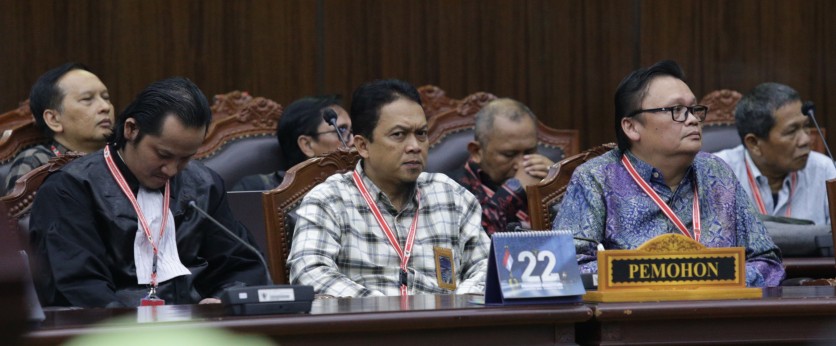
The Petitioner at the ruling hearing for the judicial review of the Law on Financial Sector Development and Reinforcement for case No. 61/PUU-XXIII/2025, Thursday (8/14/2025). Photo by MKRI/Bayu.
JAKARTA (MKRI) — The Constitutional Court (MK) rejected the petition for case No. 61/PUU-XXIII/2025 on the material judicial review of Article 161 paragraph (2), Article 162 paragraph (4), and Article 164 paragraph (1) letter b of Law No. 4 of 2023 on the Financial Sector Development and Reinforcement (P2SK Law). The case concerns lump-sum payment of pension benefits under a certain amount determined by the OJK (Financial Services Authority).
“In the verdict, [the Court] adjudicated [to] reject the Petitioner’s petition in its entirety,” said Chief Justice Suhartoyo at the ruling hearing on Thursday, August 14, 2025 in the plenary courtroom.
Delivering the Court’s legal considerations, Constitutional Justice Enny Nurbaningsih said among the provisions granting authority to the OJK is Article 164 paragraph (3) of Law No. 4 of 2023, which essentially stipulates that further provisions concerning the procedures for the lump-sum payment of pension benefits, as referred to in Article 164 paragraphs (1) and (2), shall be regulated in an OJK regulation. The delegation of authority to OJK to further regulate the implementation of pension programs cannot be separated from the OJK’s duties and powers as provided under Article 6 paragraph (1) letter c of Law No. 11 of 2011, as amended by Article 8 of Law No. 4 of 2023, which establishes that one of the OJK’s functions is to regulate and supervise financial service activities in the insurance, guarantee, and pension fund sectors.
The Court has consistently held that the periodic payment of pension benefits does not contravene the 1945 Constitution. Accordingly, such regulation, including the exception provided under Article 164 paragraph (1) letter b of Law No. 4 of 2023, falls within the legislative policy of the legislature. The exception stipulated in Article 164 paragraph (1) letter b authorizes the OJK to determine the threshold or amount that may serve as the benchmark for granting pension benefits in a lump-sum payment. This remains within the scope of its mandate to regulate and supervise the administration of pension programs.
With respect to pension benefit arrangements, they apply to all participants or beneficiaries without exception and are determined based on the pension value threshold set by the OJK. This is consistent with the philosophy of pension programs, as previously considered by the Court, in that differentiating the opportunity to receive pension benefits in a lump sum payment based on the amount of pension benefits is intended to ensure that such benefits can significantly meet the needs and economic continuity of participants or beneficiaries.
If the pension benefit value is too small or insufficiently significant as measured by the benchmark established by OJK as the regulatory and policymaking body, the sustainability of the economic capacity of participants or beneficiaries, which is in line with national economic objectives, will be difficult to achieve. Therefore, in the Court’s view, the determination of a pension benefit threshold as a requirement for lump-sum payment does not constitute a discriminatory legislative policy, as it is applied without distinction by category or classification.
“Accordingly, the Petitioner’s claim that the provision of Article 164 paragraph (1) letter b of Law No. 4 of 2023 contravenes Article 28I paragraph (2) of the 1945 Constitution of the Republic of Indonesia is without legal merit,” Justice Enny stressed.
Also read:
Telkom Employees Union Tests Provisions of Widow and Widower Pension Program
Telkom Employees Union Question Different Payments of Pension
The Petitioner, SEKAR TELKOM, is represented by its chairman and the secretary-general of its central executive board. It argued that the exception in Article 164 paragraph (1) letter b of the P2SK Law had harmed their constitutional rights, as it allows pension payment in a lump sum under a certain amount determined by the OJK.
The OJK has the authority to stipulate the minimum amount of pension benefits that determines whether a participant’s pension may be paid in a lump sum or not. Under the OJK Regulation No. 27 of 2023, only pension under or up to Rp500 million may be paid in a lump sum.
Article 161 paragraph (2), which reads, “Payment of Pension Benefits to Participants and their Widows/Widowers or Children shall be made periodically.” In addition, Article 162 paragraph (4) reads, “Pension Funds that organize Fixed Contribution Pension Programs, Pension Benefits for Participants, Widows/Widowers, or Children shall be paid periodically for a certain period.” Meanwhile, Article 164 paragraph (1) letter b reads, “Pension Benefits for Participants or Entitled Parties may be paid in one lump sum with the following provisions: b. the amount of Pension Benefits is less than a certain amount determined by the Financial Services Authority.”
The Petitioner asserted that pension participants or their beneficiaries should be given freedom to choose whether to receive pension periodically or in a lump sum. In the petitums, it requested the Court to declare Article 161 paragraph (2) of Law No. 4 of 2023 unconstitutional and not legally binding insofar as it is not interpreted as “Payment of Pension Benefits for Participants, Widows/Widowers, or Children may be made periodically or at once based on the agreement of the Participants, Widows/Widowers, the guardians of the children, or the entitled party;” to declare Article 162 paragraph (4) of Law No. 4 of 2023 unconstitutional and not legally binding insofar as it is not interpreted as “Pension Funds that organize Fixed Contribution Pension Programs, Pension Benefits for Participants, Widows/Widowers, or Children shall be paid in one lump sum or periodically for a certain period based on the agreement of the Participants, Widows/Widowers, the guardians of the children, or the entitled party;” to declare Article 164 paragraph (1) letter b of Law No. 4 of 2023 unconstitutional and must be interpreted as “binding according to the agreement of Participants, Widows/Widowers, the guardians of the children, or entitled parties without being determined based on the value of their Pension Benefits.”
Author : Mimi Kartika
Editor : Lulu Anjarsari P.
PR : Fauzan Febriyan
Translator : Yuniar Widiastuti (NL)
Disclaimer: The original version of the news is in Indonesian. In case of any differences between the English and the Indonesian versions, the Indonesian version will prevail.
Thursday, August 14, 2025 | 17:40 WIB 205