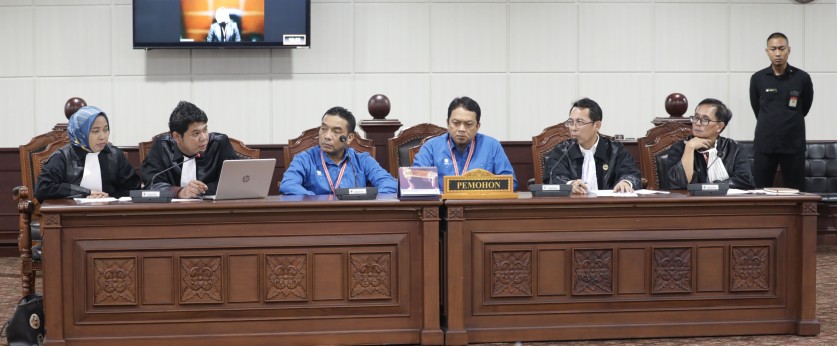
The Petitioners and their legal counsels at the judicial review hearing of the Law on Financial Sector Development and Reinforcement for case No. 61/PUU-XXIII/2025, Thursday (5/15/2025). Photo by MKRI/Panji.
JAKARTA (MKRI) — PT Telekomunikasi Employees Union (SEKAR TELKOM) conveyed the revisions to their judicial review petition of Article 161 paragraph (2), Article 162 paragraph (4), and Article 164 paragraph (1) letter b of Law No. 4 of 2023 on the Financial Sector Development and Reinforcement (P2SK Law) on Wednesday, May 28, 2025. They argued that the exception to pension payment of a certain amount is unconstitutional.
For the same thing, both participants, both the purpose of the pension program is for the benefit of the retirement of participants, of course why is this differentiated, like that, which we are arguing about
The provision in question in Article 164 paragraph (1) letter b of P2SK Law reads, “Pension Benefits for Participants or Entitled Parties may be paid in one lump sum with the following provisions: b. the amount of Pension Benefits is less than a certain amount determined by the Financial Services Authority.” The article regulates an exception, which allows pension payment in a lump sum under a certain amount determined by the OJK (Financial Services Authority).
Only pension under or up to Rp500 million may be paid in a lump sum but another provision stipulates that pension be paid periodically, not in a lump sum, i.e. Article 161 paragraph (2), which reads, “Payment of Pension Benefits to Participants and their Widows/Widowers or Children shall be made periodically.” In addition, Article 162 paragraph (4) reads, “Pension Funds that organize Fixed Contribution Pension Programs, Pension Benefits for Participants, Widows/Widowers, or Children shall be paid periodically for a certain period.”
Therefore, the Petitioners asserted that the articles being petitioned are discriminatory and prevent pension participants or beneficiaries from receiving fixed contribution pension in a lump sum. This contrasts with the fact that those articles mandating that pension be paid periodically, thus resulting in the loss of the Petitioners’ constitutional rights due to delay in obtaining their rights.
Also read: Telkom Employees Union Tests Provisions of Widow and Widower Pension Program
SEKAR TELKOM is represented by its chairman and the secretary-general of the Central Executive Board of PT Telekomunikasi Indonesia Employees Union. The Petitioners argued that participants of pension programs and their heirs should be given the freedom to choose whether to take the pension benefits periodically or all at once.
In their petitums, the Petitioners requested the Court to declare Article 161 paragraph (2) of Law No. 4 of 2023 unconstitutional and not legally binding insofar as it is not interpreted as “Payment of Pension Benefits for Participants, Widows/Widowers, or Children may be made periodically or at once based on the agreement of the Participants, Widows/Widowers, the guardians of the children, or the entitled party;” to declare Article 162 paragraph (4) of Law No. 4 of 2023 unconstitutional and not legally binding insofar as it is not interpreted as “Pension Funds that organize Fixed Contribution Pension Programs, Pension Benefits for Participants, Widows/Widowers, or Children shall be paid in one lump sum or periodically for a certain period based on the agreement of the Participants, Widows/Widowers, the guardians of the children, or the entitled party;” to declare Article 164 paragraph (1) letter b of Law No. 4 of 2023 unconstitutional and must be interpreted as “binding according to the agreement of Participants, Widows/Widowers, the guardians of the children, or entitled parties without being determined based on the value of their Pension Benefits.”
The case was heard by Constitutional Justices Arief Hidayat, Enny Nurbaningsih, and Asrul Sani. The session will be reported to the justice deliberation meeting to decide whether the case be ruled with or without plenary examination hearings.
Author : Mimi Kartika
Editor : Lulu Anjarsari P.
PR : Raisa Ayuditha
Translator : Yuniar Widiastuti (NL)
Disclaimer: The original version of the news is in Indonesian. In case of any differences between the English and the Indonesian versions, the Indonesian version will prevail.
Wednesday, May 28, 2025 | 17:38 WIB 241