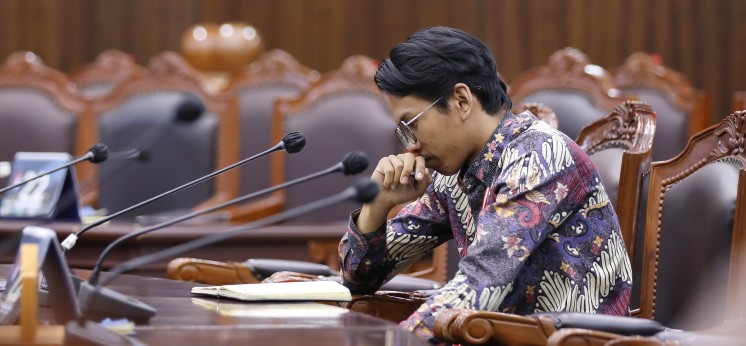
Legal counsel Brahma Aryana at the ruling hearing for the judicial review of Law No. 20 of 2003 on the National Education System, Thursday (8/14/2025). Photo by MKRI/Ifa.
JAKARTA (MKRI) — The Constitutional Court (MK) rejected the petition by Petitioners of case No. 111/PUU-XXIII/2025, filed by the Indonesian Students League for Democracy (Liga Mahasiswa Indonesia untuk Demokrasi or LMID) and four university students. They challenged Article 11 paragraph (2) of Law No. 20 of 2003 on the National Education System (Sisdiknas Law).
“Verdict: [The Court] adjudicated to reject the Petitioners’ petition in its entirety,” said Chief Justice Suhartoyo at the ruling hearing on Thursday, August 14, 2025 in the plenary courtroom.
Delivering the Court’s legal considerations, Constitutional Justice Arief Hidayat affirmed that the State remains responsible for fostering an educational ecosystem through a series of regulations designed to facilitate citizens’ access to education at all levels. However, this responsibility cannot properly be construed by interpreting Article 11 paragraph (2) of Law No. 20 of 2003 in the manner claimed by the Petitioners.
Article 11 paragraph (2) of Law No. 20 of 2003 essentially regulates the State’s obligation to ensure the allocation of funds for the provision of basic education. Constitutionally, this provision carries the same essence as the mandate enshrined in Article 31 paragraphs (2) and (4) of the 1945 Constitution, in that the State is obliged to finance basic education and to allocate a minimum portion of the state budget (APBN) for this purpose.
Justice Arief explained that the Constitution accords a higher degree of urgency to basic education compared with other levels of education. The State’s obligation to finance basic education is explicitly set forth in Article 31 paragraph (2) of the 1945 Constitution; thus, the special emphasis placed on basic education is a constitutional mandate that cannot be otherwise construed.
“Therefore, in the Court’s view, it is inappropriate to construe Article 11 paragraph (2) of Law No. 20 of 2003 as guaranteeing the availability of funds for the implementation of education at all levels,” said Justice Arief.
Although all levels of education fall under the State’s responsibility within the national education system, the interpretation sought by the Petitioners would blur the State’s constitutional duty to prioritize basic education. Fundamentally, the Court has consistently held that educational budget allocations must be prioritized to ensure the provision of free basic education, as previously considered in Decision No. 3/PUU-XXII/2024.
“Therefore, without interpreting Article 11 paragraph (2) of Law No. 20 of 2003 as requested by the Petitioners, it is evident that the provision in question remains consistent and coherent with the mandate of Article 31 of the 1945 Constitution,” Justice Arief concluded.
Also read:
Exploring Feasibility of Free Basic and Higher Education
Petitioners Express Wish for State-Funded Education Until University-Level
For reference, Article 11 paragraph (2) of the Sisdiknas Law currently reads: “The Government and Regional Governments are obliged to ensure the availability of funding to implement education for every citizen aged seven to fifteen years.” The Petitioners argued that this provision conflicted with Article 31 and Article 28C paragraph (1), Article 28D paragraph (1), Article 28I paragraph (2), and Article 31 paragraphs (1), (3), and (4) of the 1945 Constitution.
Accordingly, the Petitioners requested the Constitutional Court to declare Article 11 paragraph (2) of the Sisdiknas Law unconstitutional. They proposed that the provision should instead read: “The Government and Regional Governments shall ensure the availability of funding for the implementation of education for every citizen at all levels of education in a progressive manner.”
The Petitioners argued that the Government must guarantee education funding for every citizen at all levels of education in a progressive manner, not merely for those aged 7 to 15 years or limited to basic education. They contended that the provision in the Sisdiknas Law, which imposes the burden of financing higher education directly on students, infringes upon their constitutional rights. They believed higher education funding is not merely an economic concern but reflects a structural mechanism that perpetuates inequality and hinders national development.
They maintained that the high cost of education has led hundreds of thousands of students to discontinue their studies due to financial hardship. Data from the Ministry of Higher Education shows that more than 350,000 students dropped out of university in 2023, most of whom were enrolled in private institutions.
They particularly highlighted the burden posed by the single tuition fee system (uang kuliah tunggal or UKT), which they viewed as a major financial barrier. In the 2023/2024 academic year, the average cost of higher education reached Rp19.01 million annually, with tuition fees in Indonesia having increased by approximately 50 percent between 2014 and 2023.
Author : Mimi Kartika
Editor : N. Rosi
PR : Tiara Agustina
Translator : Yuniar Widiastuti (NL)
Disclaimer: The original version of the news is in Indonesian. In case of any differences between the English and the Indonesian versions, the Indonesian version will prevail.
Thursday, August 14, 2025 | 18:56 WIB 1014