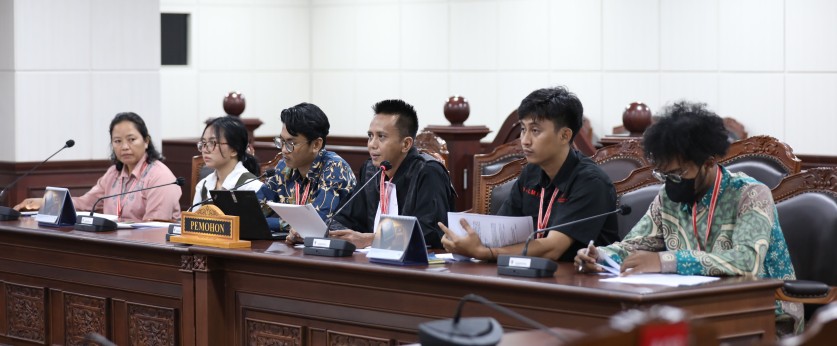
Legal counsel Girindra Sandino conveying the petition’s main points for the judicial review of Law No. 20 of 2003 on the National Education System, Tuesday (7/22/2025). Photo by MKRI/Panji.
JAKARTA (MKRI) — The Indonesian Students League for Democracy (Liga Mahasiswa Indonesia untuk Demokrasi or LMID) and four individual university students have filed a judicial review petition of Article 11 paragraph (2) of Law No. 20 of 2003 on the National Education System (Sisdiknas Law) to the Constitutional Court (MK). The Petitioners of case No. 111/PUU-XXIII/2025 argue that the Government must guarantee education funding for every citizen at all levels of education in a progressive manner, not merely for those aged 7 to 15 years or limited to basic education.
“The concept of progressively free education can be implemented by prioritizing tuition fee waivers and targeted support schemes for student living costs,” said the Petitioners’ counsel Girindra Sandino at the preliminary hearing on Tuesday, July 22, 2025.
The Petitioners contend that the provision in the Sisdiknas Law, which imposes the burden of financing higher education directly on students, infringes upon their constitutional rights. They argue that the issue of higher education funding is not merely an economic concern but reflects a structural mechanism that perpetuates inequality and hinders national development.
According to the Petitioners, the high cost of education has led hundreds of thousands of students to discontinue their studies due to financial hardship. Data from the Ministry of Higher Education shows that more than 350,000 students dropped out of university in 2023, most of whom were enrolled in private institutions.
They particularly highlight the burden posed by the single tuition fee system (uang kuliah tunggal or UKT), which they view as a major financial barrier. In the 2023/2024 academic year, the average cost of higher education reached Rp19.01 million annually, with tuition fees in Indonesia having increased by approximately 50 percent between 2014 and 2023.
For reference, Article 11 paragraph (2) of the Sisdiknas Law currently reads: “The Government and Regional Governments are obliged to ensure the availability of funding to implement education for every citizen aged seven to fifteen years.” The Petitioners argue that this provision conflicts with Article 31 and Article 28C paragraph (1) of the 1945 Constitution.
Accordingly, the Petitioners request the Constitutional Court to declare Article 11 paragraph (2) of the Sisdiknas Law unconstitutional. They propose that the provision should instead read: “The Government and Regional Governments shall ensure the availability of funding for the implementation of education for every citizen at all levels of education in a progressive manner.”
The case was heard by a panel chaired by Constitutional Justice Arief Hidayat, with Constitutional Justices Anwar Usman and Enny Nurbaningsih as members. Justice Enny advised the Petitioners to clearly and thoroughly explain the contradiction between the challenged provision and the respective constitutional articles cited as grounds for review.
“How will you construct a clear argument that all levels of education should be free, and that failure to do so violates the Constitution? How can you convince the Court that there is indeed a constitutional issue here?” she asked.
Justice Arief, meanwhile, noted that the Constitution requires the state to provide and finance basic education for all citizens. He urged the Petitioners to present strong arguments concerning the state’s and regional governments’ obligations to fund education up to the university level. He highlighted the practical challenge, given Indonesia’s large population in contrast to countries such as those in Scandinavia, which the Petitioners cited as examples of nations providing free higher education.
“You mentioned Scandinavia. Their populations are small, their state budgets are already high, and they have high per capita incomes. In our case, you must think carefully about whether your request is truly feasible for the Court to grant. Education is primarily regulated in Article 31 of the Constitution, and more specifically in paragraph (2), which is already quite limitative,” Justice Arief concluded.
At the end of the session, Justice Arief announced that the Petitioners can revise the petition within 14 days and submit the revised one by Monday, August 4, 2025 at 12:00 WIB.
Author : Mimi Kartika
Editor : N. Rosi
Translator : Yuniar Widiastuti (NL)
Disclaimer: The original version of the news is in Indonesian. In case of any differences between the English and the Indonesian versions, the Indonesian version will prevail.
Tuesday, July 22, 2025 | 17:11 WIB 279