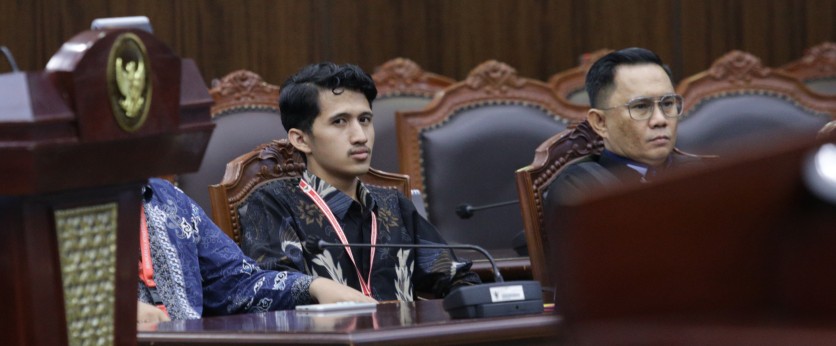
The Petitioner attending the ruling hearing of case No. 102/PUU-XXIII/2025 on the judicial review of Law No. 18 of 2003 on Advocates, Wednesday (7/30/2025). Photo by MKRI/Bay
JAKARTA (MKRI) — The Constitutional Court of the Republic of Indonesia (MKRI) rejected in its entirety the judicial review petition of Law No. 18 of 2003 on Advocates (the Advocate Law) filed by Nanang Kosasih. The ruling on case No. 102/PUU-XXIII/2025 was pronounced at a ruling hearing on Wednesday, July 30, 2025, in the plenary courtroom.
The Petitioner contested the restriction on incidental legal aid by non-advocates, particularly within a family context. He argued that the current provisions create a legal vacuum as they fail to accommodate law graduates who, despite having completed their professional education and bar exam, have not been formally sworn in as advocates.
Delivering the Court’s legal considerations, Constitutional Justice Daniel Yusmic P. Foekh emphasized that legal service providers, whether commercial or pro bono, serve as an important bridge between the public and the justice system. As such, competency and professionalism are indispensable standards in the legal profession. Without these, the fundamental rights of justice seekers (justiciabelen) may be compromised and the legal ecosystem could become unbalanced.
“In the context of the present petition, the Court acknowledges and appreciates the Petitioner’s good intentions to provide legal assistance to his family members. Normatively, such intention can be accommodated through incidental power of attorney due to blood or marital relations in civil court proceedings,” said Foekh.
The Court further explained that incidental legal representation by a family member is permissible in civil cases, as stipulated in the attachment to Supreme Court Circular (SEMA) No. 7 of 2012. However, this is not the case in criminal proceedings. The Indonesian criminal justice system, which involves the police, prosecutors, courts, correctional institutions, and advocates, does not permit non-advocates to provide formal legal assistance in criminal cases.
Given that criminal law serves the public interest, only licensed advocates are legally permitted to defend suspects or defendants. Any legal support from individuals outside the criminal justice system, including family members, is informal and cannot substitute the role of an advocate, even during pretrial proceedings as proposed by the Petitioner.
The Court also addressed the constitutional rights invoked by the Petitioner, namely the right to self-development, legal certainty, and personal and family protection as enshrined in Articles 28C(1), 28D(1), 28G(1), and 28H(2) of the 1945 Constitution. These rights, the Court asserted, must be exercised in balance with the broader public interest in a constitutional state. “This means that although the Constitution guarantees these rights, their exercise must not infringe upon the rights of others or the public interest, as stipulated in Article 28J(2) of the 1945 Constitution,” he explained.
With regard to the Petitioner’s arguments on limited access to justice due to the definition of “advocate” under Article 1 points 2 and 9 of the Advocate Law and Article 1 points 1 and 3 of Law No. 16 of 2011, the Court underscored that these articles are part of the general provisions, which serve to define key terms and outline the underlying principles and purposes of the law. If the Court were to grant the petition, it would have far-reaching consequences, potentially invalidating numerous related provisions in both laws and creating legal uncertainty.
“Therefore, the Petitioner’s arguments challenging the constitutionality of Article 1 points 2 and 9 of the Advocate Law, as well as Article 1 points 1 and 3 and Article 8 of Law No. 16 of 2011, are legally groundless,” Justice Foekh concluded.
Also read:
Petitioner Asks Law Graduates Be Allowed to Counsel Family Members
Petitioner Revises Petition for Judicial Review of Advocate Law
Author: Utami Argawati
Editor: Lulu Anjarsari P.
PR: Tiara Agustina
Translator: Yuanna Sisilia
Disclaimer: The original version of this news is in Indonesian. In case of any discrepancies, the Indonesian version shall prevail.
Full ruling available at: Decision on Case No. 102/PUU-XXIII/2025 (in Bahasa)
Wednesday, July 30, 2025 | 15:45 WIB 402