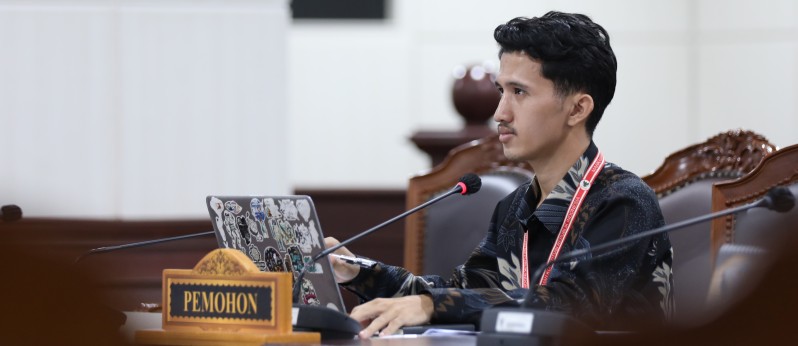
Petitioner Nanang Kosasih delivering his claims at the material judicial review hearing of Law No. 18 of 2003 on Advocates, Wednesday (7/2/2025). Photo by MKRI/Ifa.
JAKARTA (MKRI) — The Constitutional Court (MK) held the preliminary hearing for the material judicial review of Law No. 18 of 2003 on Advocates on Wednesday, July 2, 2025. In case No. 102/PUU-XXIII/2025, law graduate Nanang Kosasih challenges the restriction on the provision of legal assistance by individuals who are not sworn advocates, specifically in incidental family matters.
The hearing was presided over by Constitutional Justices Arief Hidayat (panel chair), Anwar Usman, and Enny Nurbaningsih. In his petition, the Petitioner questions the constitutionality of Article 1 paragraph (2) of the Advocate Law, which narrowly confines the provision of legal services exclusively to sworn advocates.
Appearing before the Court without legal counsel, he argued that the contested provision has created a legal vacuum by failing to accommodate incidental legal assistance offered by law graduates to their family members. He contended that it has disregarded the academic capacity of law graduates and effectively eliminated the constitutional space for citizens to provide legal support in urgent and limited circumstances.
He also referred to Constitutional Court Decision No. 006/PUU-II/2004, in which the Court held that legal assistance by non-advocates is not subject to criminal prosecution so long as it is not performed professionally. He contended that this constitutional principle should guide the interpretation of the term “legal services” in this case, encouraging a more inclusive reading.
Structural Barriers and Constitutional Harm
The Petitioner explained that the lack of clear regulation has led to administrative obstacles in practice. For example, legal assistance by law graduates who have completed both the professional training for advocates (PKPA) and the advocate professional examination (UPA), but who have yet to be sworn in, continues to be rejected by law enforcement officials.
“When my family faced serious legal problems, such as threats and arson, I could not formally assist them simply because I had not been sworn in as an advocate,” he testified. He argued that this situation conflicts with Article 28D paragraph (1), Article 28G paragraph (1), Article 28H paragraph (2), and Article 28C paragraph (1) of the 1945 Constitution.
The petition also highlighted that incidental power of attorney mechanisms is already recognized in civil law (Article 123 of the Herziene Indonesisch Reglement [HIR] and Article 147 of the Rechtsreglement voor de Buitengewesten [RBg]), as well as in Supreme Court Circular No. 7 of 2012 for industrial relations disputes. Furthermore, Law No. 2 of 2004 on Industrial Relations Dispute Settlement similarly authorizes trade union representatives to provide legal assistance.
However, in the realm of non-litigation criminal matters, no comparable recognition exists. This discrepancy, the Petitioner stressed, has created an imbalance between existing legal norms and the community’s need for legal support during critical stages such as reporting crimes, communicating with investigators, or filing pretrial motions.
Petition Not Intended to Undermine Advocate Profession
The Petitioner emphasized that his petition does not seek to compete with or diminish the role of sworn advocates. He expressed no objection to age requirements or the oath of office as stipulated in Article 3 of the Advocate Law. Rather, the core of his petition is to request that the Court provide a constitutional interpretation of the phrase “legal services,” so as not to preclude incidental legal assistance within a family context and in non-litigation matters.
“In this case, the Petitioner is not asking for the elimination of the normative provision itself, but rather asks the Court to interpret the phrase ‘legal services’ in a constitutional manner, so as not to deprive citizens with legal knowledge of their substantive right to assist their own family members in urgent legal situations,” he stated.
In response, Constitutional Justice Enny Nurbaningsih asked the Petitioner to complete the elaboration of the Constitutional Court’s authority and to elaborate the causality between the norm being petitioned and his constitutional harm in more detail.
“Please elaborate [the Court’s] authority, present the last versions of the Constitution and the Constitutional Court Law, and explain how the norm is constitutionally harmful,” she said.
The panel gave the Petitioner 14 days to revise the petition, which must be received by the Registrar’s Office by Tuesday, July 15 at 12:00 WIB.
Author : Utami Argawati
Editor : Lulu Anjarsari P.
PR : Tiara Agustina
Translator : Yuniar Widiastuti (NL)
Disclaimer: The original version of the news is in Indonesian. In case of any differences between the English and the Indonesian versions, the Indonesian version will prevail.
Wednesday, July 02, 2025 | 12:37 WIB 223