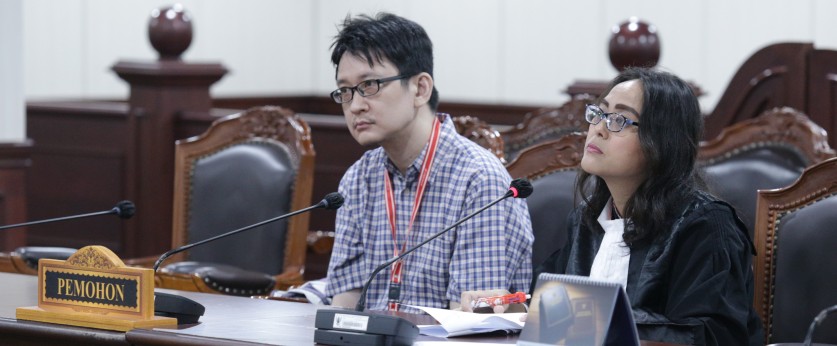
Petitioners and their legal counsel attending the petition revision of Case No. 96/PUU-XXIII/2025 on the material judicial review of Law No. 33 of 2014 on Halal Product Guarantee as amended by Law No. 6 of 2023 on Job Creation, Wednesday (2/7/2025). Photo by MKRI/Bay.
Jakarta (MKRI) – The Constitutional Court resumed the hearing on the material judicial review of Law No. 33 of 2014 on Halal Product Guarantee (Halal Law) as amended by Law No. 6 of 2023 on Job Creation. The hearing for Case No. 96/PUU-XXIII/2025 was held on Wednesday, July 2, 2025, to examine the revised petition.
Fransiska Jeane, an advocate, and Hans Adrian Lukman filed the petition. They questioned the provision on the Halal Law, which they considered contrary to the 1945 Constitution of the Republic of Indonesia. In the hearing, Jeane stated that the petitioners had elaborated in detail on their understanding of halal and haram in Christianity, their own religious beliefs, based on the Bible.
“The Halal Law, based on the Petitioners’ understanding, is based on Islamic Sharia, as emphasized, among other things, in Article 1 paragraph (2) of the law, which stated that halal products are those considered halal based on Islamic Sharia,” he said.
The Petitioners argued that the existence of the Halal Law, in essence, violates the goals of the Founding Fathers. It is based on the historical event that led to the establishment of the Jakarta Charter, which inspired the Preamble of the Constitution.
“During the second legislation in BPUPKI, the Jakarta Charter was plotted as the preamble. Subsequently, in the official 1945 Constitution, the first point containing the obligation to perform sharia for its believers was changed to Believe in God Almighty,” he said.
The Petitioners also stated that the phrase in the Jakarta Charter, which imposes the obligation to perform Islamic Sharia for its believers, has been violated by the enactment of the Halal Law, which is implemented, including for believers of other religions, who are not subject to the Islamic Sharia as the basis of the law.
Also read:
Advocate Requests Halal Assurance Law to Only Apply to Muslims
In the revised petition, the Petitioner states that the Halal Law based on Islamic Sharia, as stipulated in Article 1 paragraph (2), causes the Petitioners to suffer specific and actual constitutional losses since they have different beliefs, which apply a different understanding regarding halal and haram. However, because the Halal Law, specifically Article 4 and/or Article 26 paragraph 2, is implemented nationally, they are forced to comply with the Islamic Sharia, which is not aligned with Christianity. Hence, the obligation to conform to Article 4 and Article 26 paragraph 2 has led to potential losses.
In their petition, they also presented evidence of concrete and actual constitutional harm, including the banning of a non-halal culinary festival at Solo Paragon Mall in July 2024 and the raid of non-halal food stalls in Lubuklinggau. They argued that these incidents were direct consequences of implementing the Halal Law.
They requested that the Court declare the word “mandatory” in Article 4 and Article 26 paragraph (2) of the Halal Law, as amended by the Job Creation Law, unconstitutional and not legally binding.
Author: Utami Argawati
Editor: Lulu Anjarsari P.
PR: Fauzan Febriyan
Translator: Rizky Kurnia Chaesario/Yuniar Widiastuti
Disclaimer: The original version of the news is in Indonesian. In case of any differences between the English and the Indonesian versions, the Indonesian version will prevail.
Wednesday, July 02, 2025 | 15:20 WIB 158