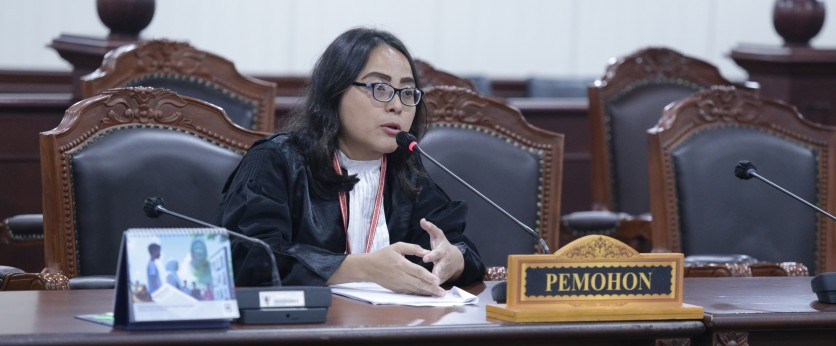
The Petitioner’s legal counsel at the preliminary hearing for the judicial review of the Halal Product Assurance as amended by the Job Creation Law, Thursday (6/19/2025). Photo by MKRI/Bayu.
JAKARTA (MKRI) — The Constitutional Court (MK) held the preliminary hearing for the material judicial review of Law No. 33 of 2014 on Halal Product Assurance (JPH) as amended by Law No. 6 of 2023 on Job Creation for case No. 96/PUU-XXIII/2025 on Thursday, June 19, 2025 in the plenary courtroom.
The petition was filed by Fransiska Jeane, an advocate. She argued that the JPH Law, in its entirety, is subject to Islamic law, as reflected in Article 1 paragraph (2), which stipulates that “Halal Products are products that have been declared halal in accordance with Islamic sharia.”
She believes the provision is inconsistent with the foundational principles of the Indonesian state, which is based on Pancasila, as well as the fact that Indonesia is not a religious state. “Indonesia is a state that embraces religions, but it is not a religious state. Therefore, laws in Indonesia should be founded on general principles that apply equally to all citizens, not on the teachings of any particular religion,” she asserted.
She further highlighted Article 4 of the JPH Law, which mandates that all products entering, circulating, and being traded within the territory of Indonesia must be certified halal. She contended that this provision amounts to the imposition of Islamic teachings on adherents of other religions, thereby violating the principle of equality before the law and the principle of state neutrality in religious matters.
“The enactment of the JPH Law, which is based on Islamic law and applied universally and comprehensively—as stipulated in Article 4, requiring that all products entering, circulating, and traded within Indonesia be halal-certified—is an act of treason against the ideology of Pancasila and the 1945 Constitution. This law also betrays the ideals of our founding fathers,” the Petitioner emphasized.
In her petition, she also presented evidence of concrete and actual constitutional harm, including the banning of a non-halal culinary festival at Solo Paragon Mall in July 2024 and the raid of a non-halal food stalls in Lubuklinggau. She argued that these incidents were direct consequences of the implementation of the JPH Law.
Based on these arguments, the Petitioner requested that the Constitutional Court declare the JPH Law, as amended by Law No. 6 of 2023, unconstitutional and therefore should be rendered null and void. Alternatively, she requested that the Court declare the word “mandatory” in Article 4 and Article 26 paragraph (2) of the JPH Law unconstitutional and not legally binding. By doing so, the Petitioner’s constitutional rights as a Christian would no longer be violated by the enforcement of legal provisions that impose a particular religious standard on all citizens.
In response to the petition, Constitutional Justice Enny Nurbaningsih provided several notes and instructed the Petitioner to refine the formulation of the petition. “Please revise it, because what is being reviewed is not the entire JPH Law, but specifically the word ‘mandatory’ in Article 4 and Article 26 paragraph (2). Do not let the petitums give the impression that the entire law is under review,” she emphasized.
Additionally, Justice Enny requested that the Petitioner clarify the Petitioner’s profile. “Please specify clearly who Petitioner I is, who Petitioner II is, and so on, so that there is no confusion,” she added.
The panel gave the Petitioner 14 days to revise the petition, which will continue to the petition revision hearing.
Author : Utami Argawati
Editor : Lulu Anjarsari P.
PR : Fauzan Febriyan
Translator : Yuniar Widiastuti (NL)
Disclaimer: The original version of the news is in Indonesian. In case of any differences between the English and the Indonesian versions, the Indonesian version will prevail.
Thursday, June 19, 2025 | 17:29 WIB 212