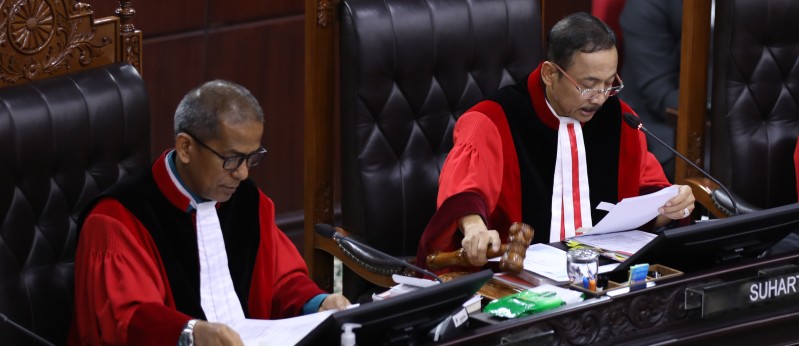
Chief Justice Suhartoyo (right) delivering the verdict for the formal judicial review of Law No. 3 of 2025 on the Indonesian Armed Forces, Thursday (6/26/2025). Photo by MKRI/Ifa.
JAKARTA (MKRI) — The Constitutional Court (MK) has handed down Decision No. 83/PUU-XXIII/2025 on the formal judicial review of Law No. 3 of 2025 on the Amendment to Law No. 34 of 2004 on the Indonesian Armed Forces (TNI Law). In is verdict, the Court declared the petition inadmissible, as the five students of the Muhammadiyah University of Surakarta (UMS) had been unable to elaborate their legal standing in filing the formal judicial review petition against the TNI Law.
“[The Court] adjudicated, to declare the petition by Petitioners No. 83/PUU-XXIII/2025 inadmissible,” said Chief Justice Suhartoyo at the ruling hearing on Thursday, June 26, 2025 in the plenary courtroom.
In its legal considerations, delivered by Deputy Chief Justice Saldi Isra, the Court stated that the Petitioners had not demonstrated a clear constitutional harm linked to the alleged constitutional irregularities in the legislative process of Law No. 3 of 2025. They merely alleged that the legislative deliberations on the TNI Bill had been conducted in a closed manner, contrary to the principles of openness and transparency as mandated by law. However, they did not substantiate this claim with descriptions or evidence of any concrete involvement in state affairs during the legislative process.
“For example, they could have presented tangible activities such as seminars, discussions, written opinions, or communications addressed to lawmakers—any activities that might have shown their engagement in the formation of Law No. 3 of 2025,” the deputy chief justice clarified.
The Petitioners’ objections failed to establish a sufficient link between their personal interests and the legislative process of Law No. 3 of 2025. Additionally, one petitioner submitted photographic evidence of participation in a demonstration opposing Law No. 3 of 2025 in Surakarta. However, the Court found this evidence unconvincing in establishing the relevance between the documentation presented and the alleged constitutional harm as claimed in support of their legal standing.
Also read:
TNI Law Reduces Job Opportunities for Civilians
Petitioners Revises TNI Law Formal Review Petition
The Petitioners are Mohammad Arijal Aqil, Nova Auliyanti Faiza, Shanteda Dhiandra, Bisma Halyla Syifa Pramuji, and Berlliana Anggita Putri (Petitioners I-V). Berliana, a law graduate, testified to the challenges she faced in obtaining employment due to the scarcity of job opportunities and the high number of job seekers. This situation contributes to elevated unemployment rates and intense competition. She further argued that if civil service positions requiring specific expertise were filled by military personnel lacking the relevant competencies, it would create serious inefficiencies and disadvantages for qualified civilian applicants.
The Petitioners also asserted that the TNI Law failed to meet the criteria of an emergency or urgent bill as defined under the Law on the Formation of Laws and Regulations (the Lawmaking Law). They emphasized that there was no extraordinary circumstance—such as conflict, natural disaster, or an unavoidable national crisis—that could justify enacting the law outside the standard national legislation program (Prolegnas) mechanism.
Furthermore, the Petitioners argued that the TNI Law does not qualify as a carryover bill under the Lawmaking Law. Based on legislative records and documentation, during the 2019–2024 legislative period, the TNI Bill was never included in the Problem Inventory List (DIM) and had not been initiated through a presidential letter or list as constitutionally required to begin deliberations with the House of Representatives (DPR). They maintained that the planning and enactment of the TNI Law exhibited signs of haste and a failure to observe the precautionary principle, which should serve as a cornerstone of any legislative process.
The Petitioners submitted petitums requesting the Court to declare the TNI Law not having satisfied the lawmaking requirements based on the 1945 Constitution and, thus, unconstitutional and not legally binding.
Author : Mimi Kartika
Editor : N. Rosi
Translator : Yuniar Widiastuti (NL)
Disclaimer: The original version of the news is in Indonesian. In case of any differences between the English and the Indonesian versions, the Indonesian version will prevail.
Thursday, June 26, 2025 | 15:48 WIB 324